
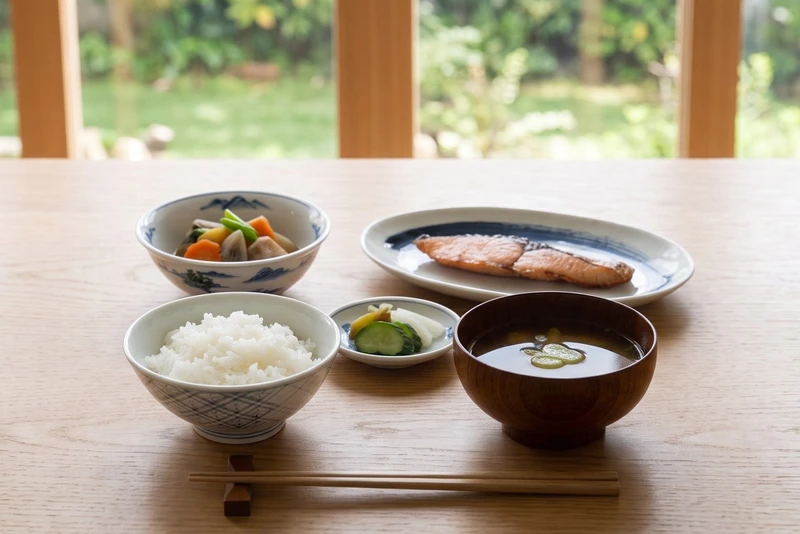
The meal is already made. What remains is the part most recipes leave out: which bowl holds what, and where each one goes.
The rice is done, the soup is hot, there is a piece of grilled fish and something green from yesterday. A Japanese table is not arranged by rule so much as by habit — a set of small decisions repeated until they stop feeling like decisions at all. Once you can see those habits, an ordinary weeknight dinner starts to look composed rather than assembled, and it takes no extra cooking to get there.
This guide covers the vessels that do most of the work, the simple frame behind a Japanese meal, where each piece sits on the table and why, and a few ways of reading a plate that make food look settled rather than crowded. You will not need to buy anything new to try any of it.
On this page
1. The Vessels That Do the Work
Most Japanese meals at home are carried by a handful of shapes. Knowing what each one is for makes the rest of this easier.
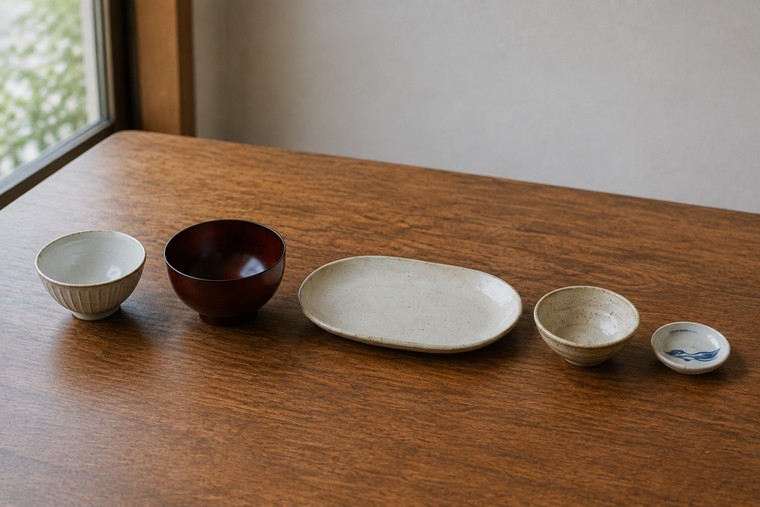
The rice bowl (meshiwan, or gohan-chawan) sits at the center of everything. It is sized to be lifted — small enough to rest in one hand, deep enough to hold a serving of rice without packing it down. A rice bowl is not the same thing as a matcha bowl, though both are called chawan in Japanese; a matcha bowl is wider, heavier, and made for whisking.
The soup bowl (shiruwan) is often wood or lacquer rather than ceramic. There is a practical reason for this. Lacquered wood does not pass heat to the hands the way porcelain does, and it stays light when full, which matters when the bowl is lifted to the mouth. If you have a lacquer soup bowl, our guide to caring for Japanese lacquerware covers what it asks of you day to day.
The main-dish plate is the one people most often lack. An oval or long plate of roughly 26 centimeters does a surprising amount of work: a whole grilled fish lies along it without its tail hanging off, a piece of chicken sits with room around it, and a pile of dressed vegetables reads as a dish rather than a heap. A round dinner plate can do the job, but the oval shape gives the food a direction, which is half of what makes a Japanese plate look intentional.
The small bowl (kobachi) is the workhorse of the side dishes — simmered vegetables, a spoonful of something pickled, tofu, a dressed salad. If you add only one piece to what you already own, this is often the one that changes the table most.
The tiny dish (mamezara) holds condiments, a few pickles, a smear of mustard, a dab of grated ginger. It is small enough that it can be tucked into any gap on the table.
One more thing worth saying early: Japanese tableware does not need to come from a matching set. Mixing shapes, glazes, and materials can give each dish its own place at the table, and a bowl chosen for a particular food will usually look better beside its neighbors than a bowl chosen to match them.
2. Ichiju-Sansai — The Frame Behind the Table
If you have read about Japanese food, you have probably met the phrase ichiju-sansai — "one soup, three dishes." It describes a meal built from rice, a bowl of soup, one main dish, and two smaller side dishes.
The format has roots in older formal Japanese meal arrangements, including honzen cuisine. Today, though, it is more useful to think of ichiju-sansai as a simple framework for organizing a meal than as a historical form to be reproduced.
What makes it useful is that it is really a description of vessels. Rice bowl, soup bowl, one larger plate, two small bowls. That is the whole set. Once you see it that way, the question "what do I need on the table?" has an answer you can count on your fingers, and a meal that would otherwise land on two large plates spreads out into something with more air in it.
3. Where Each Vessel Goes
There is a standard arrangement, and it is worth knowing, because it appears in many traditional Japanese table settings.
Seen from where you sit:
- Rice, front left.
- Soup, front right.
- Main dish, back right.
- Side dish, back left.
- Pickles or a small dressed dish, in the center between them.
- Chopsticks across the front, laid horizontally, with the tips pointing left.
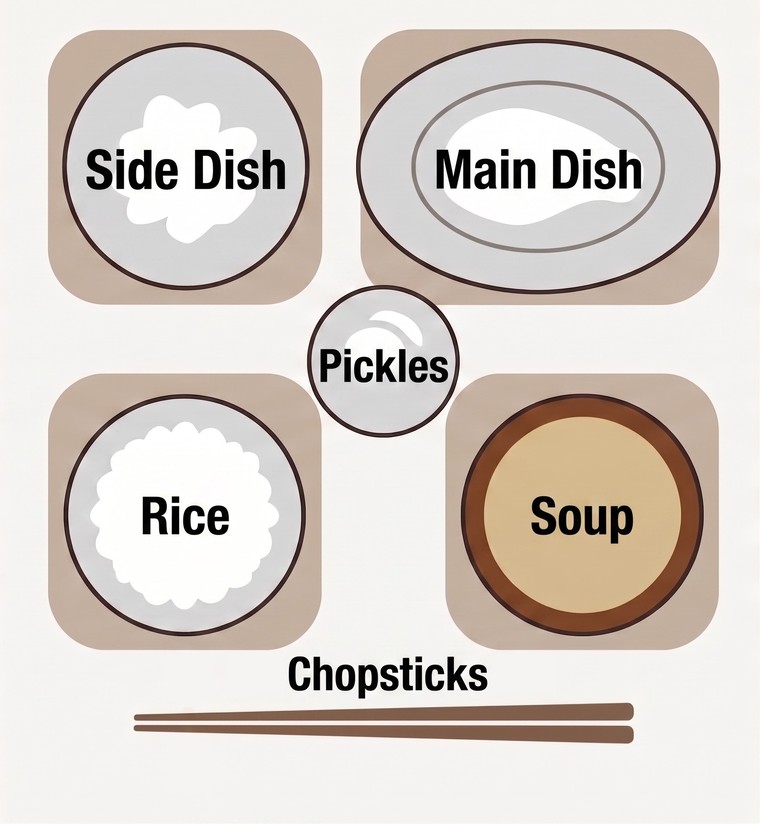
The arrangement is also practical. Rice is traditionally held in the left hand, while the main dish remains on the table and is reached with the chopsticks. Keeping the bowls toward the front also makes them easier to lift without reaching across the table.
Once you know the basic arrangement, it becomes easier to remember and to adjust to the dishes and space available.
You may also see the soup bowl placed differently depending on the region or household. These variations are part of everyday dining culture rather than something that needs to be treated as simply right or wrong.
4. Reading the Table — Space, Height, and Odd Numbers
Beyond where the vessels go, there is the question of what happens inside them. A few habits recur across Japanese plating, and they are easier to apply than they sound.
Leave space. A bowl filled to its rim reads as a portion; the same food with a margin of empty glaze around it reads as a dish. More space tends to look refined, less space tends to look generous, and neither is wrong — but it is worth choosing on purpose. The practical version of this rule is to pick the vessel to suit the amount of food, rather than filling whatever vessel you picked first.
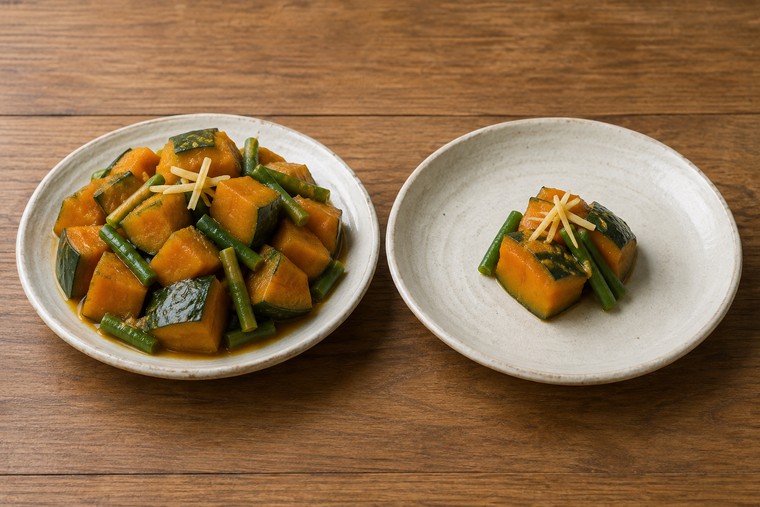
Give it height. Japanese plating tends to gather food upward rather than spread it flat, and the classic description is to build it like a cedar tree — higher at the back, lower at the front. A small mound of shredded vegetables placed against the far side of a bowl looks composed; the same amount raked flat across the bottom does not.
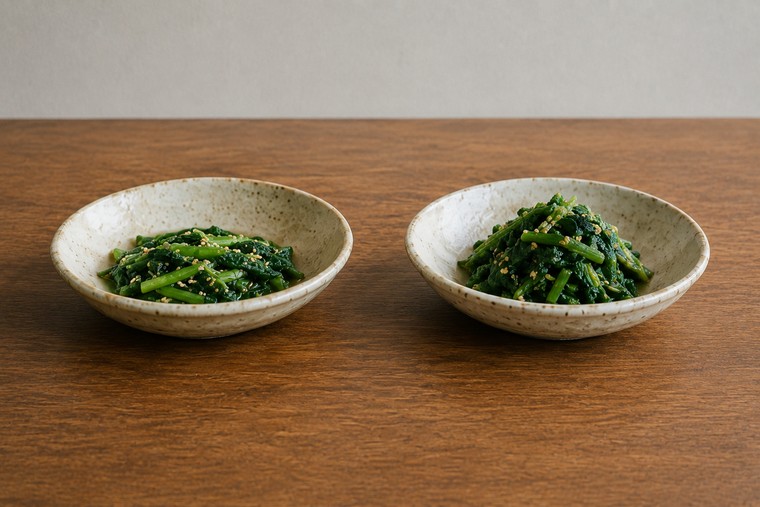
Count in odds. In more formal Japanese plating, food is often arranged in odd numbers such as three or five. At home, this can still be a useful visual guide rather than a strict rule.
Let it be uneven. A vessel usually has a front — the side its pattern or its best glaze faces — and food is arranged in relation to that front rather than centered on it. Japanese plating is generally asymmetrical, and a table arranged too evenly can end up looking stiff.
Follow the season, lightly. Thin porcelain and glass feel cooler in summer; thicker stoneware and warmer colors suit autumn and winter. This is the easiest of the habits to adopt, because it asks nothing more than choosing a different bowl for the same food.
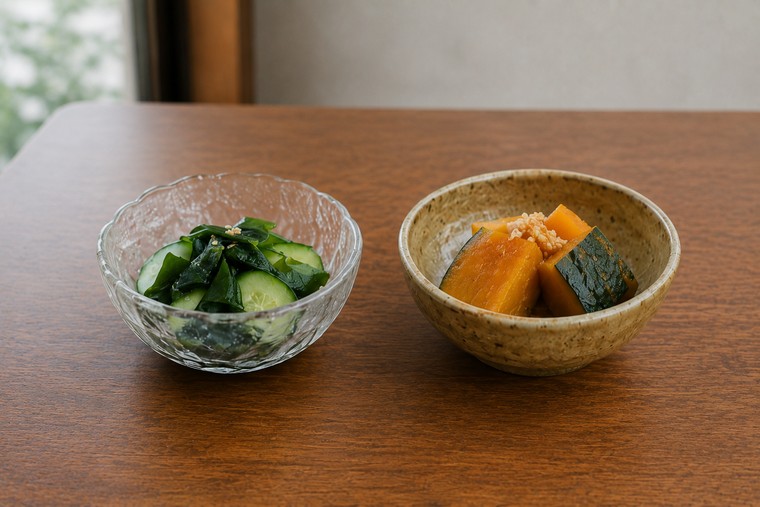
None of this is a technique to be practiced. It is closer to a way of looking, and it applies just as well to leftovers as to anything else.
5. Building a Set for the Way You Actually Eat
If you are starting from nothing, four pieces per person will carry almost any Japanese meal: a rice bowl, a soup bowl, one main-dish plate, and one small bowl. A tiny dish makes a natural fifth. Everything after that is preference rather than need.
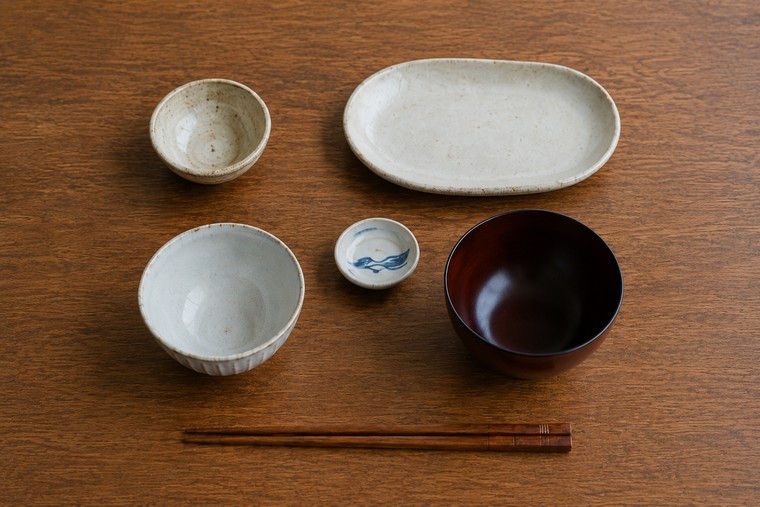
For two people, there is a choice worth making consciously. A matched pair reads as a set and is a common form for a gift in Japan. Two different pieces of a similar size read as a table where each person has their own bowl — which is, in fact, the older Japanese habit. Neither is more correct.
Materials are worth thinking about by role rather than by rank. Porcelain is the easiest to live with and works all year. Stoneware brings texture and a little more weight in the hand, which suits rice bowls and side dishes well. Lacquer and wood are often used for soup bowls and trays. Glass earns its place in summer, usually for a cold side dish.
A word on everyday handling. Whether a piece can go in a dishwasher or a microwave depends on the maker, the glaze, and the decoration, so it is best to follow the notes that came with it rather than assume. Pieces decorated with gold or silver overglaze are a clear exception worth remembering: hand wash them, and keep them out of the microwave entirely, as metallic decoration can spark.
6. Editor's Picks — Three Vessels, Three Jobs
Three pieces that between them cover the frame of a one-person meal, from three different pottery regions.
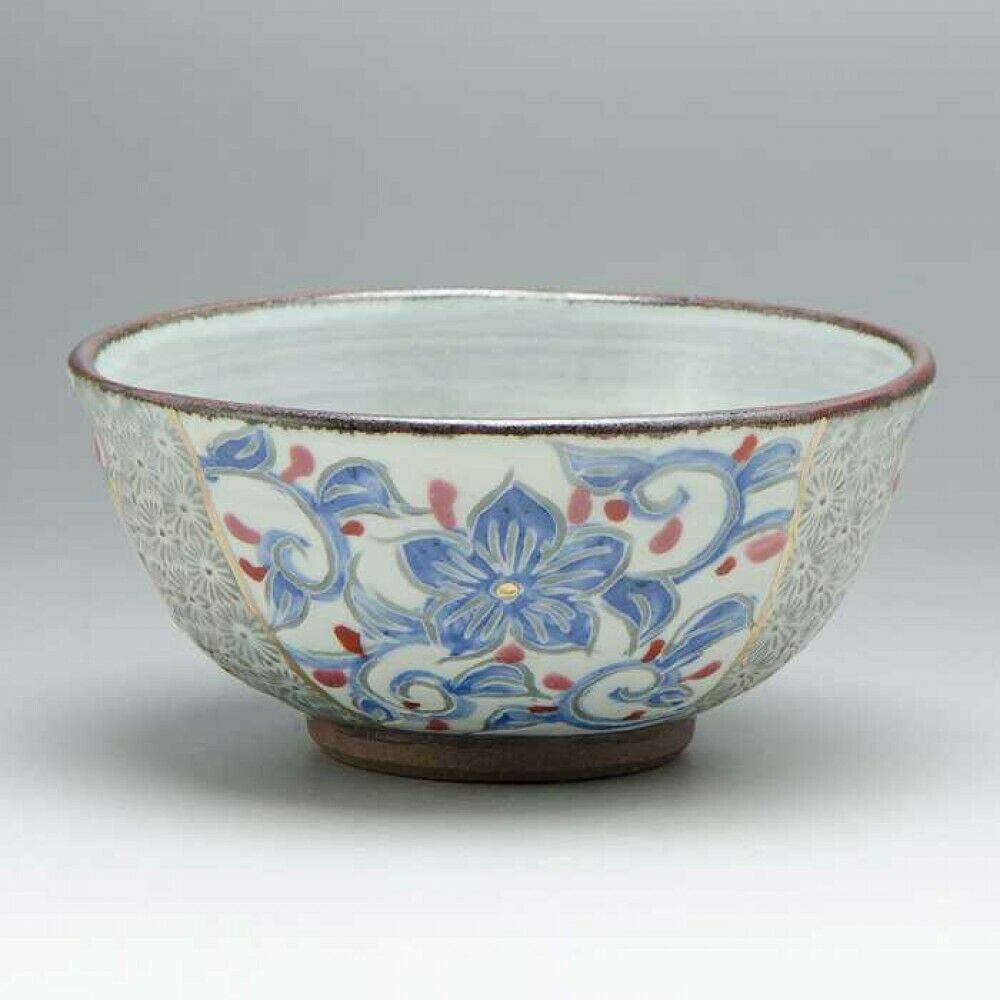
Pick 1 — The starting point. Porcelain from Kyoto, 11 cm across and 5.5 cm deep — a size that sits easily in one hand. The arabesque is line-carved into the body, and the small repeated crests around it are applied with a stamp, a technique known as inka. The foot is left unglazed, so you can see the clay itself when the bowl is lifted. If you are building a set one piece at a time, the rice bowl is where most people begin. (See the rice bowl) — Kyo Kiyomizu ware rice bowl, Mishima arabesque — $78
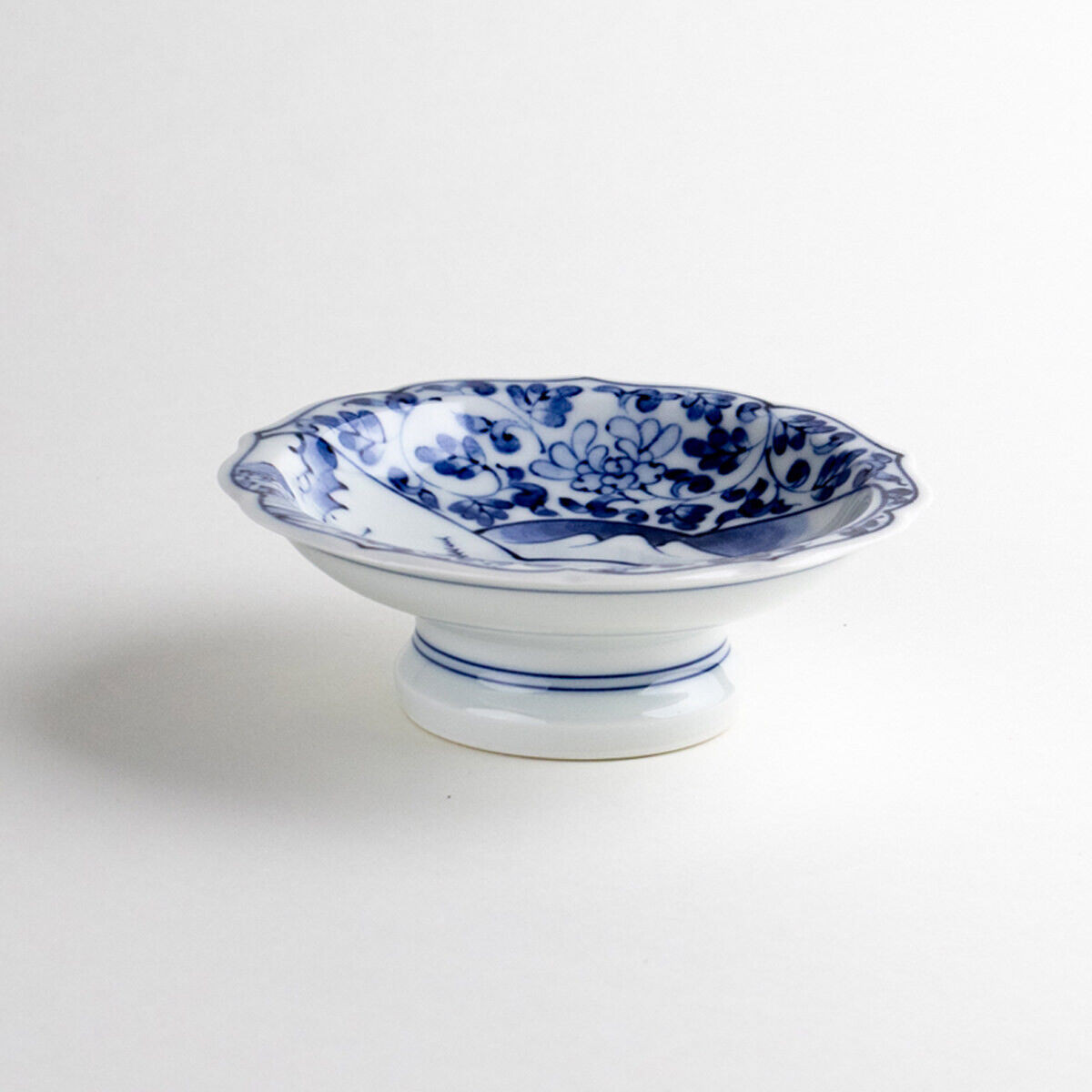
Pick 2 — The one that changes the table. Porcelain from Arita in Saga Prefecture, 10.2 cm across and 2.8 cm deep, painted in blue and white with a landscape and flowering scrollwork, and raised on a small pedestal foot. This is the vessel for simmered vegetables, a dressed salad, or a few pickles — the piece that turns rice and a main dish into a meal with a shape. (See the small bowl) — Arita ware kobachi, Matori-Sansui — $47
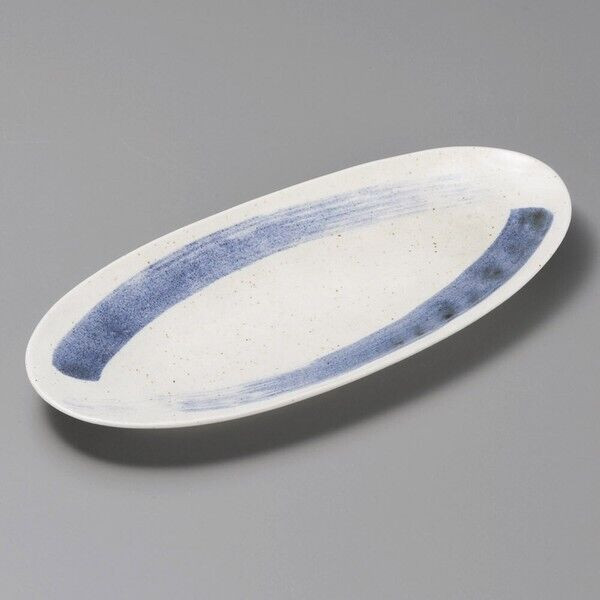
Pick 3 — The plate that does the work. Porcelain from Gifu Prefecture, 26.5 by 12.5 cm and shallow. That length is the reason to own it: a grilled fish lies along it whole, and a piece of meat or a portion of vegetables sits with room to spare. A single broad indigo brushstroke runs the length of the plate, which gives the food a direction to sit against. (See the oval plate) — Mino ware oval plate, indigo brushstroke — $78
7. A Note from the Shop
If we could pass on one thing, it would be that a Japanese table is not meant to be bought all at once. Most households here built theirs slowly, adding a bowl when one broke, or when a dish they had started cooking asked for a shape they did not own. That is a perfectly good way to do it, and it tends to produce a more interesting table than buying a set.
Start with whatever is missing from the meals you already cook. If you are unsure which piece that is, tell us what you made last week and we will happily help you work it out.
8. Frequently Asked Questions
Q: What is ichiju-sansai?
It means "one soup, three dishes," and it describes a meal made up of rice, a bowl of soup, one main dish, and two smaller side dishes. In practice it is most useful as a way of deciding which vessels to put on the table.
Q: Where do the rice bowl and soup bowl go?
In the standard arrangement, rice goes at the front left and soup at the front right, with the main dish at the back right and a side dish at the back left. You may also see the soup bowl placed differently depending on the region or household. These variations are part of everyday dining culture rather than something that needs to be treated as simply right or wrong.
Q: Do the vessels need to match?
No. Japanese tableware does not need to come from a matching set, and mixing shapes, glazes, and materials is ordinary rather than careless. Choosing each bowl for the food it will hold tends to look better than choosing bowls to match one another.
Q: How many pieces do I need to start?
Four per person will carry most Japanese meals: a rice bowl, a soup bowl, one main-dish plate, and one small bowl. A tiny dish for condiments makes a natural fifth.
Q: Can I use Japanese vessels for food that is not Japanese?
Yes, and many people do. A small bowl is as good for olives as for simmered vegetables, and an oval plate suits roasted vegetables or a piece of fish cooked any way at all. The shapes were designed around how food is eaten, not around a particular cuisine.
Q: Is a rice bowl the same as a matcha bowl?
No, although both are called chawan in Japanese, which is where the confusion comes from. A rice bowl is smaller and deeper, sized for one hand. A matcha bowl is wider and heavier, with room to move a whisk.
9. In Closing
Plating a Japanese meal is less about technique than about giving each part of the meal a vessel of its own and a place to sit. The frame is small enough to remember — rice, soup, one plate, one or two small bowls — and the rest is a matter of leaving a little space and letting the table be slightly uneven.
If you would like to go further into the pieces themselves, our guides to Shigaraki ware, Tokoname ware and choosing a kyusu, and Hagi ware each look at one region in detail. For the parts of the table this guide only touched on, see our guides to choosing Japanese chopsticks and choosing a Japanese sake cup.
— from Osaka, Team Manekineko-Ai