
A tea bowl that looks a little different at the end of its life than it did on the day it was made — that's not a flaw in Hagi ware. It's the point.
In Hagi, a castle town on Yamaguchi's Sea of Japan coast, potters have shaped clay much the same way for more than four hundred years: a pale, softly fired body, under a glaze that settles into a network of fine cracks as it cools. Hagi ware has long been celebrated in tea culture through the saying "First Raku, second Hagi, third Karatsu," and generations of tea drinkers have watched a single cup slowly change color with nothing more than ordinary daily use.
This guide covers what Hagi ware actually is, why it developed where it did, what to look for in a piece, and how to choose and care for one of your own.
On this page
1. What Hagi Ware Actually Is
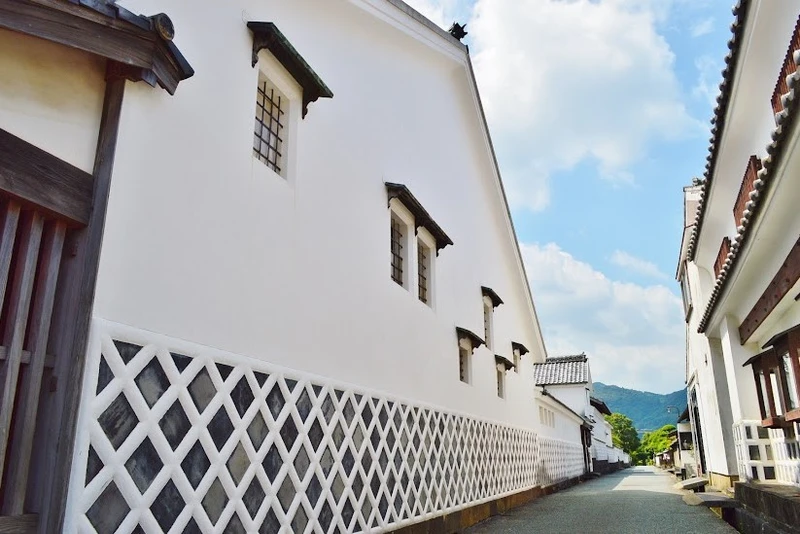
Hagi ware (萩焼, Hagi-yaki) is the pottery of Hagi, a castle town on Japan's western coast, facing the Sea of Japan across from the Korean Peninsula. It is best known as a stoneware for tea and sake vessels — matcha bowls, everyday teacups, small sake cups — rather than for large decorative pieces.
What sets it apart is less a single glaze color than a quality of surface. Hagi clay is fired at comparatively modest temperatures, which leaves the body soft and somewhat porous. The glaze over it — traditionally a pale, milky white, though contemporary kilns now work in blues, purples, and warmer tones as well — cools at a slightly different rate than the clay beneath it, and that mismatch leaves the surface laced with a fine network of hairline cracks. In tea circles, this combination of soft clay and crackled glaze is well known enough that a piece is recognizable by feel nearly as much as by sight.
2. Why This Coast, This Clay
Hagi sits on the Sea of Japan side of Yamaguchi Prefecture, closer to the Korean Peninsula than to most of Japan's other pottery centers. That geography matters here more than it does in most production stories: Hagi ware's origins trace directly back to Korean potters who crossed that stretch of water.

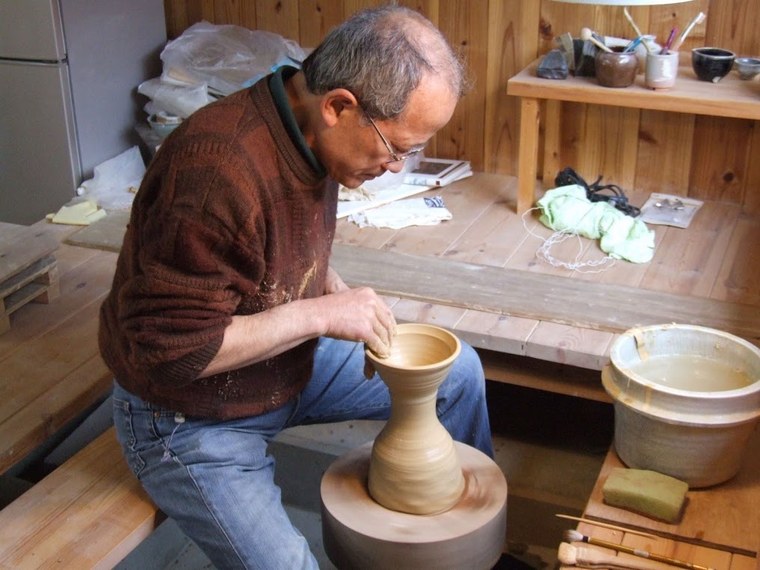
Locally, potters blend several clays quarried around the region — most often named Daido and Mishima, sometimes with a local clay called jido worked in — and it's this particular blend, fired relatively gently, that gives the ware its soft, absorbent body. That softness is not a technical shortcoming; it's the trait the entire tradition is built around, since it's what allows a piece to slowly take on color with use later on.
3. A Short History
The story of Hagi ware is tied to Japan's late-16th-century military campaigns on the Korean Peninsula, during which Korean potters were brought back to Japan by a number of feudal domains — a pattern behind the founding of several Japanese pottery traditions, not just this one.
In Hagi's case, the direct beginning is generally placed shortly after 1600, when the feudal lord Mōri Terumoto, defeated at the Battle of Sekigahara, relocated his domain's seat to Hagi. He invited two Korean potter brothers — recorded as Yi Jak-gwang and Yi Kyung — to open a kiln there, and their work became the official pottery of the Mōri domain, made for the tea ceremony and for gifts befitting the lord's household. Production later spread to the Fukawa area, in what is now the city of Nagato, by the mid-1600s.
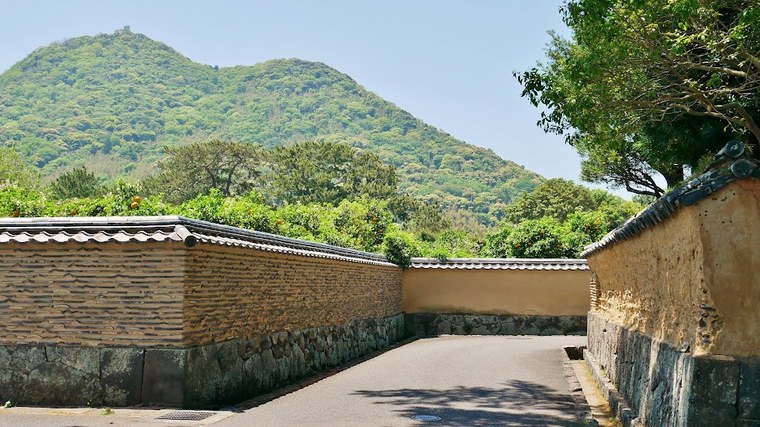
For roughly two and a half centuries, Hagi ware stayed largely within this domain system, made under the patronage of the Mōri family rather than sold on an open market. That changed with the Meiji Restoration in 1868: when the old domain structure was dismantled, the potters who had worked under Mōri patronage lost that support and began operating as independent workshops, and production spread beyond Hagi itself into other parts of southwestern Yamaguchi. Much of what defines Hagi ware today — its wider range of glaze colors, its presence in ordinary households rather than only in a lord's collection — took shape in the century and a half since.
4. Reading Hagi Ware
A few details are worth knowing before you look closely at a piece.
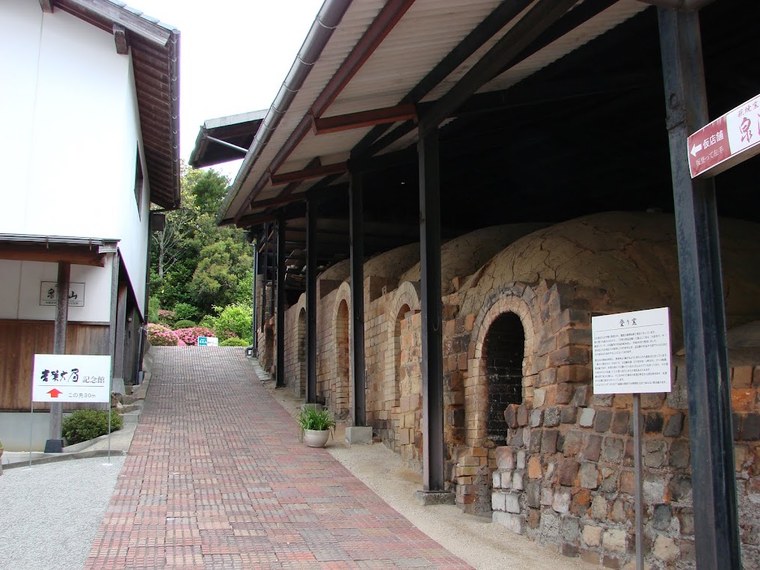
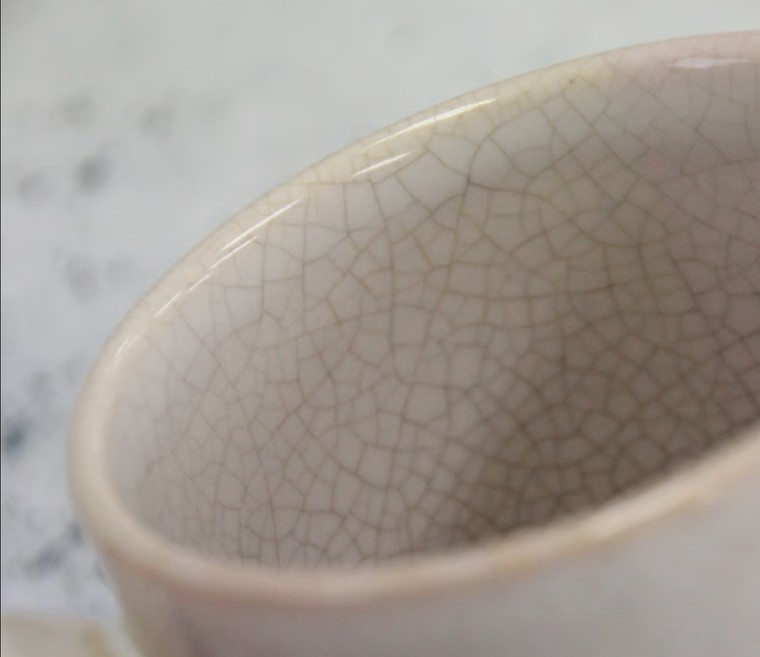
Kan-nyu, the crackle. The fine network of hairline cracks across a Hagi glaze isn't a defect — it's a natural result of the clay and glaze cooling and shrinking at slightly different rates after firing. It's called kan-nyu, and on Hagi ware in particular, it's functional as well as decorative: it's the pathway through which tea or sake will gradually work its way into the clay beneath.
Kairagi. Among the glaze textures you'll come across, one called kairagi — a white glaze that pulls slightly as it cools, leaving a faintly pebbled, granular surface rather than lying smooth — shows up often enough on Hagi pieces that it's worth knowing by name. It's a texture worth running a thumb over, not just looking at.
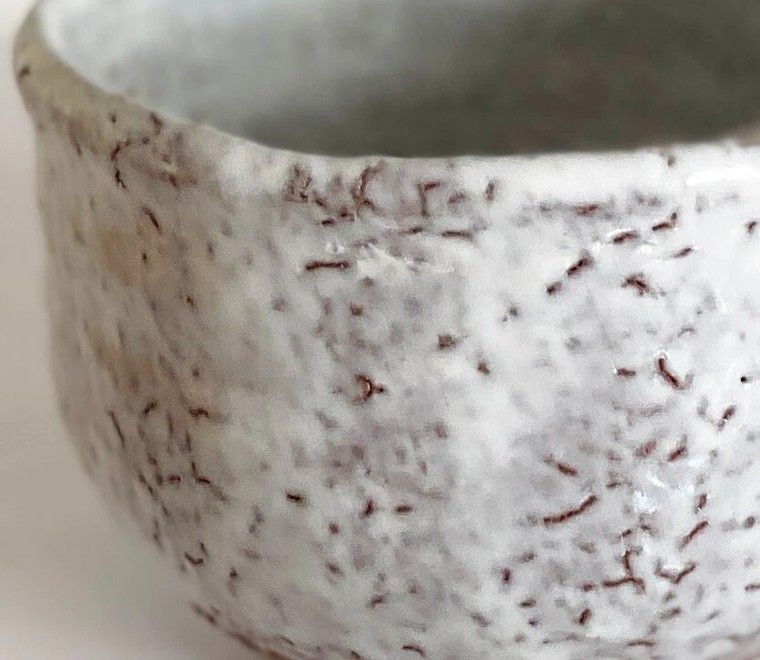
Color. The classic image of Hagi ware is a pale, milky white to soft pink-beige, sometimes with a warm blush where the clay took more heat. Contemporary kilns also work in deeper glaze colors — blues, lavenders, and purples in particular are common today — so a piece described as Hagi ware isn't necessarily the pale color people first picture. All of these belong to the same tradition; it's the clay body and the crackled glaze, not one specific color, that define the ware.
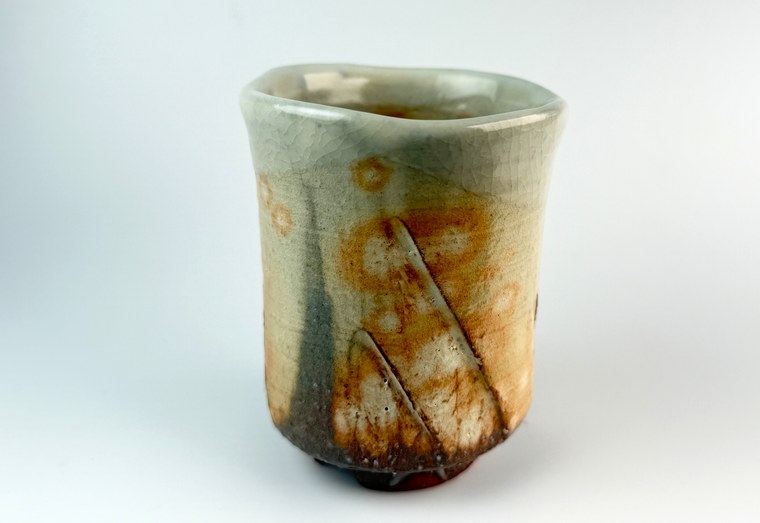
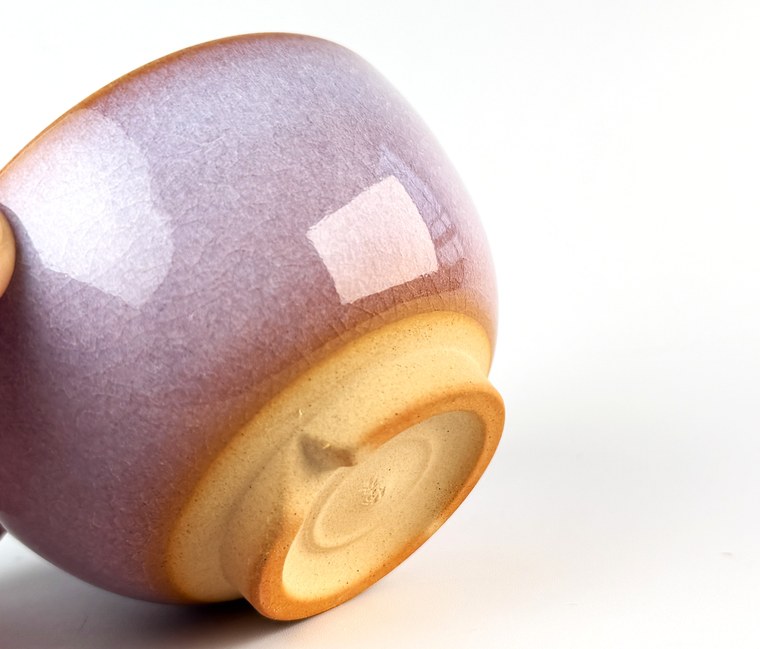
The notched foot. Some Hagi tea bowls have one or two small notches or cuts in the foot ring — the raised base a bowl stands on. Several explanations circulate for this: that it once let common households use bowls otherwise reserved for the domain's elite by deliberately marking them as imperfect; that the cuts made bowls easier to bundle and carry with rope during transport; that they let air move under an upturned bowl, given how readily the clay takes on moisture; that they helped the base fire more evenly; or that the notch reflects an aesthetic preference for a form that isn't quite perfect, in the same spirit as favoring a waning moon over a full one. No single explanation has been settled on, and the detail may owe something to more than one of these at once — worth knowing as a detail to look for, without a tidy story attached.
5. Choosing a Piece
Hagi ware spans several everyday forms, and the right one depends mostly on how you plan to use it.
Chawan (matcha bowls) are the form most associated with the tradition, sized for whisking powdered tea and holding it comfortably in both hands. If you're drawn to Hagi ware for the tea ceremony, or simply want a bowl that will visibly change with use over time, this is the traditional starting point.
Yunomi (everyday teacups) are smaller, made for drinking loose-leaf green tea in everyday settings rather than whisking matcha. They take the same glazes and crackle as a chawan, at a size suited to daily use rather than ceremony.
Guinomi (sake cups), often paired with a small tokkuri bottle, are Hagi ware's other well-known form. Because sake, like tea, will work its way into the crackled glaze with use, these develop the same slow color change as a chawan or yunomi — just on a smaller scale.
Within any of these, glaze color is mostly a matter of preference — the classic pale white-beige, or one of the deeper contemporary colors. Since many Hagi pieces are shaped and glazed by hand, slight variations in form, glaze flow, and surface texture are part of their character, rather than something to look for and avoid.
6. Care
Hagi ware's defining feature — that porous, crackled surface — asks for a slightly gentler routine than most glazed ceramics.
Because the glaze's fine cracks let liquid into the clay itself, a strong detergent can work its way in along with everything else, so a plain water rinse is usually enough on its own; if a piece needs more than that, a mild, unscented soap is the safer choice. Hand-washing rather than a dishwasher is the general recommendation, since both the heat and the detergent load of a dishwasher cycle are harder on a porous body than on a fully glazed one. After washing, leave the piece in a well-ventilated place until it is completely dry before storing it, since trapped moisture in a porous body can lead to a musty smell over time.
Beyond that, the most common advice from people who use Hagi ware regularly is simply to use it regularly. The slow color change described below is a product of ordinary use, not a special technique — a piece that sits on a shelf will stay much as it started, while one used for tea or sake on an everyday basis will gradually show its age.
On the color change. With repeated use, tea or sake is said to work its way into a Hagi piece through the crackle and gradually deepen or shift its color — a process referred to as Hagi no nanabake, the "seven transformations of Hagi." It happens gradually through ordinary use rather than a handful of pourings, and how much a given piece changes, and how quickly, varies by the piece and by what's been poured into it. It isn't something to force or rush; it's simply what tends to happen with a piece that gets used.
7. Editor's Picks — Three Ways to Start With Hagi
Three pieces, three everyday uses — matcha, tea, and sake — each showing a different side of Hagi ware's range.
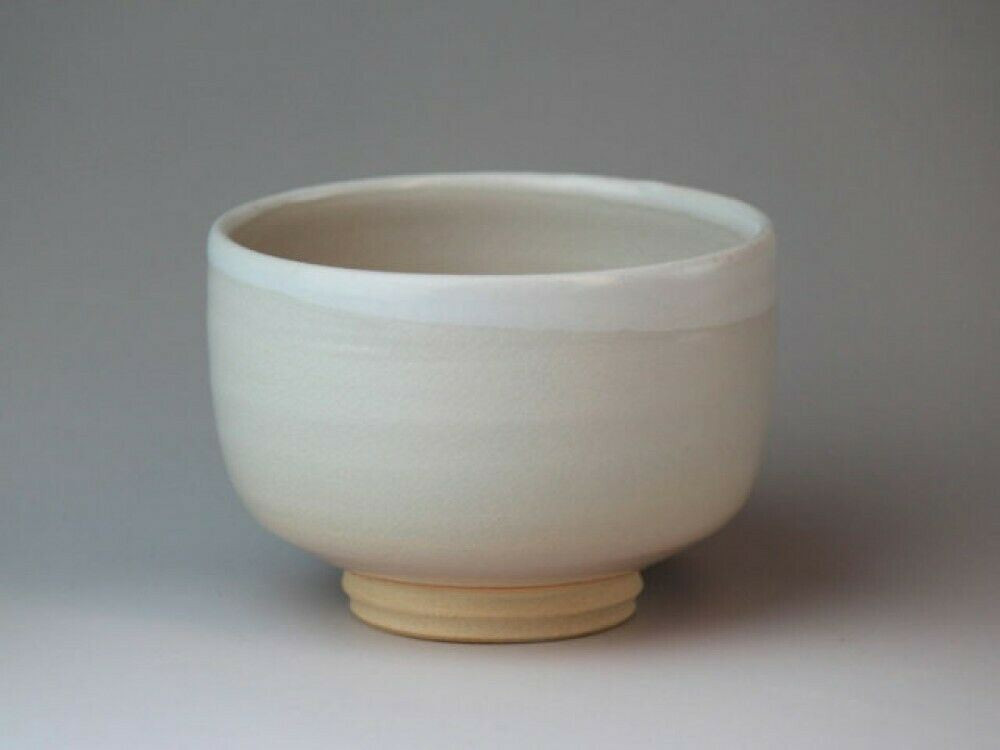
Pick 1 — For Matcha. A classic chawan in a soft, milky white-cream glaze, with the faint crackle visible near the rim. A straightforward, traditional starting point if you're drawn to Hagi ware through the tea ceremony, or simply want a bowl that will change slowly with use. (See the chawan) — Chawan, Himetsuchi Raku glaze — $82
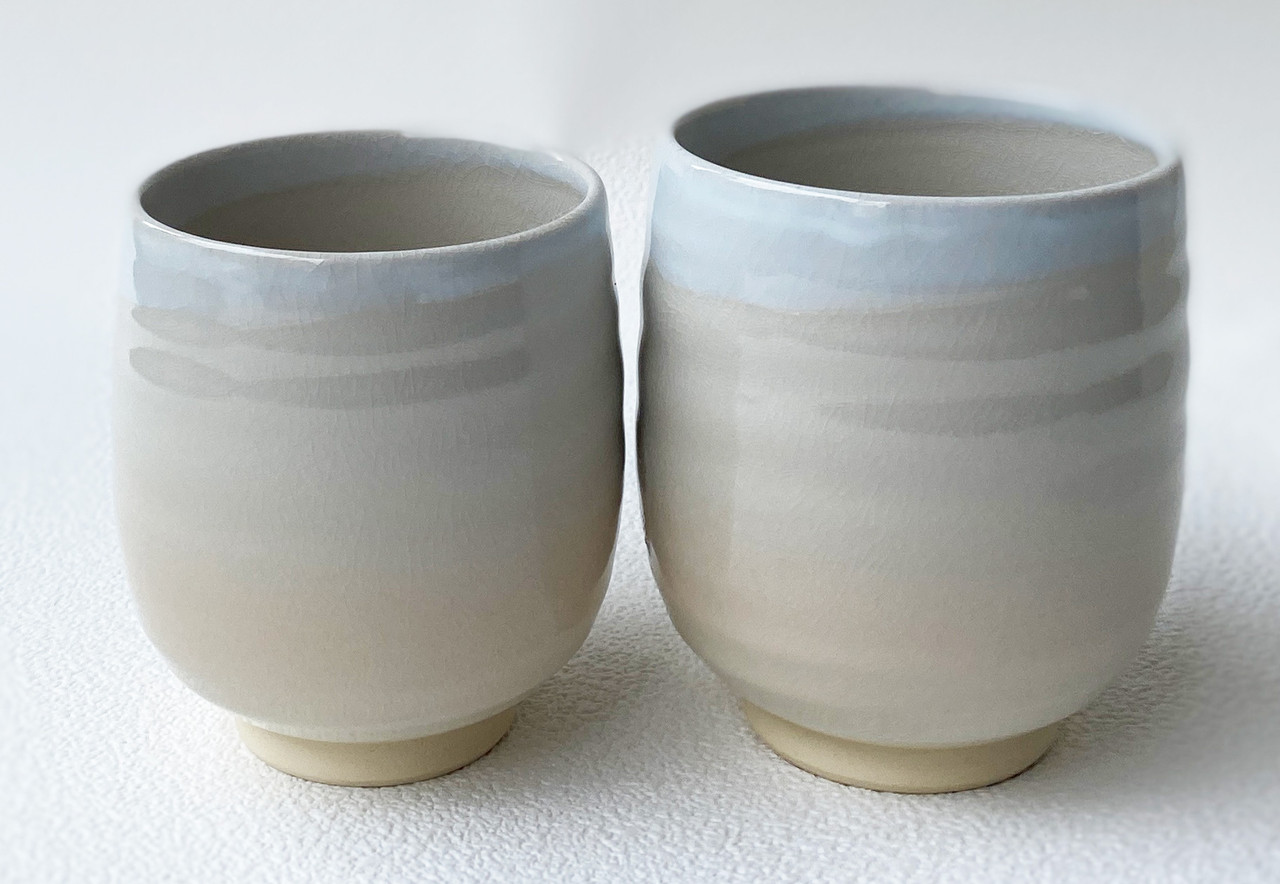
Pick 2 — For Everyday Tea. A pair of yunomi in a soft blue-to-cream gradient glaze, sized for drinking green tea in everyday settings rather than whisking matcha. A gentle way to bring Hagi ware into daily use, and a natural pair for sharing tea with someone else. (See the yunomi pair) — Yunomi, Hime Tsuchi glaze, set of 2 — $49
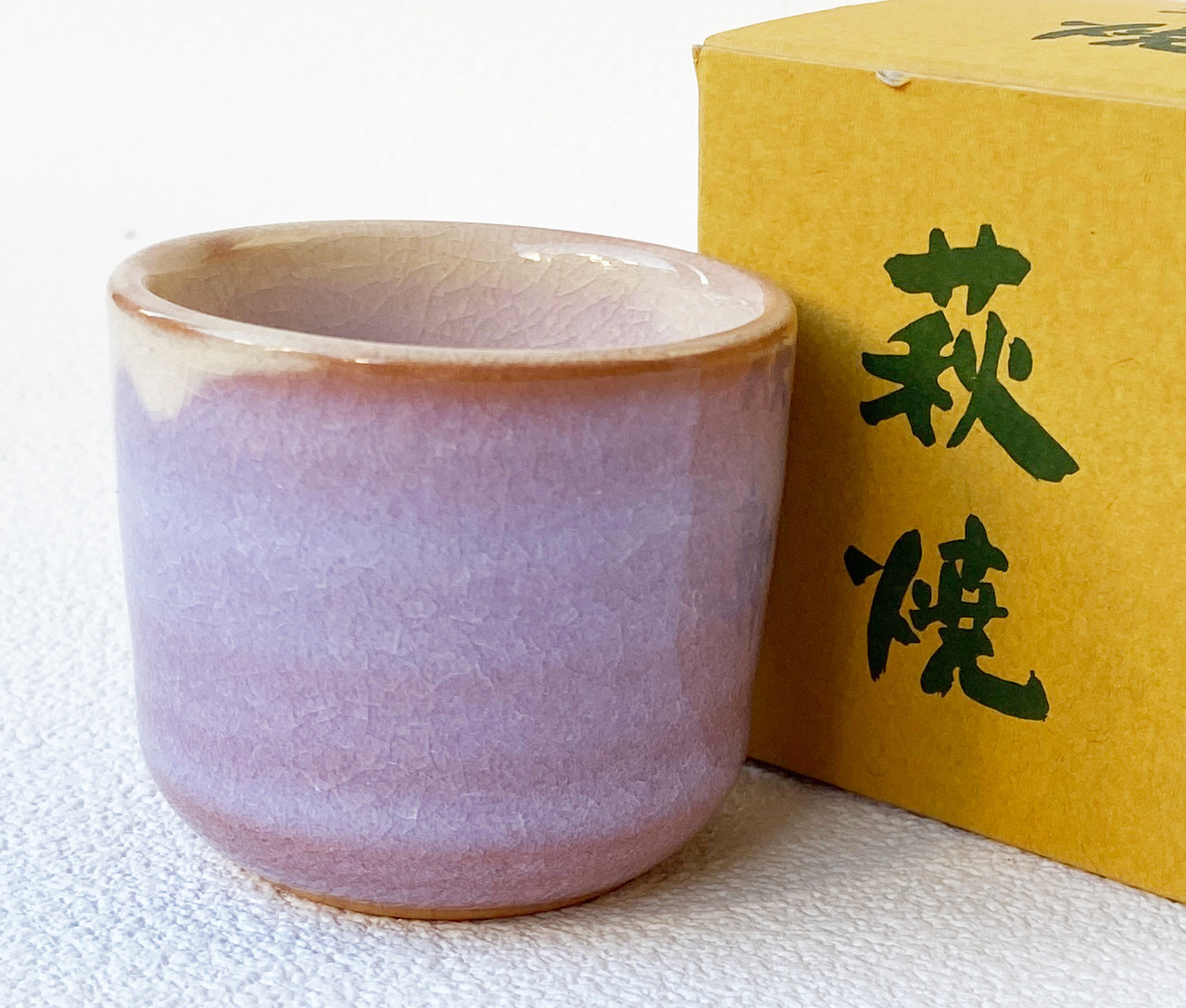
Pick 3 — For Sake. A guinomi in a contemporary purple glaze, with the crackle running clearly across the surface — an easy piece to see kan-nyu on up close. A small, unhurried way to bring Hagi ware to the table. (See the guinomi) — Guinomi, Hagi Murasaki (purple) glaze — $59
8. A Note from the Shop
If you're choosing your first piece of Hagi ware, we'd suggest thinking less about the glaze color you're drawn to today and more about how you'll actually use it — a bowl for tea, a cup for the table, a small cup for sake — since that's what will put it in your hands often enough to watch it change. There's no single correct color or form to start with; the tradition holds all of them. We're happy to help you think through which piece fits how you actually drink tea, or pour sake, at home.
9. Frequently Asked Questions
Q: What does "Ichi Raku, Ni Hagi, San Karatsu" mean?
It's a traditional saying among tea practitioners ranking three types of tea bowls by reputation — Raku ware first, Hagi ware second, Karatsu ware third. It reflects a long-standing preference among tea drinkers for the soft, earthy qualities these three wares share, more than a strict or official ranking.
Q: What's the difference between Hagi ware and Karatsu ware?
Both are associated with Korean potters brought to Japan around the same period, and both are valued in tea circles for an unpolished, earthy character. Hagi ware, from Yamaguchi, is defined by its pale, crackled glaze and the way it gradually changes color with use. Karatsu ware, from Saga and Nagasaki prefectures on the opposite side of Kyushu, covers a broader range of surface treatments and is generally less associated with that particular color-changing quality.
Q: What is "Hagi no nanabake"?
It's the traditional term for the gradual color change a Hagi piece develops with repeated use, as tea or sake works its way into the clay through the glaze's natural crackle. It happens gradually through ordinary use, and how it looks varies from piece to piece.
Q: Can I put Hagi ware in the dishwasher?
Hand-washing is generally recommended instead. The porous, crackled surface that gives Hagi ware its character also makes it more sensitive to the heat and detergent of a dishwasher cycle than a fully glazed piece would be.
Q: Does the color change wash out or fade back to how it started?
The change associated with regular use is generally regarded as part of the character a Hagi piece develops over time, rather than something to prevent, reverse, or wash away.
10. In Closing
Hagi ware asks for a kind of patience that not every piece of pottery does: buy it pale, and let ordinary use — tea in the afternoon, sake with dinner — slowly shape its appearance over time. Start with the form you'll actually reach for, and the color will follow on its own schedule.
For more on Japanese pottery traditions shaped by their clay and firing, see our guides to Shigaraki ware, Bizen ware, and Tokoname ware.
— from Osaka, Team Manekineko-Ai