
Some pottery hides its clay. Shigaraki puts it on display — coarse, flecked, and warmed by fire until the earth itself becomes the decoration.
Pick up a piece of Shigaraki ware and the surface asks to be touched before it asks to be looked at. On an unglazed section it is coarser than most pottery you will have handled, scattered with small pale flecks that catch the light, and warm in the hand in a way that smoother, glassier ware rarely is. Somewhere on the piece you will often find a soft blush of color, or a trail where something once ran and cooled into glass. On a traditionally fired, largely unglazed piece, none of it was painted there.
If you are new to Shigaraki, two questions tend to come up quickly. What makes that texture, and those marks on the surface? And is a piece this rustic difficult to live with? The short answers are simple: the texture comes from the clay itself, the marks — where they appear — come from the kiln, and daily care is closer to common sense than to any special ritual. Below is what the surface is telling you, and how to choose a piece you will actually reach for.
On this page
2. Why This Clay, This Place
3. A Short History — From Storage Jars to the Tea Room
4. Reading the Kiln — Three Marks of Shigaraki Firing
5. Choosing a Piece
6. Living With Shigaraki — Use and Care
7. Editor's Picks
8. A Note from the Shop
9. Frequently Asked Questions
10. In Closing
1. What You Notice in the Hand
The first thing most people notice is the grain. Shigaraki clay is coarse rather than fine, and if you run a thumb across an unglazed section you can feel small particles just beneath the surface — flecks of feldspar and grains of quartz that did not fully dissolve into the clay. During firing, some of those feldspar particles melt just enough to rise as small, milky-white specks across the surface, a texture that is unmistakably Shigaraki once you know to look for it.
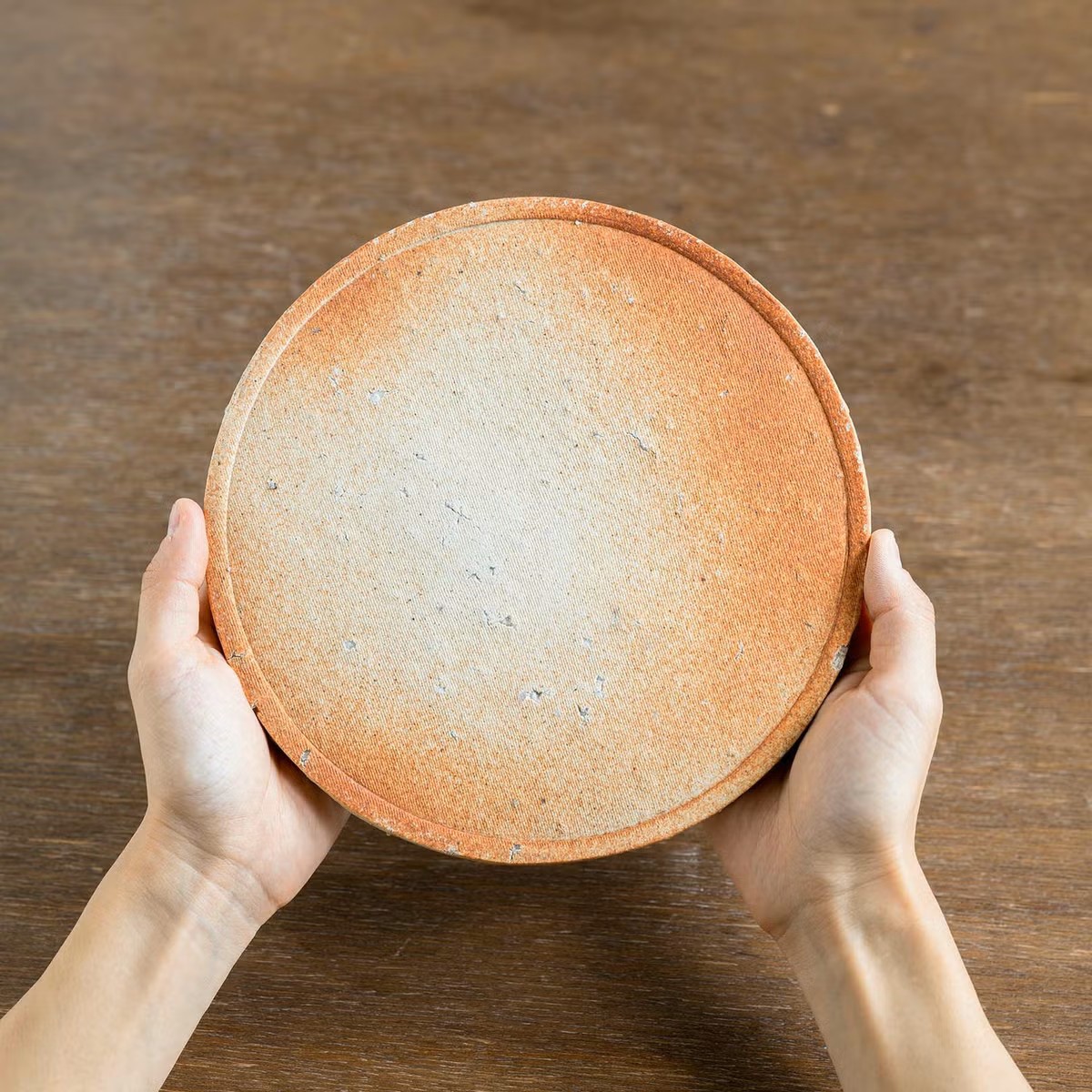
The color runs wide, too, often across a single piece. Warm terracotta and soft pink can sit near passages of gray-brown or a deeper, scorched brown, and here and there a patch may carry a faint sheen where melted ash pooled and cooled into something closer to glass. Some Shigaraki pieces are left largely to the kiln this way; others carry an applied glaze or hand-painted decoration over some or all of the surface — both are long-established parts of the Shigaraki tradition, not a lesser alternative to bare clay. On an unglazed, traditionally fired piece, the coloring is decided by where it sat in the kiln and how the fire moved around it, rather than by a brush.
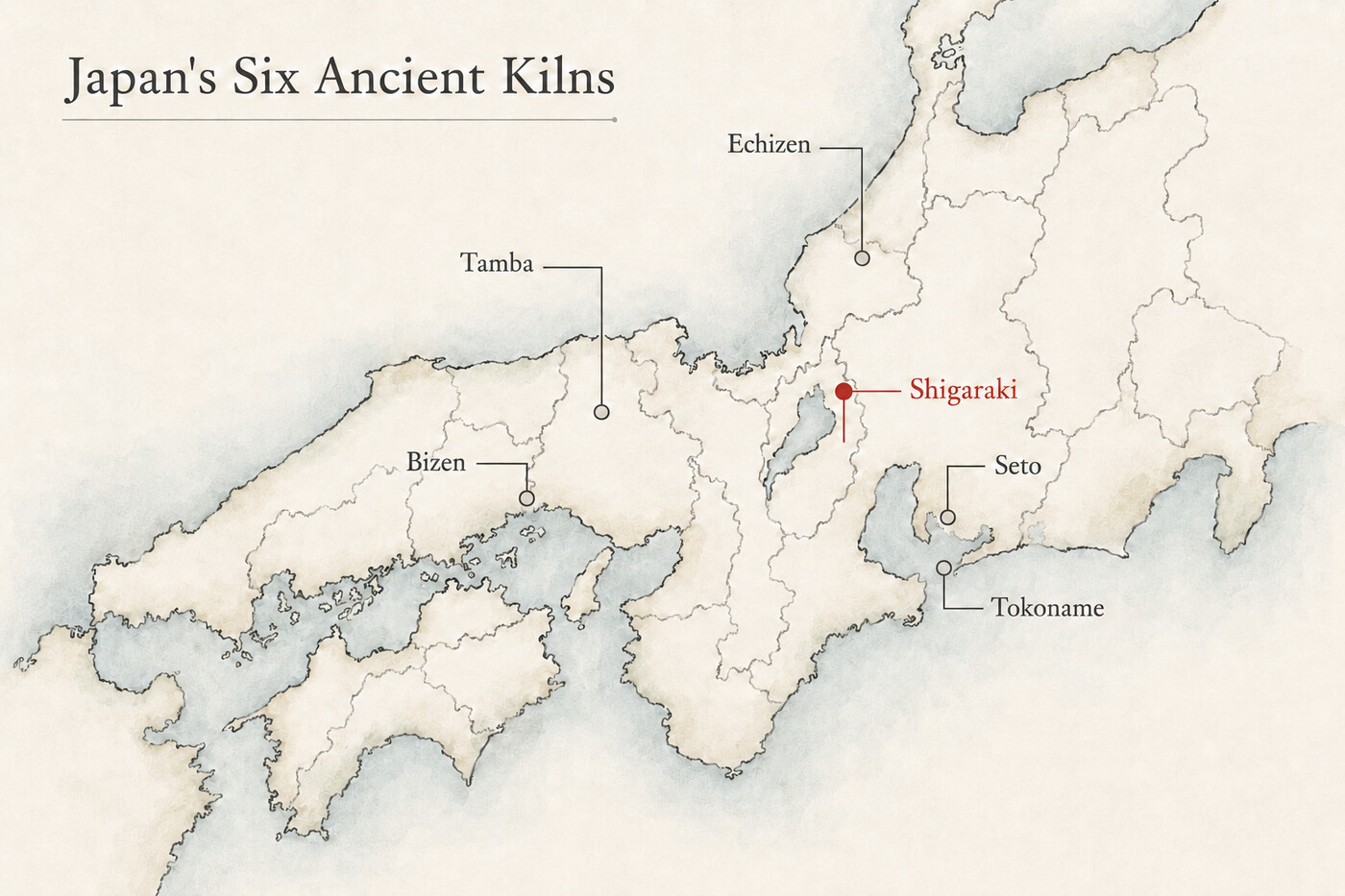
Put simply, Shigaraki ware is a stoneware tradition centered on the town of Shigaraki, in Koka City, Shiga Prefecture. It is one of Japan's Six Ancient Kilns — the handful of pottery centers that have fired more or less continuously since medieval times. What sets Shigaraki apart, even among those, is the clay itself: a coarse, mineral-rich material that carries its own texture into the finished piece, whether or not a glaze is added on top.
2. Why This Clay, This Place
Shigaraki's clay is geologically tied to the Old Lake Biwa Group — the layers of sediment left behind as an ancient, larger version of Lake Biwa slowly shifted across this region over a long span of time. Weathered granite contributed quartz and feldspar, and lake, marsh, and wetland deposits added to the mix, giving the area a wide range of clay types. Depending on how it is prepared and refined, this clay can supply both the backbone needed for large pieces and the smoother workability wanted for finer, wheel-thrown ones — a versatility that is a large part of why Shigaraki's potters have kept returning to local clay for centuries.
3. A Short History — From Storage Jars to the Tea Room
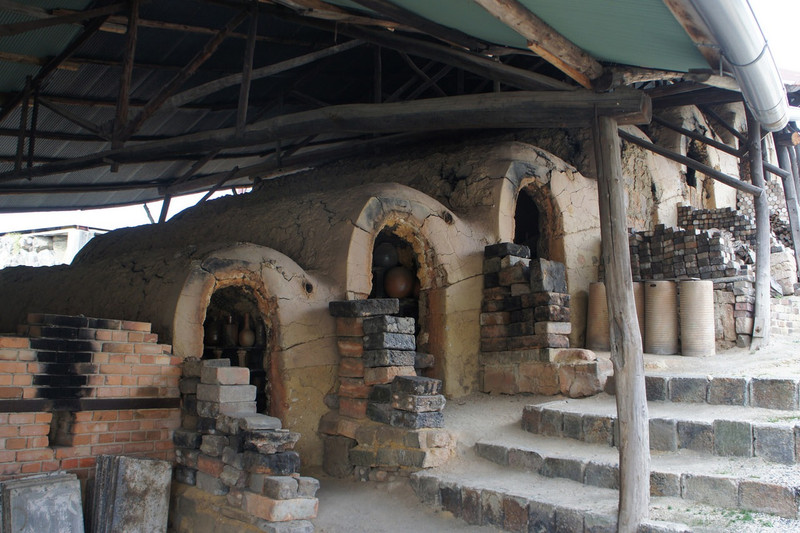
One legendary account of Shigaraki's origin traces back to the 8th century, when tiles are said to have been fired during the brief construction of Shigaraki-no-miya, a palace built under Emperor Shōmu. Separately, the documented history of continuous production is generally traced to the mid-Kamakura period, when kilns in the area — influenced by techniques from nearby Tokoname — began firing jars, storage vessels, and bowls for everyday use.
By the Muromachi and Momoyama periods, that same plain, sturdy ware found an unexpected second life in the tea ceremony. Tea practitioners drawn to wabi — an aesthetic that prizes the unadorned and the honest over the polished — came to prize Shigaraki water jars, flower vases, and tea containers. Through the Edo period, the same kilns continued to produce tea-ceremony vessels alongside the storage jars and everyday wares that trade and daily life demanded. In the Meiji era, advances in glaze technology helped Shigaraki become a major center for hibachi braziers, produced in large numbers well into the mid-20th century, until changing lifestyles moved the industry on. Production shifted again toward bonsai pots, and eventually toward the tableware, vases, garden pieces, and cookware the region is known for today.
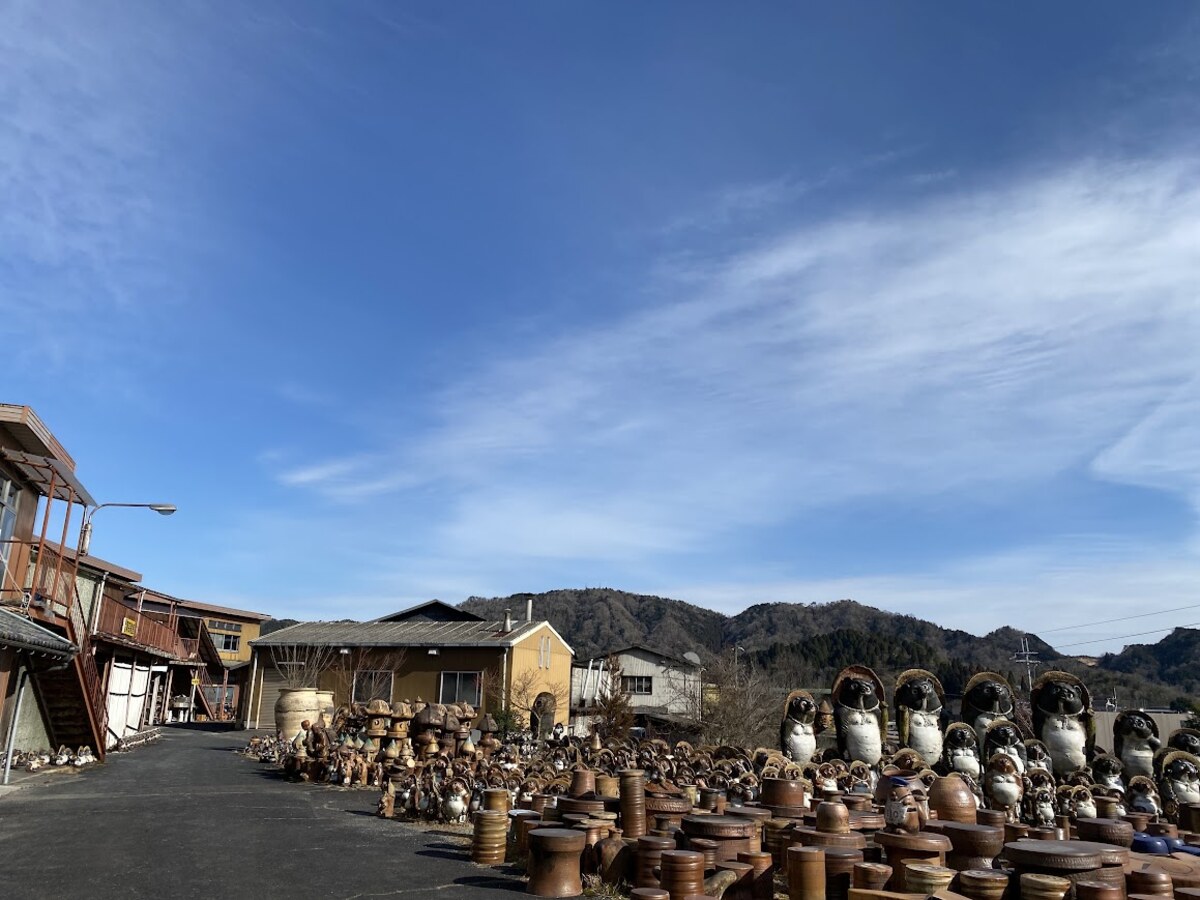
One more thread is worth a brief mention here. If you have ever seen a photo of a Japanese town lined with cheerful, pot-bellied raccoon dog statues, there is a good chance it was Shigaraki — the tanuki figures are made in the same kilns as the vases and tableware, and today they stand outside shops and homes throughout the town. They became widely known nationally following a 1951 imperial visit to the area, when the ones lining the roadside caught the public's attention. We cover that story in full in our guide to Shigaraki tanuki statues. In 1975, Shigaraki ware was officially designated as a Traditional Craft by Japan's national government — recognition that arrived after centuries of continuous production, not the start of it.
4. Reading the Kiln — Three Marks of Shigaraki Firing
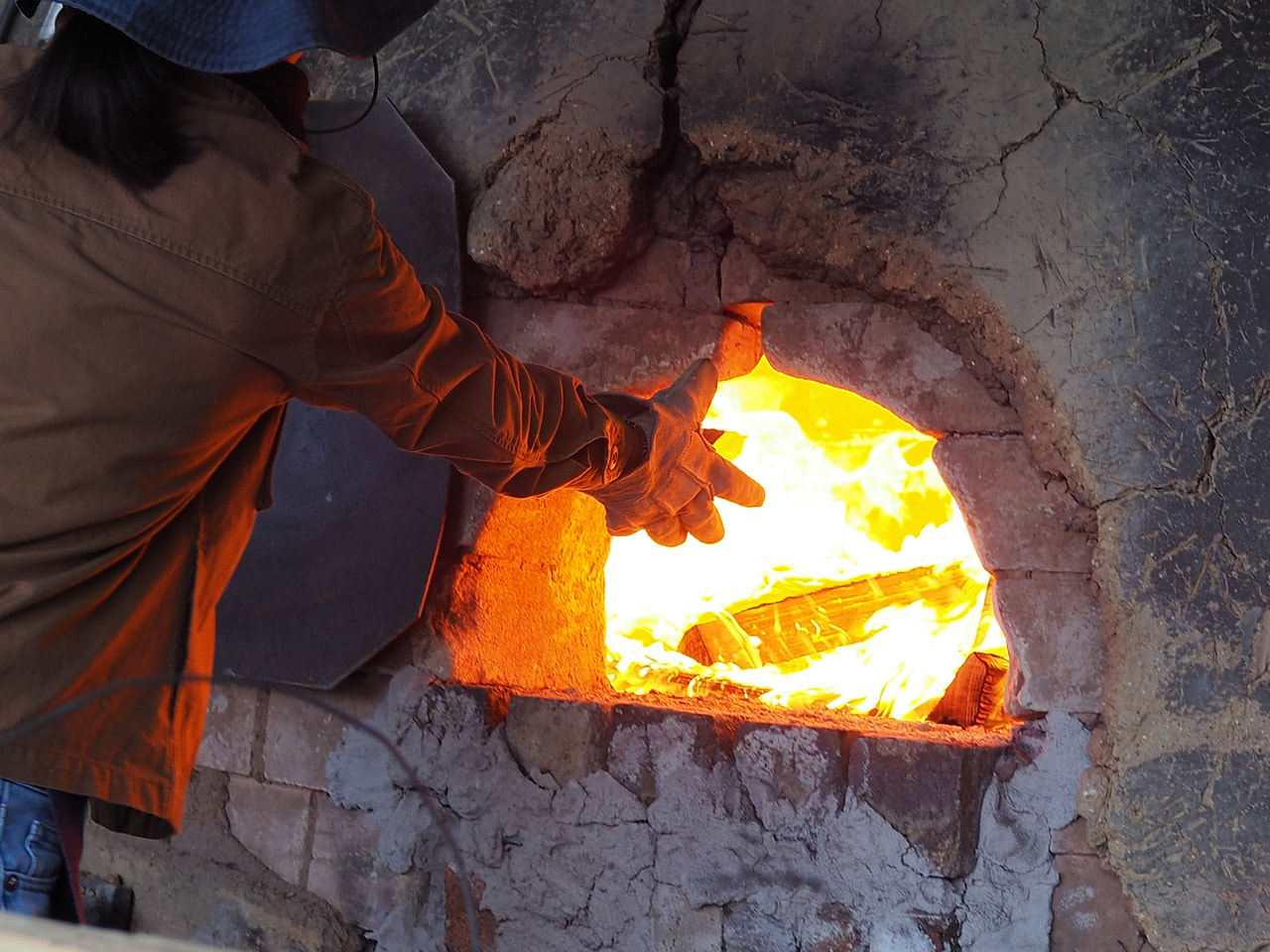
Shigaraki's traditional core is coarse local clay fired with wood, where flame and ash do much of the work. Contemporary Shigaraki ware also includes glazed pieces fired in gas or electric kilns, so not every piece will show all — or any — of the marks below. Still, on ware fired the traditional way, three marks come up often enough to be worth knowing.
Hiiro — "fire color." Where a piece sat closer to open flame, the clay often takes on a gentle blush of red, pink, or orange, sometimes deepening toward scarlet. It is one of the softer effects of the fire, and it shifts with humidity and exactly how a kiln was fired, so no two hiiro passages read quite the same.
Koge — "scorch," also called haikaburi, or "ash-covered." In a wood-fired kiln, ash from the burning fuel settles and builds up over days, and it tends to gather most heavily low on a piece, near the foot. Where that ash sits thick, the surface can darken toward black-brown — a shadow at the base that reads as weight and depth rather than damage.
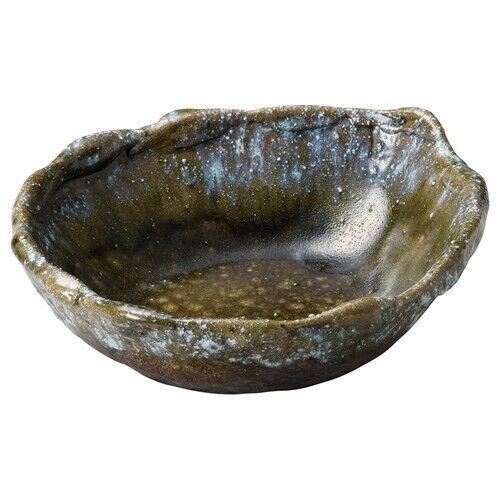
Bidoro — "glass," Shigaraki's natural ash glaze. Where falling ash melts together with the feldspar already in the clay, it can flow and pool into a glassy sheen in tones from yellow-green to a deeper blue-green, sometimes running in a visible trail down the surface. Nothing was brushed on; the glaze formed itself, in the kiln, out of ash and stone.
None of the three ranks above the others. A single piece may show one, two, or all three of these marks together, or none at all — plenty of good Shigaraki ware is closer to plain, warm clay with only a whisper of hiiro at the shoulder. Once you notice them, though, they become a quiet way of telling one piece from another on a shelf that might otherwise look uniform.
5. Choosing a Piece
With the marks in mind, choosing becomes mostly a question of what you want the piece to do.
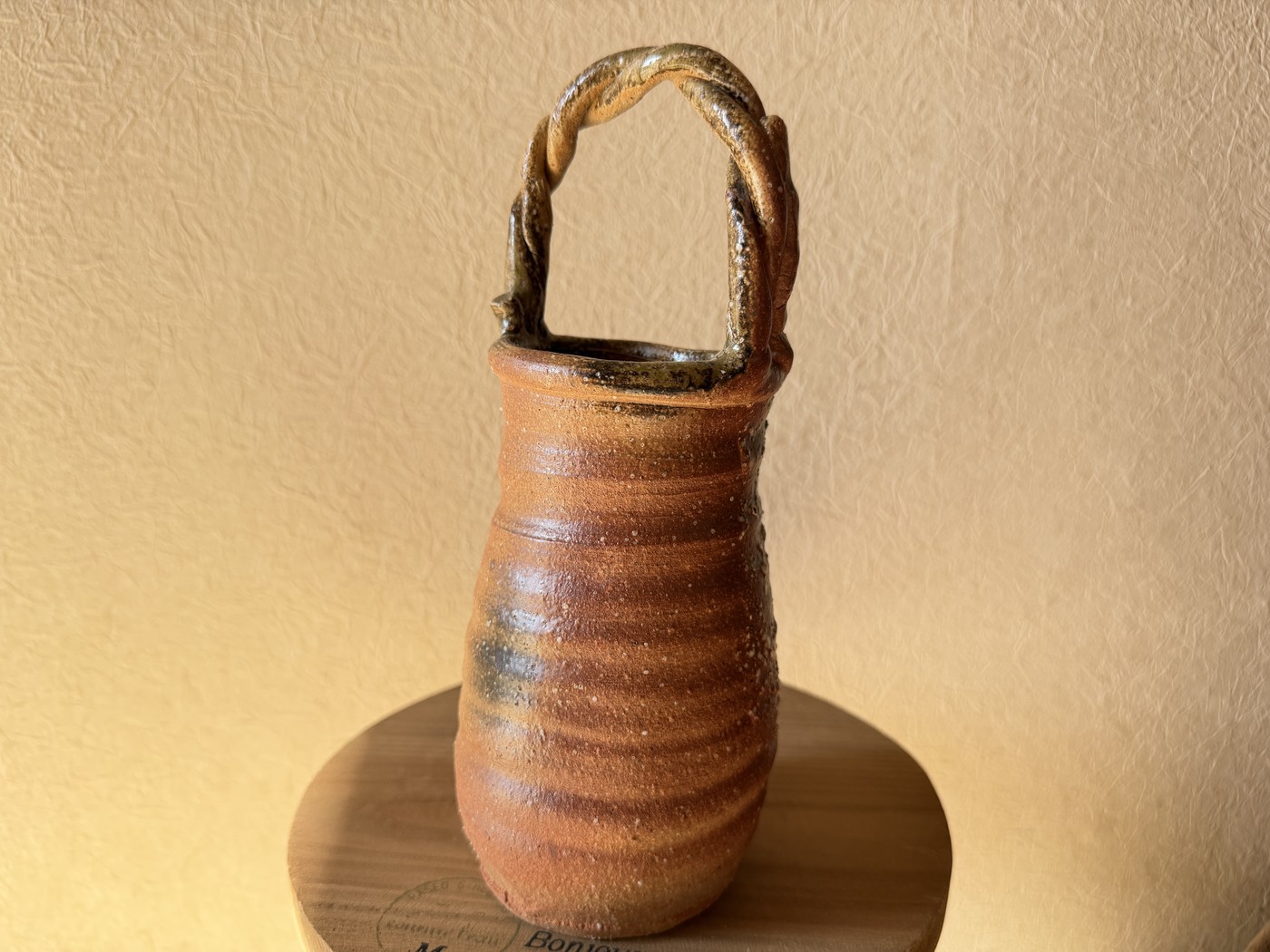
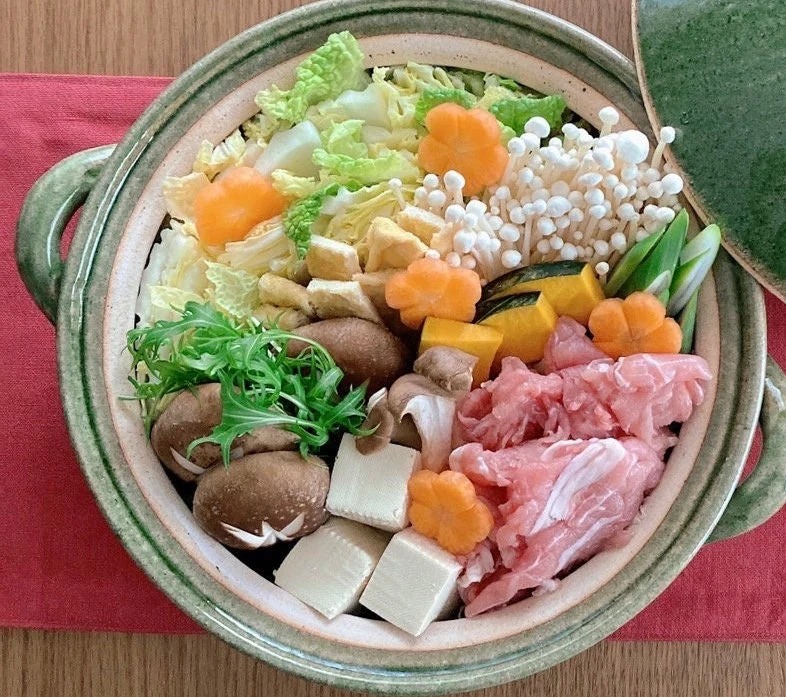
For flowers, Shigaraki has a long history as a vase and container clay, and a single-stem holder or small vase is one of the most forgiving ways to bring the material home — the coarse, warm surface tends to flatter a single branch more than it competes with it. For the table, Shigaraki appears as tea cups, sake cups, and small bowls, sometimes left largely to the clay and sometimes finished with a poured or brushed glaze over part of the surface; either approach is traditional, so choose by what you find yourself drawn to rather than assuming one is "more authentic" than the other. And because the clay holds heat and shape well in thick sections, Shigaraki also has a long history as a donabe clay — the heavy pots used for nabe, rice, and other slow-cooked dishes. Not every donabe is built for direct-flame use, though, so check the product description or the maker's own guidance for that particular piece before cooking with it.
By surface, let the marks guide you the way you would choose among the patterns of any wood-fired ware. A quiet piece with only a soft hiiro blush suits an everyday table; one with a visible run of bidoro or a deep koge shadow tends to read as a small statement piece, better suited to a vase you will look at often or a gift meant to be noticed. If this is your first piece, there is a lot to be said for starting small — a single-stem vase or a modest cup that sits well in the hand and lets you live with the material before committing to something larger.
6. Living With Shigaraki — Use and Care
A coarse, rustic clay sounds like it might ask a lot of you. In practice, Shigaraki asks for ordinary care, plus a little extra attention to drying.
For tableware and vases, wash a new piece with mild dish soap before its first use, and in daily use, mild soap and a gentle sponge are all that is needed. Because the clay itself is more porous than a fully glazed surface, especially where it is left bare, it is worth drying a piece thoroughly before putting it away rather than leaving it damp — this matters more for Shigaraki than for a smooth glazed cup, simply because there is more open clay for moisture to sit in. Whether a piece is microwave- or dishwasher-safe depends on its individual glaze and firing rather than on Shigaraki as a whole, so check the maker's guidance before either.
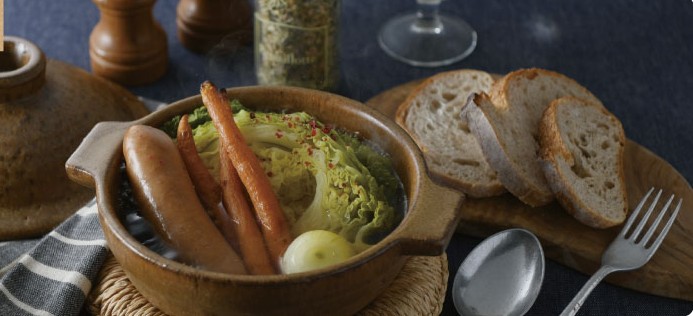
For donabe and other cookware pieces, follow the seasoning and use instructions provided by the maker before the first use, and keep to it afterward — the details vary by piece, and the maker's own guidance is the right reference rather than a general rule. Across all Shigaraki pieces, it is best to avoid sudden changes in temperature. A piece that has cracked or is losing its watertight seal is best retired from cooking or serving use, though a piece with only a small chip may still have a long life ahead of it as a decorative or display object.
What the clay gives back, in exchange for that small attentiveness, is a kind of quiet individuality. The scatter of feldspar flecks, the reach of a bidoro glaze, and small variations in color from piece to piece are part of what the kiln leaves behind on traditionally fired ware, rather than a flaw to look past — though, as with any pottery, a piece should still be checked for soundness before it goes into daily use. They are a large part of why a shelf of Shigaraki pottery never looks quite mass-produced, even when every piece was thrown by the same hand.
7. Editor's Picks — Three Expressions of Modern Shigaraki

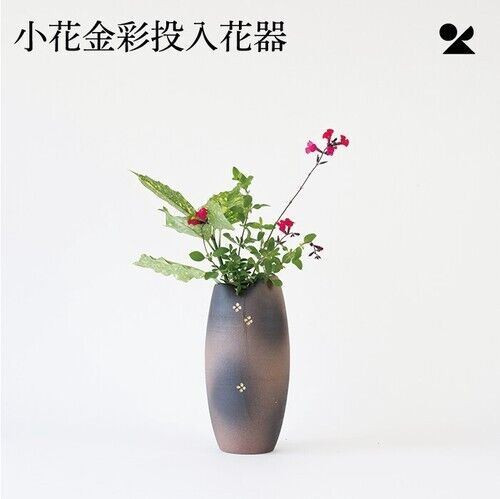
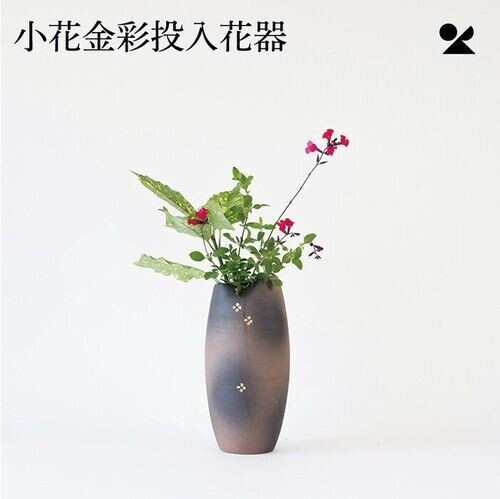
Pick 1 — A Quiet Column. A tall, slender vase in a deep bronze-brown clay, with a scatter of small gold flower accents catching the light — an understated shape that holds its own even before a stem is added. (See the vase) — Flower Pot Vase, H25.5cm, Little Flower Carved Gold — $150
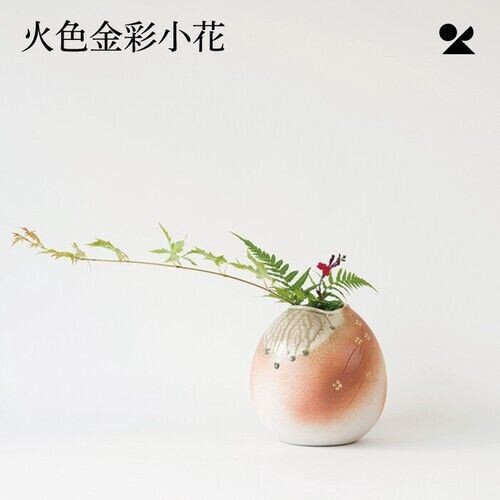
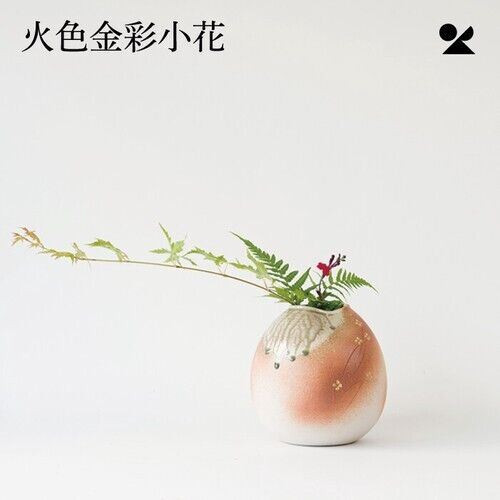
Pick 2 — Where the Glaze Runs. A rounder vase where a pale, glass-like glaze flows down into a warm scarlet base, finished with small painted gold accents — a shape and surface that echo the bidoro described above, on a piece finished rather than left entirely to the kiln. (See the vase) — Flower Pot Vase, H20cm, Scarlet Kinsai Little Flower — $160
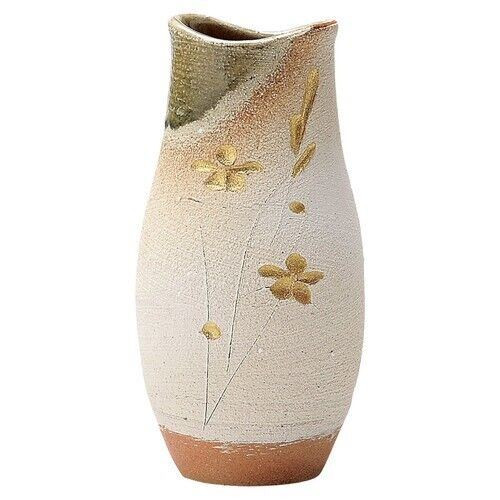
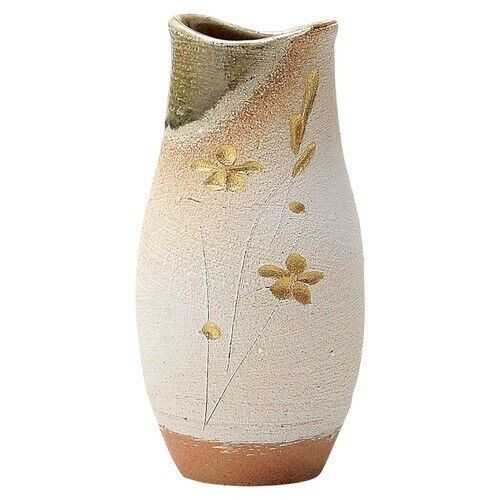
Pick 3 — A Warmer Accent. A tall vase in soft, cream-toned clay, with a natural ash glaze pooling toward green at the shoulder and a small motif of gilded flowers near the base — a quieter kind of statement piece, better suited to a room that wants warmth than drama. (See the vase) — Flower Pot Vase, H26cm, Myoyo Gold Flower — $160
8. A Note from the Shop
If there is one thing we would gently explain about Shigaraki, it is that the roughness is not a rougher version of something else — on traditionally fired ware, it is the point. The flecks in the clay, the blush of hiiro, the shadow of koge, the occasional run of bidoro: none of it is a defect to look past. It is the record of clay tied to a lakebed millions of years in the making, shaped by hand, and left in a fire to do what only fire can do. We are here mainly to help you read that record, and to find the piece that belongs in your home.
9. Frequently Asked Questions
Q: What is Shigaraki ware in Japanese?
Shigaraki ware is 信楽焼, read Shigaraki-yaki. In English it is usually called "Shigaraki ware," though you will also see "Shigaraki-yaki" used. 信楽 (Shigaraki) is the place name — a town within Koka City, Shiga Prefecture — and 焼 (yaki) means "fired," the same ending attached to other regional pottery names such as Bizen-yaki or Hagi-yaki.
Q: Is all Shigaraki ware unglazed?
No, and this is a common misunderstanding. Shigaraki pieces range from entirely bare clay, shaped only by the kiln, to pieces finished with an applied glaze or hand-painted decoration over part or all of the surface — both are established parts of the Shigaraki tradition. The coarse clay and the way it colors in the fire are usually what make a piece recognizably Shigaraki, whether or not glaze is part of it.
Q: I'm new to this — how do I choose one?
Start from how you plan to use it — a vase, a cup, a cooking pot — and then let the surface guide you. A quiet piece with only a soft hint of hiiro suits everyday use; a piece with a clear run of bidoro or a deep koge shadow reads as more of a statement. For a first piece, choose something small enough to live with comfortably, and let it teach you what you like.
Q: Is an inexpensive piece lower quality or harder to use?
Price can reflect size, the technique used, the maker's reputation, and how rare or dramatic a firing result turned out to be. A modest, quietly marked piece is not automatically lower quality than a larger or more strikingly marked one — but it's worth checking the condition, intended use, and any care notes for the specific piece you're considering.
Q: Do I need to season it, and is it hard to care for?
For most Shigaraki tableware and vases, no special seasoning is needed — wash before first use with mild dish soap, and dry well afterward. Donabe and other cookware pieces are the exception: follow the maker's own seasoning and care instructions for that specific piece, since methods vary.
Q: Why does every piece look a little different?
On traditionally fired ware, much of the coloring comes from the kiln rather than from paint or a uniform glaze. Where a piece sat, how close it was to the flame, and how ash settled around it all shape the final surface — the hiiro, koge, and bidoro described above are the visible results. Two pieces from the same batch of clay can still come out of the fire looking quite different.
Q: Is Shigaraki ware still made and used in Japan today?
Yes. Shigaraki has been producing pottery for centuries, moving through storage jars, tea-ceremony wares, hibachi braziers, and now tableware, vases, garden pieces, and cookware as tastes changed. It was formally recognized as a Japanese Traditional Craft in 1975, and the kilns around the town are still active today.
Q: What about the Shigaraki raccoon dog statues (tanuki)?
The cheerful tanuki figures you may associate with Shigaraki are a real and famous part of the tradition — they became widely known nationally after a 1951 imperial visit to the area — but they are their own subject. We cover them separately in our guide to Shigaraki tanuki; this article focuses on Shigaraki as a clay for vases, tableware, and cookware.
10. In Closing
Shigaraki rewards a hands-on kind of attention. Once you can feel the grain of the clay and read a little of what the fire left behind — the blush of hiiro, the shadow of koge, the occasional glassy trail of bidoro — a shelf of earth-toned pottery stops looking uniform and starts looking like a set of small, individual records. Begin with one piece small enough to live with easily, and let it earn its place on your table.
For more from Japan's kilns, see our guide to Bizen ware, another of the Six Ancient Kilns, known for its unglazed, wood-fired stoneware from Okayama — and look for more of the Six Ancient Kilns to come.
— from Osaka, Team Manekineko-Ai
PIECES IN THIS ARTICLE
Three ways to start with Shigaraki ware
CONTINUE READING
MORE IN KOGEI →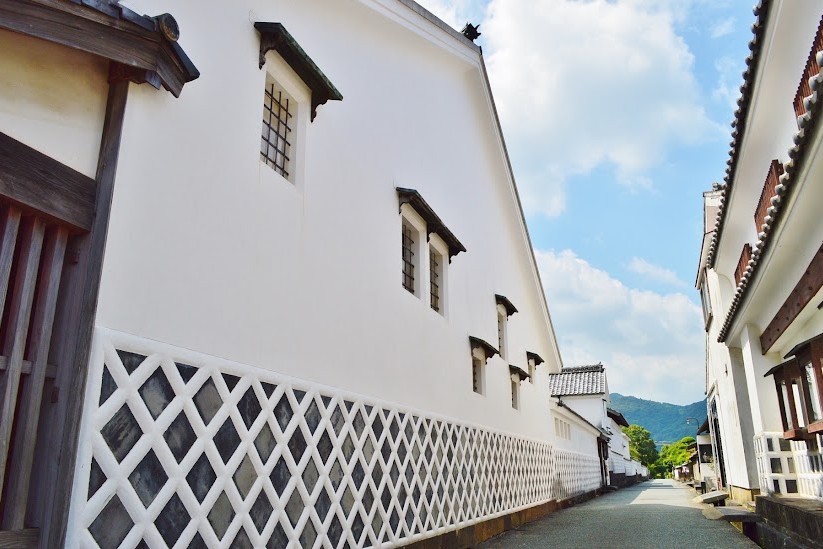 KOGEI
Hagi Ware — A Guide to Japan’s Slowly Changing Pottery
Pale, crackled glaze that slowly changes color with use, and how to choose a piece.
KOGEI
Hagi Ware — A Guide to Japan’s Slowly Changing Pottery
Pale, crackled glaze that slowly changes color with use, and how to choose a piece.
 KOGEI
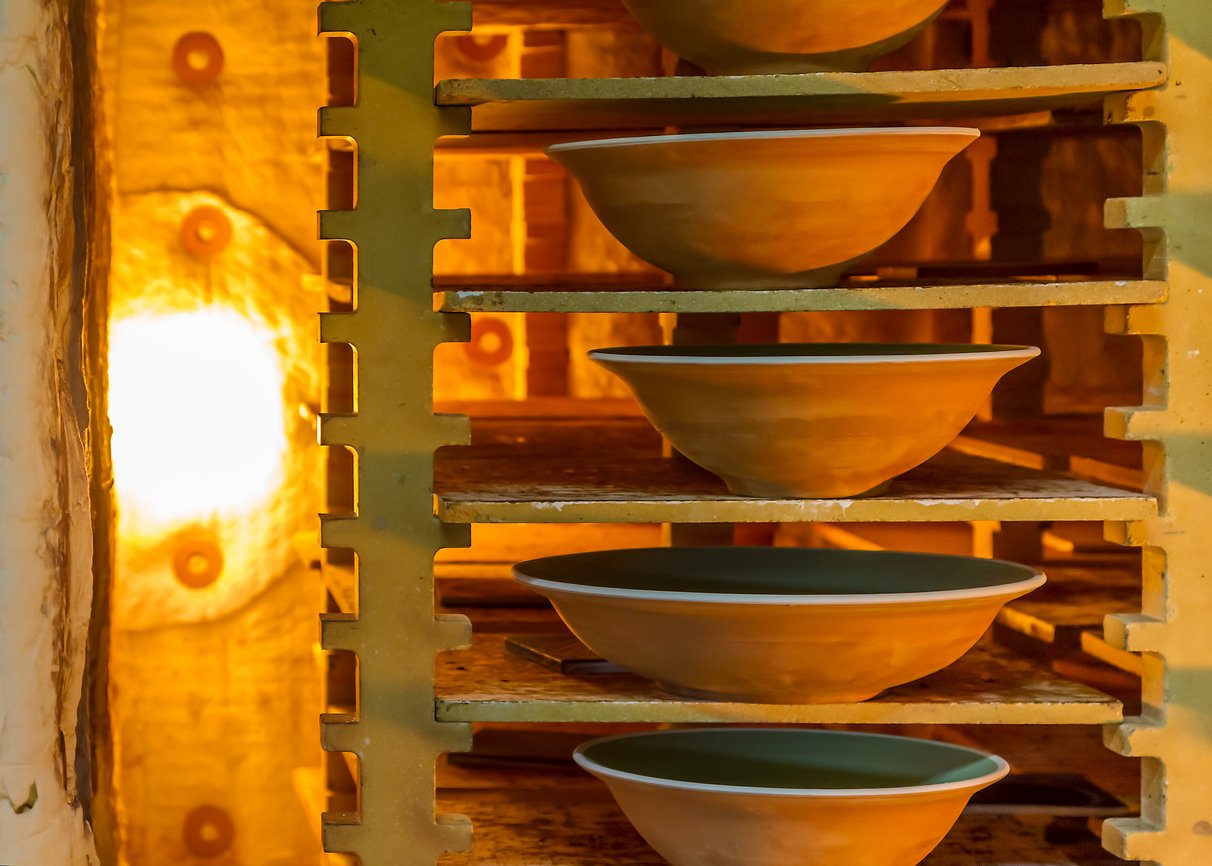
What Is Mino Ware? The Everyday Japanese Ceramic You Probably Already Own
What is Mino ware? A beginner's guide to Japan's most common ceramic: the Tono region, the Shino, Oribe, Kizeto and Setoguro glazes, and how to choose a piece.
KOGEI
What Is Mino Ware? The Everyday Japanese Ceramic You Probably Already Own
What is Mino ware? A beginner's guide to Japan's most common ceramic: the Tono region, the Shino, Oribe, Kizeto and Setoguro glazes, and how to choose a piece.
 KOGEI
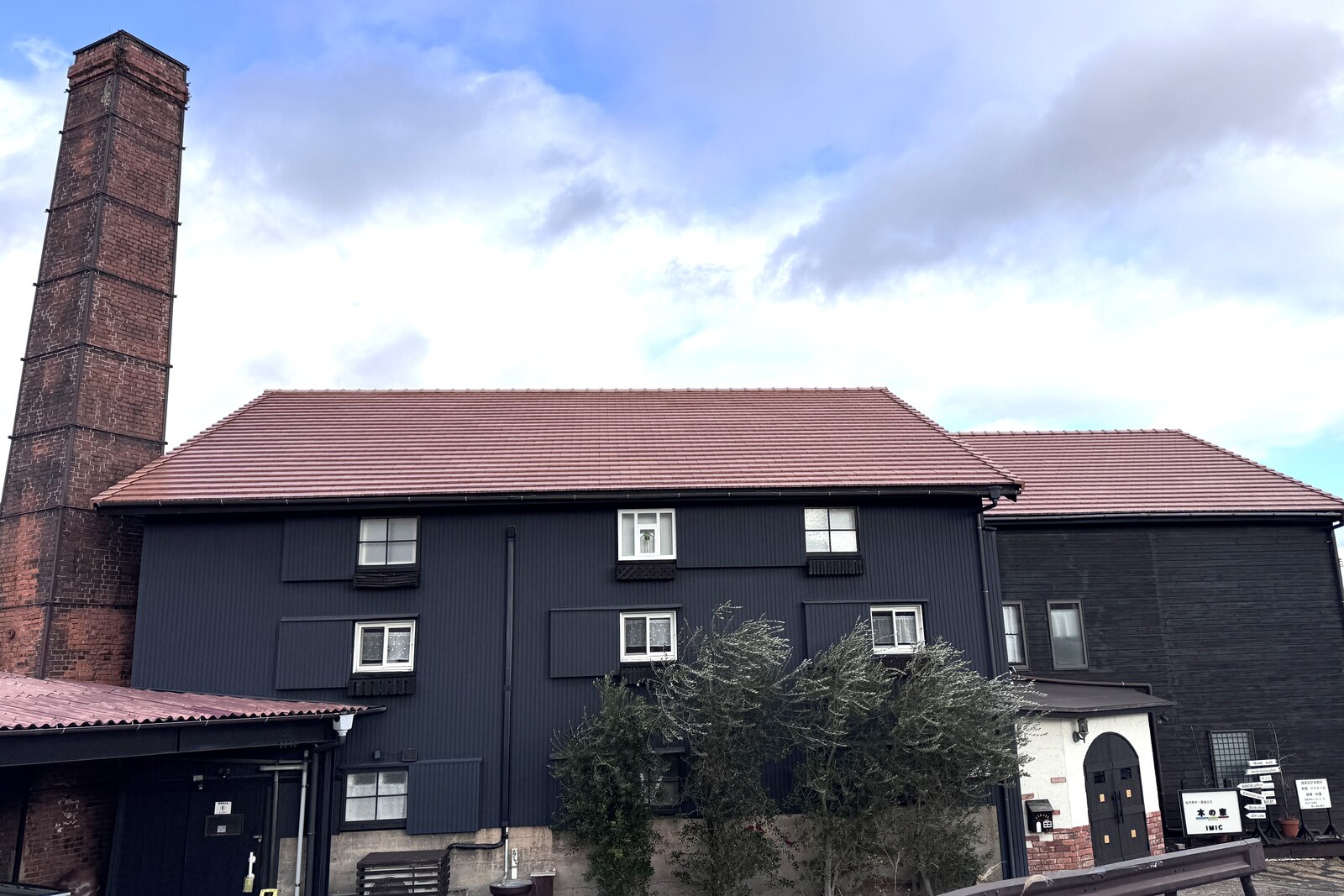
What Is Tokoname Ware? A Guide to Choosing a Kyusu
Tokoname ware is Japan's leading kyusu region, known for iron-rich clay and built-in ceramic strainers.
KOGEI
What Is Tokoname Ware? A Guide to Choosing a Kyusu
Tokoname ware is Japan's leading kyusu region, known for iron-rich clay and built-in ceramic strainers.