
The same sake, poured into a thin porcelain cup and a thick stoneware one, is no longer the same drink. The vessel is part of what you taste.
There is a small, quiet truth that anyone who has spent time around sake comes to know: the vessel changes the drink. The same junmai, poured first into a thick stoneware guinomi and then into a thin porcelain ochoko, will not taste the same. The first will feel rounder, slower, almost mineral. The second will arrive cleaner, sharper, with the rice notes lifted toward the top of the palate. Nothing about the sake itself has changed. What changed is the conversation between the liquid and the wall it touches — the temperature it holds, the curvature it climbs, the thickness of the rim that meets the lip.
This is why, in Japan, choosing a sake set has never been treated as a decorative afterthought. It is treated as part of the act of drinking. A tokkuri with a narrow neck behaves differently in warm water than one with a broad shoulder. A flat sakazuki opens the aroma in a way a deep guinomi never will. Tin softens. Porcelain clarifies. Lacquer warms the lip in winter. Glass cools the eye in summer. Every choice is a quiet preference about what kind of evening you would like to have.
This guide is a map. It is for the reader who is considering a first Japanese sake set — perhaps as a gift to themselves, perhaps for a single ritual at the end of a long week — and who would like to understand what the pieces are, why they took the shapes they did, and how to read them in a collection. The pleasure of choosing is yours, and we hope, by the end, the choosing feels less like guesswork and more like a conversation you are having with the long history of these objects.
Tokkuri (徳利) — The Carafe That Holds the Pour
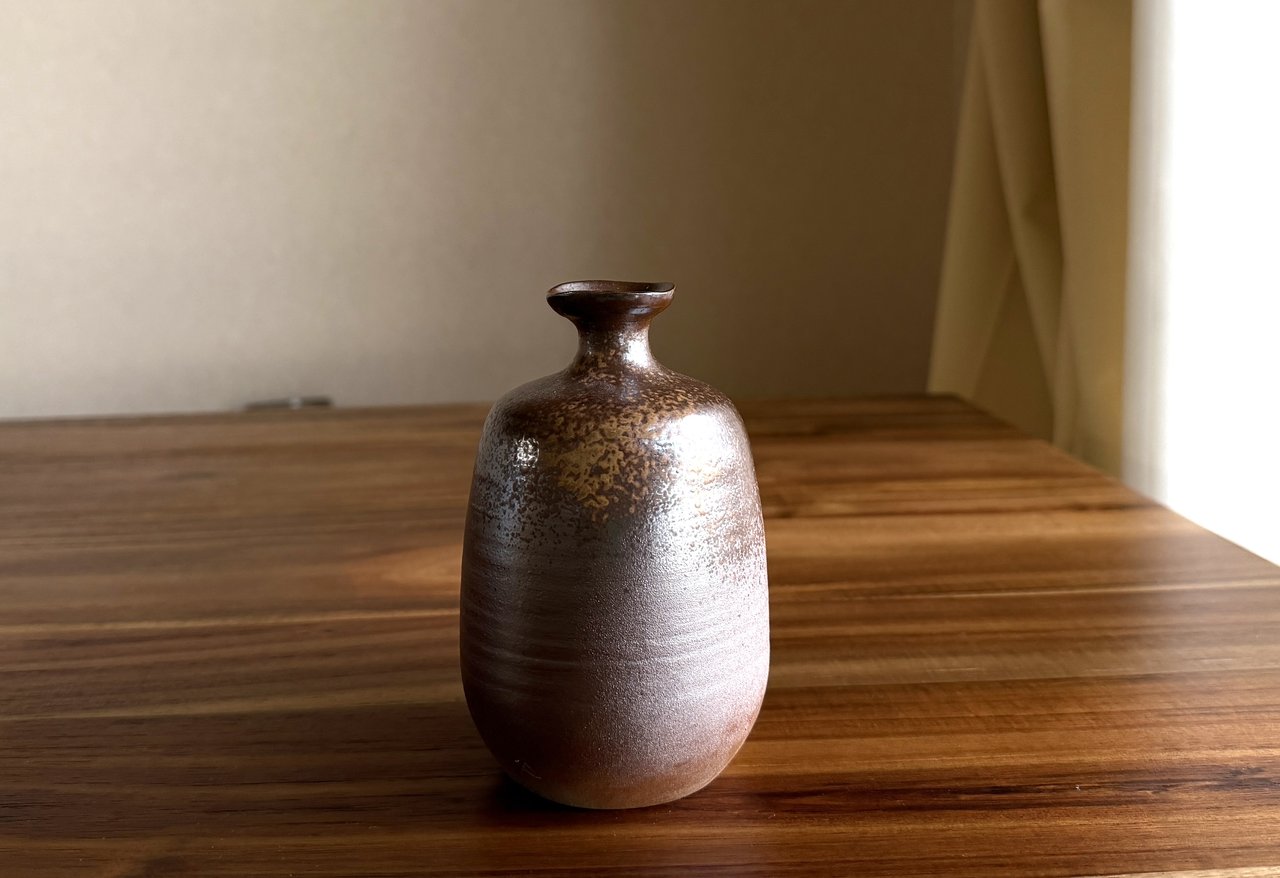
Every line of the silhouette is traceable to a function — the narrow neck preserves heat, the rounded shoulder holds volume, the thumb finds the widest point.
The tokkuri (徳利) is the vessel most people picture when they hear the words sake set. It is the small carafe with the narrow neck and the rounded shoulder, used to bring the sake from the kitchen to the table and to pour from there into the smaller cups.
Its shape is not arbitrary. The narrow neck slows the rate at which heat escapes, which matters because tokkuri were designed in an era when warm sake was the everyday form. A wider mouth would let warmth dissipate within minutes; the contracted neck preserves the temperature long enough for two or three full pours. The widening shoulder below the neck holds volume without making the vessel top-heavy when filled. The rounded base sits comfortably inside the chirori or warming bowl and inside a tokkuri-warmer of hot water (yu-doko). Every line of the silhouette is traceable to a function.
Capacities are spoken of in the old measures. A standard tokkuri holds one go (一合, ~180 ml). Smaller ones hold five shaku (五勺, 90 ml) for a single guest. Larger ones hold two go (二合) for a slow pour shared between two. Many in our collection sit close to one go, which is the size most readily warmed at home and most generous for an evening of two or three pours each.
The pouring lip varies more than first-time buyers expect. Some tokkuri have a clearly defined spout cut into the rim; others have only the slightest tightening of the lip line, almost invisible until you tilt and watch the stream form. The first kind delivers a cleaner pour for beginners. The second is the older, quieter form, and rewards a steadier hand.
Colour note. Tokkuri painted in classical sometsuke indigo on white ground are the everyday backbone of Japanese sake culture and pair well with almost any cup. Iron-glaze and ash-glaze tokkuri in deep brown or charcoal carry weight and gravity, and read beautifully on a dark wood table. Black tokkuri — whether from Bizen kiln-fired without glaze or from Mino with a thick temmoku coat — have a stillness that older drinkers tend to come back to over the years; the colour does not perform, it simply holds.
A craftsman shaping a tokkuri thinks first about how the warm hand will hold it during the pour. The widest point of the body is where the thumb and four fingers meet most naturally. If you pick up a tokkuri and the grip feels obvious within a second, the maker did the work well.
In our collection: Bizen Sake Set — Tokkuri & Guinomi, Goma, Tosho Kiln
Ochoko (お猪口) — The Small Cup
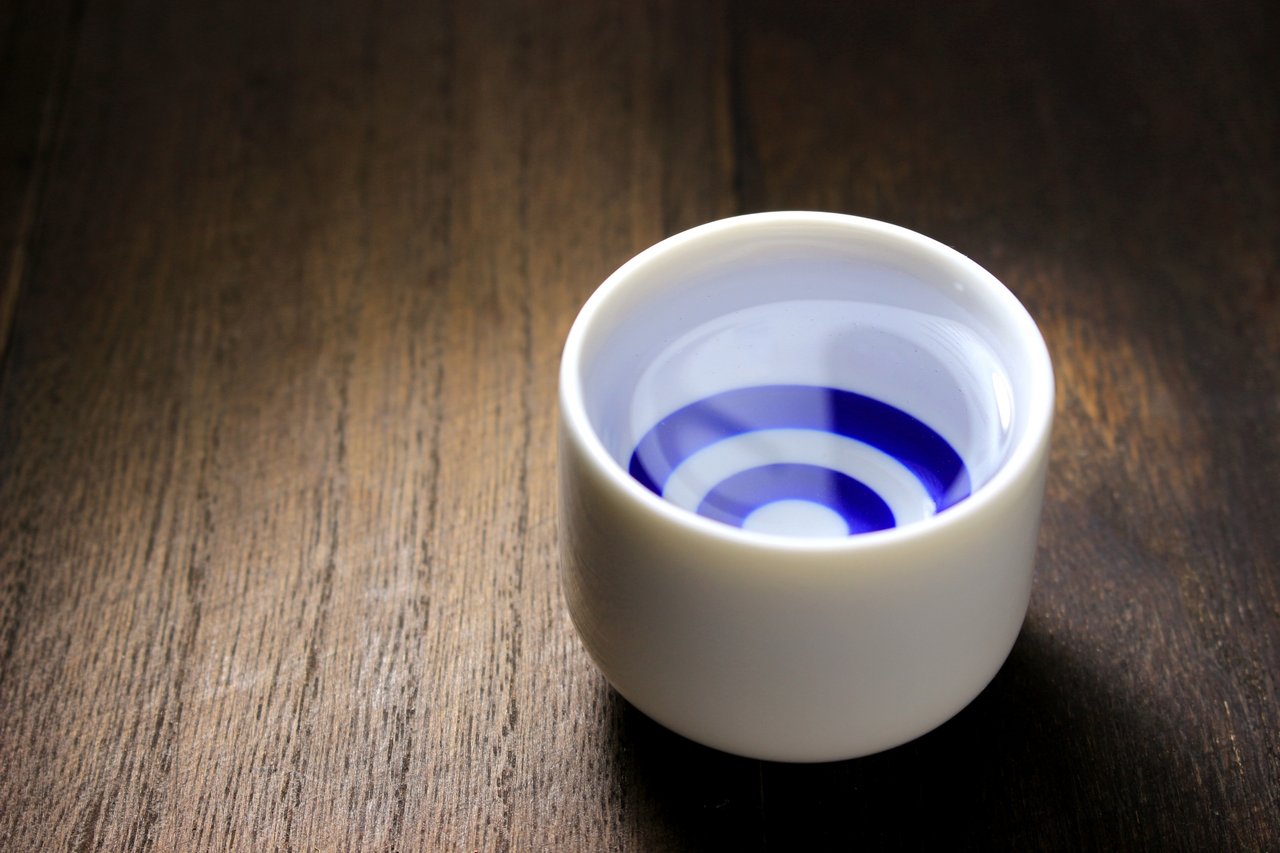
Two concentric rings on the inside of a small cup — one cobalt, one red — not for ornament, but to read the clarity of the sake.
The ochoko (お猪口) is the small cup that almost everyone associates with sake. The diameter is roughly that of a plum; the depth, roughly the width of a thumb. It holds about one or two mouthfuls.
The size is not modest by accident. Sake at warm temperatures should be received and finished while the warmth is still present in the mouth — a large cup forces the drinker to nurse the temperature and watch it fall. The ochoko was sized to be emptied in one or two sips and refilled, which is also why pouring for one another, rather than for oneself, became the social ritual of the table.
The classic decoration on the inside of the cup is the janome (蛇の目) — two concentric circles, one cobalt blue, one red, painted onto a white porcelain base. This is the pattern on the cups used in formal sake tasting (kikizake), where the colours allow the taster to read the clarity and hue of the liquid: the blue ring against the white shows transparency, the red ring shows iridescence and viscosity. The pattern is not only an ornament; it is a calibration tool, made beautiful enough to live on the dinner table.
The thickness of the rim is the detail to feel for. A thin porcelain rim — almost paper-thin where it meets the lip — delivers the sake straight to the front of the palate, where the higher aromatic notes register. A thicker stoneware rim slows the entry, broadens the contact, and brings the drink into the rounder middle of the mouth. Neither is better; they are simply two different conversations.
Colour note. White porcelain ochoko with cobalt patterns are the cleanest way to read what you are drinking, which is why they remain the studio standard. Coloured-glaze ochoko — celadon green, iron rust, deep iron-glazed black — make the drinking more about feeling than reading, which suits a slow evening with a sake whose character you already know. Black-glazed ochoko, in particular, treat the liquid not as an object to be inspected but as something held in private; the cup gives away nothing from the outside, and that quiet is its own pleasure.
A good ochoko, held empty and turned upside down, has a foot ring (kōdai, 高台) that is finished with care — a small, often-unglazed band that reveals the clay body underneath. The foot ring is where collectors look first.
In our collection: Arita Aizome Guinomi — Shinemon Kiln, with Wooden Box
Guinomi (ぐい呑) — The Cup You Choose for Yourself
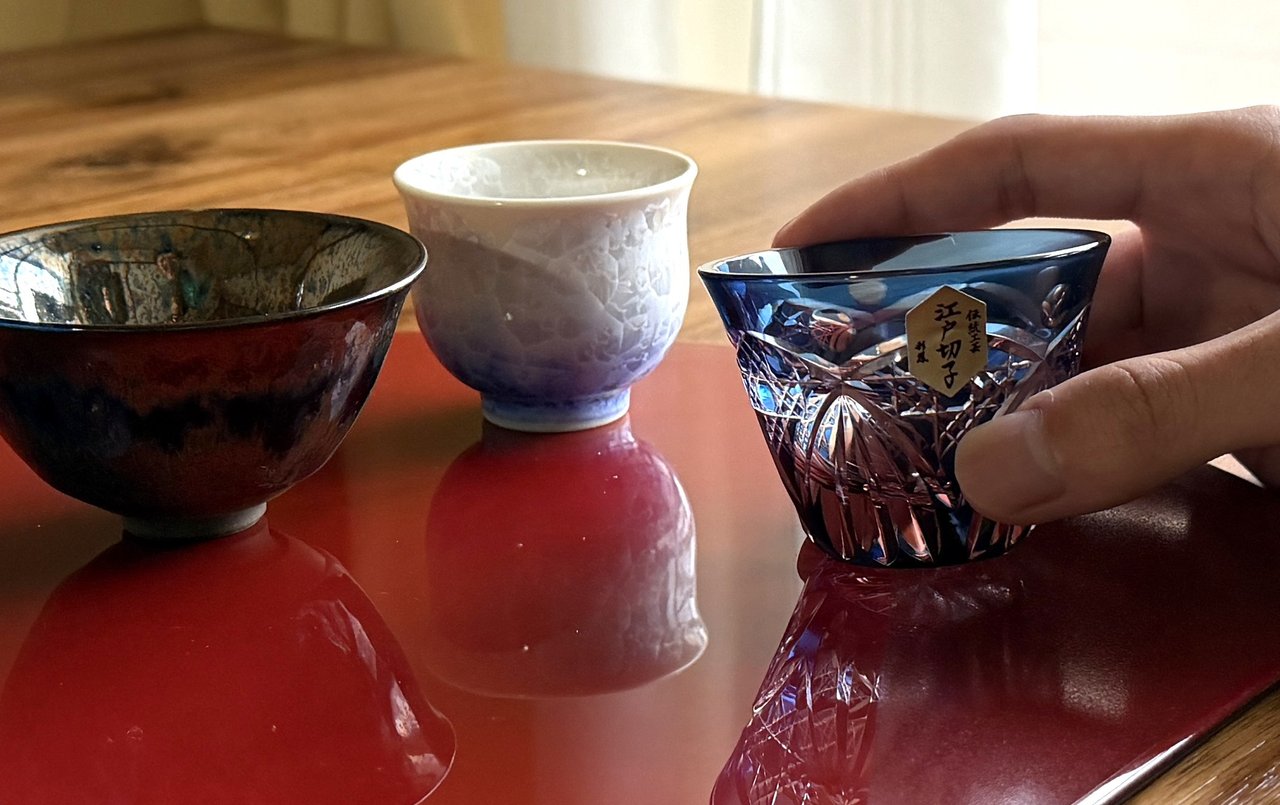
It is acceptable, even traditional, to own one beautiful guinomi and no other sake vessels at all.
The guinomi (ぐい呑) is, at first glance, a larger ochoko — and at second glance, an entirely different object. The name comes from gui-tto nomu, "to drink in one decisive swallow", and it speaks to the spirit of the cup. Where an ochoko is sized for the rhythm of pouring for others, a guinomi is sized for the rhythm of pouring for yourself.
The bowl is deeper. The capacity is roughly twice that of an ochoko, sometimes more. The wall is often thicker. The clay is often left more visible, more textured, less polished — many guinomi are signed by a single maker and carry the marks of the wheel and the kiln on their outside. They feel less like tableware and more like something you are choosing to hold.
This is why the guinomi is, for many serious drinkers, the most personal vessel in their collection. It is the one used at the end of a long day, with a single bottle taken slowly. It is the one travellers buy on temple visits and bring home. It is the one most often given as a gift between people who know each other well, because the giver is, in effect, choosing what kind of evening they wish for the receiver to have.
Guinomi from kilns associated with the wood-fired tradition — Bizen, Iga, Shigaraki — carry the marks of natural ash glaze and fire-flashing, and read as quiet, sculptural objects rather than tableware. Guinomi from Kyoto and Kanazawa kilns are often more refined, with painted decoration in the kutani or kyo-yaki manner.
Colour note. A guinomi is the place where personal preference matters most, because no one else will be drinking from it. If you are drawn to earth and the slow pace of evenings, the wood-fired browns and greys speak the closest. If you find yourself returning to deep, settled colour, the ash-glaze blacks and the iron-glaze blacks of the Bizen and Mino traditions are the long-quiet companions. Many drinkers, after years of trying brighter cups, end up drinking from the same dark guinomi every night without quite remembering when the change happened.
It is acceptable, even traditional, to own one beautiful guinomi and no other sake vessels at all.
In our collection: Edo Kiriko Guinomi — Octagonal Sakura, Blue & Pink
Katakuchi (片口) — The Spouted Bowl
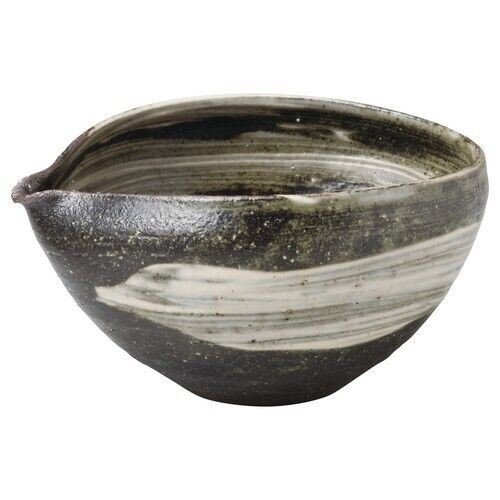
A bowl with one mouth — older than the tokkuri, and the form that has aged best into contemporary tables.
The katakuchi (片口) is, literally, "one mouth" — a small, open-topped bowl with a single pouring lip cut into the rim. It is older than the tokkuri in the village kitchen, where it was used to portion out shoyu, vinegar, and oil before being adopted, in the modern era, as one of the most flexible vessels of the sake table.
The katakuchi is the form that has aged best into contemporary Japanese tableware, partly because its open mouth allows the cold sake of summer to breathe — a quality that closed-neck tokkuri were not designed for. Junmai-shu, ginjo, and especially the lighter modern namazake often arrive at their best when poured first into a katakuchi, allowed to open for two or three minutes, and then drawn into smaller cups.
It also reads as a more contemporary object on a table. A small katakuchi in iron-glaze, set beside two guinomi, makes for a setting that does not feel ceremonial — which is exactly what most modern drinkers, who are not hosting a formal dinner but are simply ending an evening alone or with one other person, are looking for.
The pouring lip is the place where the maker's craft is most visible. A poorly made lip drips; a well-made lip releases the stream cleanly and stops it cleanly. Many of the katakuchi in our collection have lips formed by a single, deliberate press of the maker's thumb against the still-soft clay rim — the indent is not symmetrical, and the asymmetry is the signature.
Colour note. Iron-glaze katakuchi in deep brown and black are the most versatile, settling into both warm and cool palettes on a table. Celadon and white katakuchi feel cooler and pair particularly well with chilled summer sake. Lacquered katakuchi exist as well, in vermilion and in black, and these belong to a more formal table — the lacquer keeps cold drinks cold longer than ceramic does.
Many drinkers, after a few years, find that a katakuchi and two guinomi has quietly replaced the tokkuri-and-ochoko set as their everyday rhythm. There is no rule against this.
In our collection: Shigaraki Katakuchi Set — Kuroiso, Three Pieces
Sakazuki (盃) — The Flat Cup of Ceremony
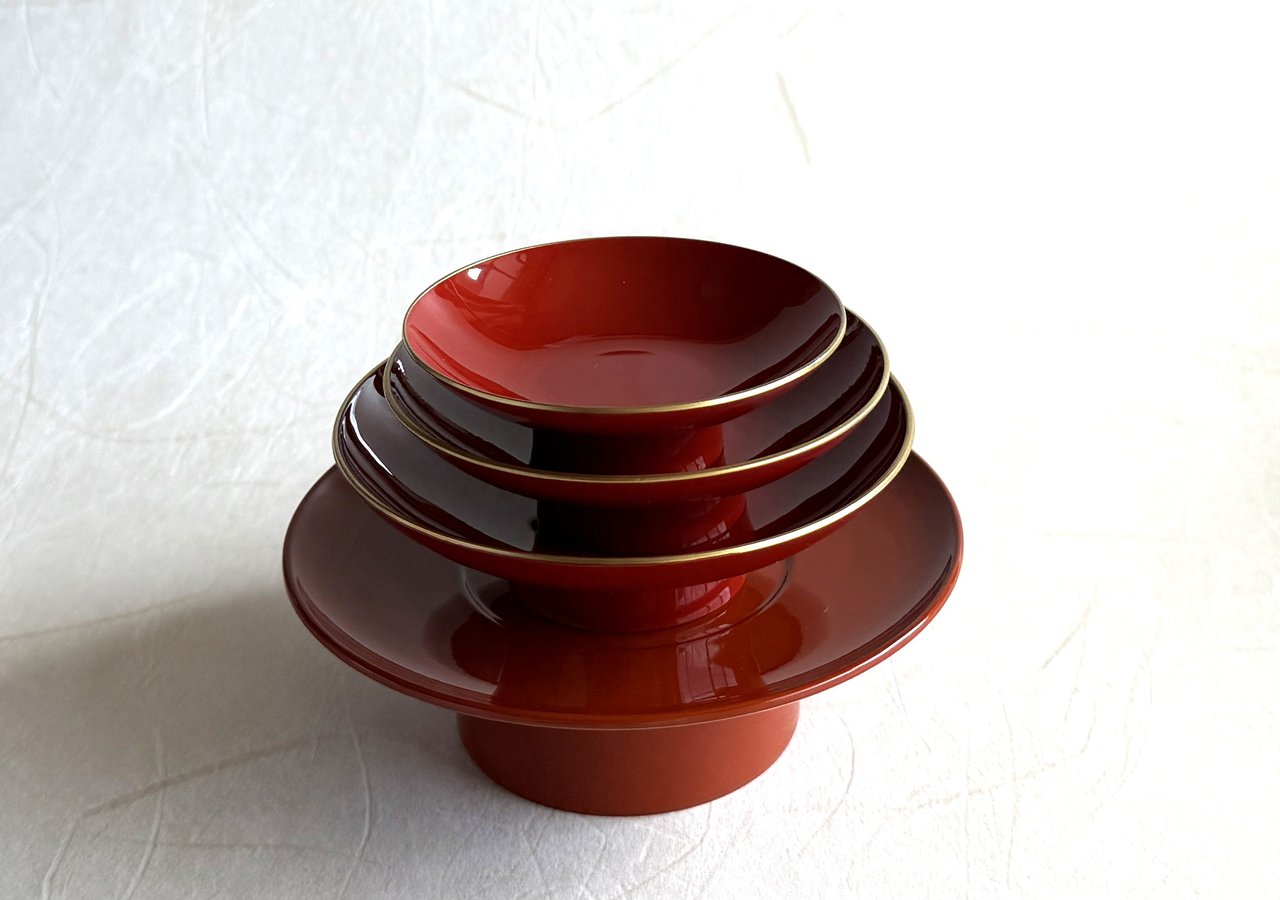
The black of urushi lacquer is not the absence of colour but the accumulation of layers — depth that the eye reads as substance.
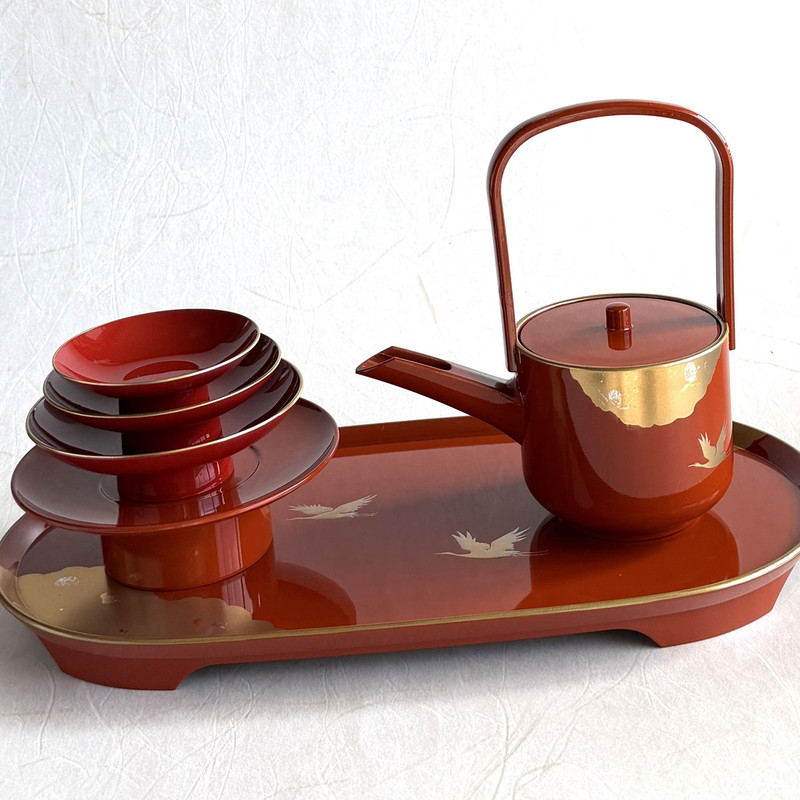
The sakazuki (盃) is the flat, shallow, plate-like cup that most readers will recognise from photographs of Shinto weddings — the san-san-ku-do exchange, where bride and groom share three sips from each of three lacquered cups stacked together.
The sakazuki is the oldest form of all the cups discussed in this guide. Before the small ochoko, before the personal guinomi, sake was drunk from broad, low cups passed between people. The flatness is not a stylistic choice; it is an invitation. A flat cup must be held with both attention and respect, because the sake is so close to the rim that any sudden movement spills it. To drink from a sakazuki is to slow down. To pass one to another person is, in the older grammar of the table, to honour them.
In modern homes, sakazuki are most often used for the New Year's first cup, for celebrations, and for moments where the formality of the vessel is part of the ritual — a promotion, a milestone birthday, the first cup poured to an absent friend.
The materials divide into two families. Ceramic sakazuki, often unglazed or lightly glazed, carry the weight of pottery and feel of the earth. Lacquered sakazuki, almost always in vermilion (shu-nuri) or in black (kuro-nuri), are warmer to the lip, lighter in the hand, and traditional for the most formal occasions.
The lacquered sakazuki is one of the places where Japanese craft most fully expresses what dark colour can do. A well-made kuro-nuri sakazuki has a depth that is not flat black but rather a black that holds light beneath its surface — the result of many layers of natural urushi lacquer, each polished, each adding a millimetre of depth that the eye reads not as colour but as substance. A vermilion sakazuki is brighter, more festive, more declaratively celebratory; a black sakazuki is quieter, more reflective, and reads as the cup of a more private celebration. Many households keep one of each, used on different occasions for reasons that the household understands without needing to articulate.
Colour note. For a first sakazuki, vermilion lacquer is the more traditional festive choice and reads most readily as ceremonial. Black lacquer is the form chosen by those who prefer quieter ritual; it is also the form most often given as a personal gift, because its restraint asks the receiver to bring their own meaning to the cup. Ceramic sakazuki, particularly in white porcelain with cobalt patterns or in the deep black of temmoku glaze, are the everyday alternative.
A lacquered sakazuki should never be washed in a dishwasher and should be dried gently with a soft cloth. Treated this way, it will last decades, and its black or red will deepen rather than fade.
In our collection: Yamanaka Otoso Drinking Set — Flying Crane, Vermilion, and in black, Yamanaka Sake Cup — Kurourushi & Gold.
Reading the Material — Porcelain, Stoneware, Tin, Glass, Lacquer
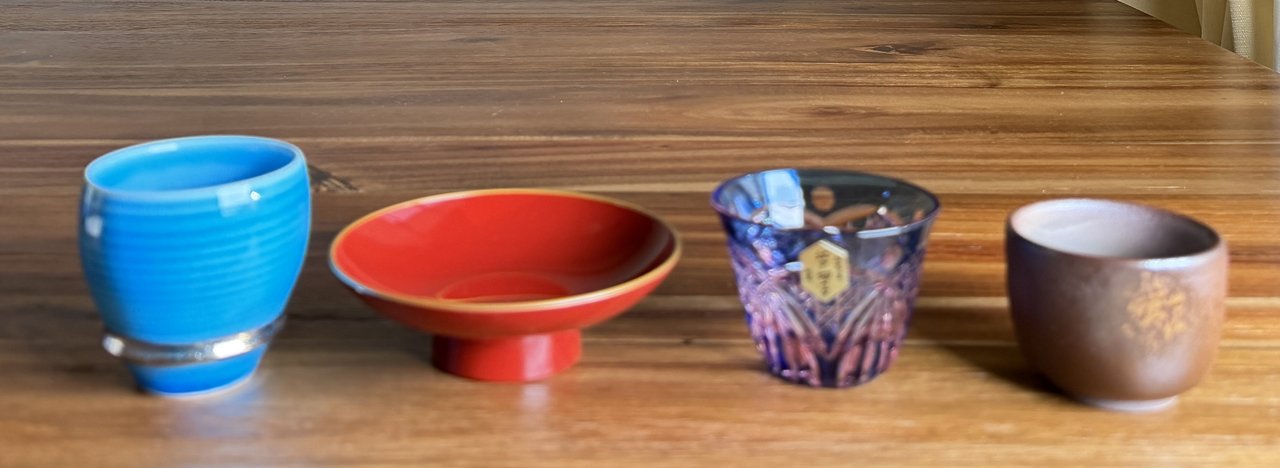
The shape is the first conversation. The material is the second — and often the more important one.
The shape of the vessel is the first conversation. The material is the second, and often the more important one.
Porcelain (磁器, jiki) is the lightest, smoothest, and most acoustically clear of the materials. A porcelain ochoko held to the ear and gently struck with a fingernail will ring faintly. The rim can be drawn extremely thin — almost as thin as paper — which is why porcelain delivers sake most cleanly to the lip and lets aromatic ginjo and daiginjo sake show their full upper register. The classical kilns are Arita, Hasami, and Kutani.
Stoneware (陶器, tōki) is heavier, more porous in feel, and warmer in temperature transfer. The walls are usually thicker, and the clay body is often left visible at the foot. Stoneware rounds the edges of the sake's character — the high notes recede slightly, the body becomes fuller, the finish lengthens. Bizen, Shigaraki, Iga, Tokoname, and Mashiko are the kilns most associated with the form.
Tin (錫, suzu) is the quiet specialist of the sake world. Tin tokkuri and tin cups have been made in Osaka and Toyama for centuries, and the metal is prized for one specific quality: it is said to soften the edges of sake without changing its character. The molecular reason is debated, but the experienced result is consistent — many drinkers describe sake from a tin cup as feeling rounder and more settled. Tin also conducts temperature with unusual evenness, which is why it has remained a specialist's choice for warm sake.
Glass (硝子, garasu) is the modern entry, and a serious one. Glass cools quickly, holds cold beautifully, and shows the colour of the sake without interference. For chilled summer sake — particularly namazake and unfiltered nigori — a glass tokkuri or katakuchi is often the most honest vessel. Edo Kiriko (江戸切子) cut-glass guinomi from Tokyo are a contemporary form that bridges traditional craft and modern cold-drinking culture; we will explore these in a dedicated essay.
Lacquer (漆, urushi) appears most often as sakazuki and as the inner surface of warming bowls. It is the warmest material against the lip — the only one that does not feel cold at first touch — and the only one that adds true depth of dark colour. The black of lacquer is unlike any other black in the kitchen: it is not the absence of colour but the accumulation of layers, each one polished and built upon, until the surface holds a depth that ceramics and metals cannot reach.
A small note on dark colour. Black sake vessels are not a contemporary trend but one of the oldest preferences in the tradition. Bizen black, Mino temmoku, kuro-nuri lacquer, smoked tin — each is a different kind of black, with a different history, and each was chosen because dark vessels tend to draw attention away from the appearance of the sake and back toward the experience of drinking it. The drink is not put on stage; it is held in private.
Temperature and the Vessel — The Quiet Pairing
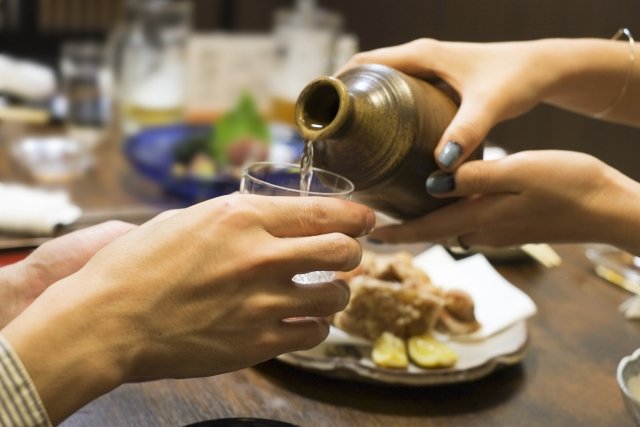
Almost every temperature band has its own name in Japanese — and the names are not technical but poetic.
The final consideration is temperature, because temperature, more than any other variable, decides which vessel is right for the evening.
What makes Japanese sake temperature culture distinct, and what is worth unraveling for the first-time buyer, is that almost every temperature band has its own name — and the names are not technical but poetic. They were given by people who had spent enough hours with the drink to notice that 40°C and 45°C are not the same evening, and that the difference deserved a word.
There is a quiet moment, when sake passes from one temperature to another in the cup, where the vessel seems to disappear and the season briefly enters the room. The names that follow are the words for those moments.
Warm — 40°C to 50°C
Atsukan (熱燗, ~50°C) is "hot warmed sake" in the literal sense, but the older meaning is closer to "the warming that braces". This is the temperature for cold winter nights and for sake with body — junmai and honjozo varieties whose character opens with heat. Best from a tokkuri with a narrow neck, into ceramic ochoko with a moderately thick rim. The narrow neck preserves the heat during the pour; the thicker rim slows the loss of warmth from cup to lip. Tin tokkuri perform exceptionally here — the metal holds warmth with unusual evenness — but ceramic tokkuri are the everyday choice.
Jōkan (上燗, ~45°C) is "upper warm" — the everyday register of warmed sake at home. Slightly below the brace of atsukan, the aromatic top of the sake stays present rather than burning off.
Nurukan (ぬる燗, ~40°C) is "tepid warm" — closer to the temperature of the body, and the favourite of many serious drinkers because it is the temperature at which a good junmai shows the most balance. The Japanese name carries no judgement of the lower heat; nurui in everyday Japanese can mean lukewarm in a flat sense, but in the sake table it is a praise word for restraint.
Body & Room — 20°C to 37°C
Hitohada-zake (人肌酒, ~37°C) translates as "person-skin sake" — sake at the temperature of human skin. This is one of the more poetic names in the Japanese culinary vocabulary, and it captures something true: at this temperature, the sake feels neither cold nor warm in the mouth, and the rice and koji notes are most evenly balanced. It is the temperature at which most beginners are first invited to taste a new sake, because it hides nothing.
Jō-on (常温, ~20°C) is simply "ordinary temperature" — room temperature, with no warming or chilling. Best from a porcelain ochoko or a small guinomi, where the wall does not introduce its own thermal opinion. Glass also reads beautifully here, particularly for junmai-shu with high acidity.
Cold — 5°C to 15°C
Suzubie (涼冷え, ~15°C) is "cool-chilled" — the lightest of the cooling bands, with the kanji suzu (涼) suggesting the relief of a cool breeze rather than cold itself. This is the temperature for late spring and early autumn evenings, and porcelain or thin glass shows it well.
Hanabie (花冷え, ~10°C) is "flower-chilled" — the temperature at which cherry blossoms are said to feel the spring cold. The naming is seasonal and tender; the temperature is best for ginjo and daiginjo sake, which need cool air to keep their delicate aromatics intact. Glass and porcelain are the natural choices.
Yukibie (雪冷え, ~5°C) is "snow-chilled" — the coldest of the conventional sake temperatures, named for the touch of snow on skin. Reserved for the cleanest, most aromatic sake, often namazake and the lighter daiginjo. Calls for porcelain, glass, or a katakuchi that can be quickly poured before the temperature shifts. A heavy stoneware vessel will warm yukibie sake by several degrees within a minute or two, which may or may not be what you want.
There is no rule that says you must own one set for each temperature. A single katakuchi in iron-glaze stoneware, paired with two ochoko in white porcelain, will handle nearly every situation a beginner is likely to meet. The further refinements come over years, as you discover which of your sakes asks for which temperature, and which of your vessels asks for which sake.
Reading the Vessel — Foot Rings, Signatures, and the Marks of the Kiln
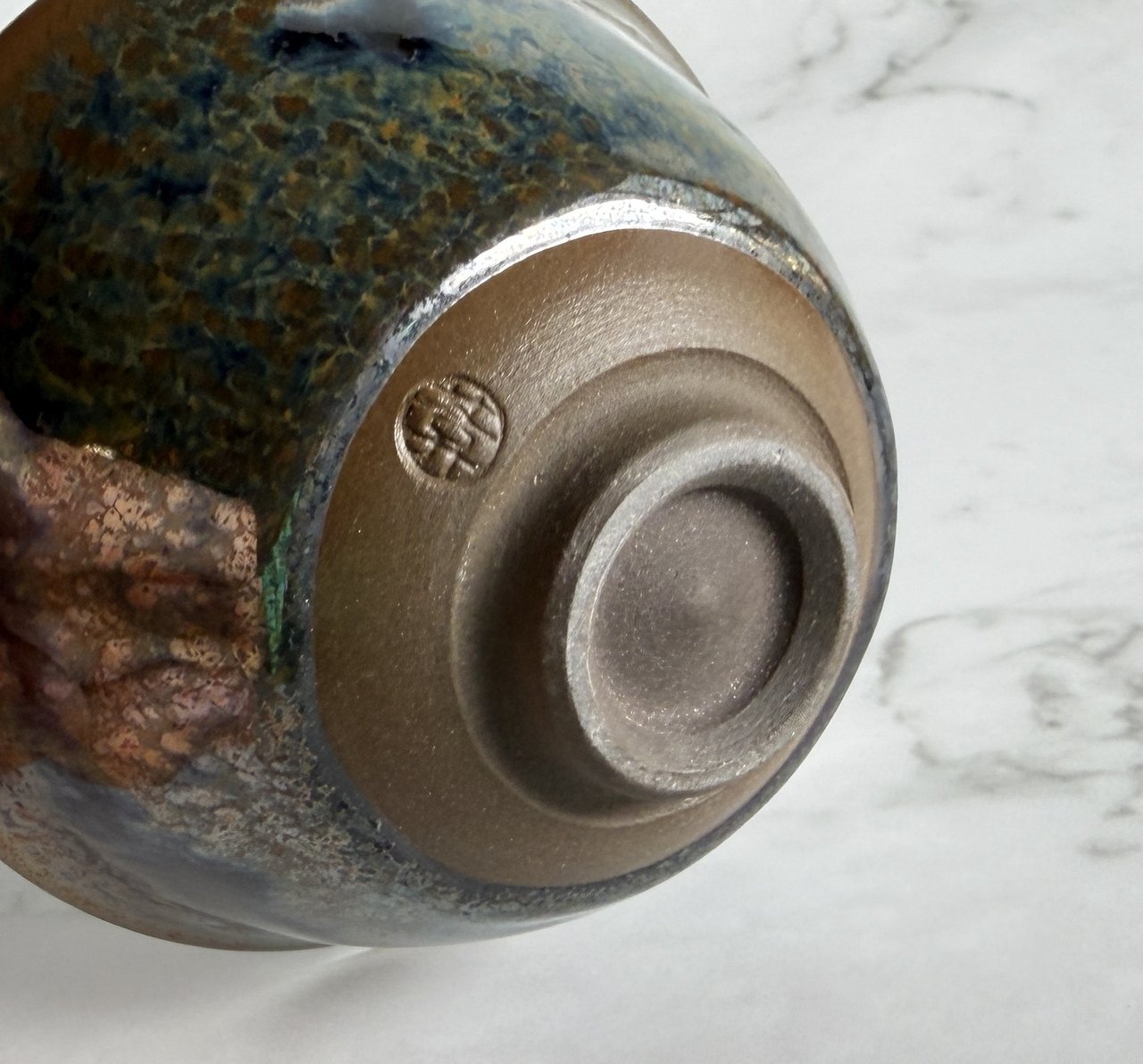
Turn a piece upside down. The maker's hand is most plainly visible on the underside.
A first-time buyer of Japanese sake vessels will, sooner or later, turn a piece upside down. This instinct is correct. The underside of a sake cup or tokkuri is where the maker's hand is most plainly visible, and learning to read it is the quiet pleasure that separates collecting from buying.
The kōdai (高台), or foot ring, is the small raised circle at the base of the cup or carafe. It is the part that touches the table, and the part that is left, in most pieces, partially or wholly unglazed. The unglazed portion is not an oversight; it is the window through which the clay body of the vessel can be read. A Bizen guinomi will show a deep iron-rich brown clay; an Arita porcelain ochoko will show a fine, sugar-white body; a Shigaraki piece will show coarser sand and small stones embedded in the foot. Many serious collectors will glance at the kōdai before they look at the surface, because the kōdai cannot be hidden by glaze and tells the truer story of the kiln.
The mei (銘), or signature, may be inscribed or stamped on the underside of pieces by named makers. Studio potters from the established kilns often sign their work with a small kanji stamp pressed into the wet clay before firing; the impression is then either glazed over (and visible only as a slight texture) or left unglazed for clarity. Older pieces and pieces from anonymous workshops may carry only a small kiln mark, or no mark at all. The presence of a mei does not make a piece more beautiful; it makes the piece more locatable in the long history of the form.
The kiln-flash and ash deposits are not marks of the maker's hand but of the kiln itself. In wood-fired traditions — Bizen, Iga, Shigaraki — the flame and the ash from burning pine fall on the pieces during the firing, and the patterns left behind are the signature of that particular kiln on that particular day. A Bizen piece may carry a goma (sesame) pattern of small ash deposits on the shoulder, a hidasuki band of red where rice straw was wrapped against the clay, or a deep sangiri charcoal blackness where the piece sat closest to the firebox. These are not flaws; they are the kiln writing on the vessel, and no two pieces will carry the same writing.
For the first-time buyer, the practical guidance is small and modest: turn the piece over, look at the foot ring, and feel the weight in the hand. A vessel that has been well made will feel slightly heavier than expected at the base — the maker has thickened the clay where it meets the table to prevent tipping — and slightly lighter at the rim, where the clay has been drawn thin to meet the lip. The balance, once you have felt it in three or four good pieces, becomes easy to recognise everywhere.
Choosing Your First Set — A Map, Not a Recommendation
There is no single right first set. There are, instead, several traditional combinations, each suited to a different rhythm of drinking. The most common are:
One tokkuri and two ochoko — the classical pairing, suited to warm sake and to evenings shared with one other person. This is the form most photographs of izakaya tables will show, and the form that pairs most naturally with the wider Japanese tradition.
One katakuchi and two guinomi — the contemporary pairing, suited to chilled and room-temperature sake, and to a quieter evening that does not require warming. This combination has become, for many modern drinkers in their thirties and forties, the everyday rhythm.
One sakazuki, kept separately — the ceremonial vessel, used for the New Year's first cup, for milestones, for moments where a deliberate, slow drink is what the evening calls for. A black-lacquer or vermilion sakazuki kept in a small drawer is one of the most quietly meaningful objects a sake drinker can own.
One guinomi alone — for the drinker whose evenings are private. This is, surprisingly often, the most loved configuration in a long-term collection. A single piece, chosen with care, in a colour and material the drinker returns to year after year.
For those choosing a piece as a gift to themselves, a quiet observation: the act of selecting a sake vessel is, in Japanese tradition, treated with the same attention as the act of selecting a tea bowl. It is not an indulgence. It is the act of choosing what your evenings will look like for the next decade. The pleasure is in the choosing as much as in the drinking, and the pleasure of choosing for yourself is, in our view, one of the more underrated forms of attention a person can give their own life.
A Note from the Shop
This article maps the eight foundations of a Japanese sake set — the tokkuri, the ochoko, the guinomi, the katakuchi, the sakazuki, the materials and temperatures that connect them, and the small marks on the underside of each piece that locate it in the long history of the form. It is meant as a beginner's map, drawn so that the wider vocabulary becomes navigable rather than overwhelming.
There is, of course, more. Edo Kiriko cut-glass guinomi from Tokyo, tin tokkuri from the Osaka and Takaoka traditions, Bizen wood-fired pieces from Okayama, lacquer sakazuki from Wajima and Yamanaka, the iron-glazed Mino temmoku tradition, and the porcelain studios of Arita and Hasami — each of these deserves its own essay, and each will be the subject of a dedicated article in the months to come.
A small practical note for the new owner: porcelain and stoneware pieces are dishwasher-safe in most modern machines, but the ash-glazed and unglazed wood-fired pieces (Bizen, Shigaraki, Iga) prefer hand-washing in warm water without detergent, which lets the kiln-flash patterns deepen rather than dull over the years. Lacquer pieces should always be hand-washed and dried with a soft cloth. Tin pieces should be rinsed quickly, never scrubbed with abrasive cloths, and dried by hand. Treated this way, every piece in this guide will outlive its first owner and become more, not less, beautiful with use.
— from Osaka, Team Manekineko-Ai
Pieces in Our Collection
A few examples of pieces in our collection that suit a first sake set in the rhythms above. These are examples, not recommendations.
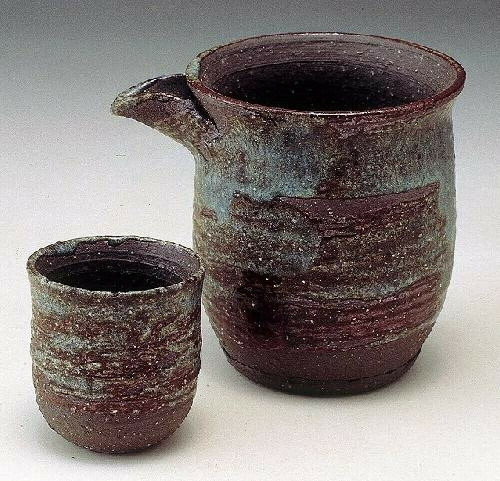
Pick 1 — Shigaraki Sake Set — Tokkuri & Guinomi, Black Gradation. A wood-fired Shigaraki set: one tokkuri and two guinomi, the black gradient glaze deepening from rim to base. The texture of the wheel and the kiln is left visible — the piece holds the evening as much as the sake. (See the set)
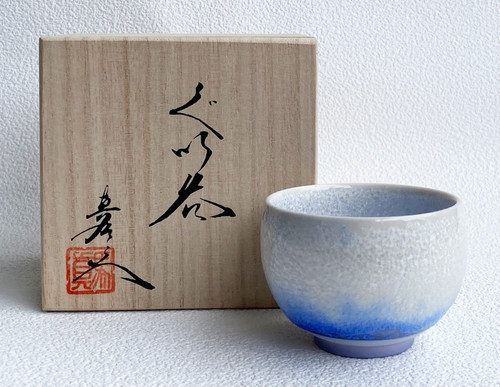
Pick 2 — Arita Aizome Guinomi — Shinemon Kiln, with Wooden Box. A single hand-painted guinomi in the Aizome (indigo) tradition, the snow-white surface deepening into cobalt at the base. The wooden box, signed in calligraphy, makes this the kind of piece chosen quietly for oneself. (See the piece)
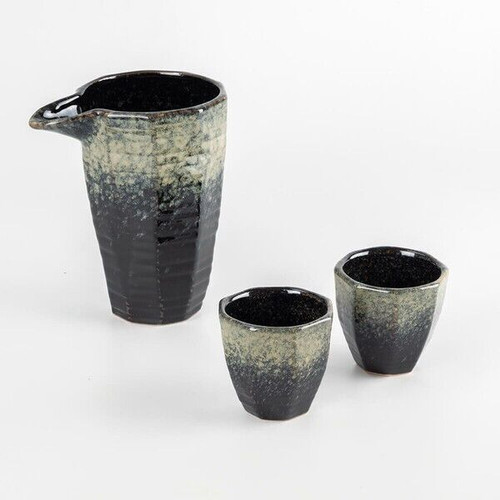
Pick 3 — Mino Sake Set — Katakuchi & Guinomi, Tenmoku Nagashi. A modern Mino set: one katakuchi spouted bowl and two guinomi, the iconic temmoku-nagashi glaze flowing from pale cream-green at the top to a deep, settled black at the base. A rhythm many contemporary drinkers gradually settle into. (See the pair)
Frequently Asked Questions
Q: What is the difference between a tokkuri and a katakuchi, and which should a beginner choose first?
The tokkuri is the closed-neck carafe traditionally associated with warm sake; its narrow neck preserves heat. The katakuchi is the open-mouth spouted bowl, originally a kitchen vessel, that has aged into one of the most flexible vessels of the modern sake table — particularly suited to chilled and room-temperature sake. For a beginner who drinks mostly chilled sake, a katakuchi is often the more useful first piece. For a beginner who drinks mostly warm sake, a tokkuri is the older companion. Many drinkers eventually own both, and many discover after a few years that the katakuchi quietly does most of their evening's work.
Q: Do I really need different cups for warm and cold sake?
Strictly speaking, no. A single ceramic ochoko of moderate rim thickness will handle the full temperature range a beginner is likely to encounter. Refined practice does prefer thinner porcelain or glass for chilled sake (which keeps the temperature stable for longer) and thicker stoneware or tin for warm sake (which holds heat against the lip). But these are refinements, not requirements. One well-chosen pair of cups, used across all temperatures, is a perfectly traditional way to begin.
Q: How do I warm sake at home without a special device?
The traditional method is the yu-doko: place the filled tokkuri in a tall, narrow container of hot water (not boiling) for two to three minutes for nurukan (~40°C), three to four for jōkan (~45°C), and four to five for atsukan (~50°C). The narrow neck of the tokkuri keeps the temperature stable once warmed. Many serious drinkers prefer this slow water-bath method to the microwave, which heats unevenly and can scorch the upper edge of the sake. Tin tokkuri are particularly forgiving here, conducting heat with unusual evenness.
Q: Is it acceptable to buy a sake set as a gift to myself?
Yes — and in Japanese tradition, it has long been considered an act of attention rather than indulgence. The act of selecting a sake vessel is treated with the same care as the act of selecting a tea bowl: it is the act of choosing what your evenings will look like for years to come. A guinomi chosen for oneself is, in particular, one of the most personal objects in Japanese craft. The pleasure of choosing for yourself is part of the pleasure of the drink itself.
Q: How do I care for a lacquered sakazuki?
Lacquered pieces are durable but require gentle handling. Hand-wash only, in warm water with a soft cloth and no detergent (or, if needed, a very small amount of mild dishwashing liquid). Never use a dishwasher, abrasive sponge, or boiling water. Dry immediately with a soft cloth. Avoid prolonged soaking and prolonged direct sunlight. Cared for this way, a well-made kuro-nuri or shu-nuri sakazuki will last decades, and the colour will deepen rather than fade with use.
Q: Are tin sake vessels safe? They sound unusual to first-time buyers.
Tin (suzu) sake vessels have been made in Japan for centuries and are entirely safe for sake. The metal is non-reactive at the temperatures sake is served, food-safe, and traditionally prized for its claimed ability to soften the edges of the drink. The two main centres are Osaka (where Osaka Suzuki has produced tin ware since the 17th century) and Toyama (the Takaoka tradition). Tin pieces should be rinsed in warm water, never scrubbed with abrasive cloths, and dried by hand. They will develop a soft, even patina over time that many collectors prefer to a polished finish.
Q: What does it mean when a guinomi or tokkuri is signed?
A signed piece (mei, 銘) carries the small kanji stamp or inscription of the maker, usually pressed or painted on the underside before firing. Studio potters from the established kilns — Bizen, Shigaraki, Mashiko, Kyo-yaki and others — commonly sign their pieces. The presence of a signature does not make a piece more beautiful, but it does locate it: you can trace the maker, the studio, sometimes the era. Unsigned pieces are not lesser; they are simply pieces from anonymous workshops, which is the older and more common form of Japanese craft. The signature is information, not a guarantee of quality.
Q: Are there sake vessels that are particularly suited to gift-giving?
Lacquered sakazuki — whether vermilion or black — are the traditional gift for milestone occasions: weddings, retirements, milestone birthdays, the New Year. A signed guinomi is the traditional gift between people who know each other well, because the giver is, in effect, choosing what kind of evening they wish for the receiver to have. A tokkuri-and-ochoko pair suits a gift to a couple or a new household. For a gift to oneself, the tradition is broader: the cup or carafe that the giver returns