
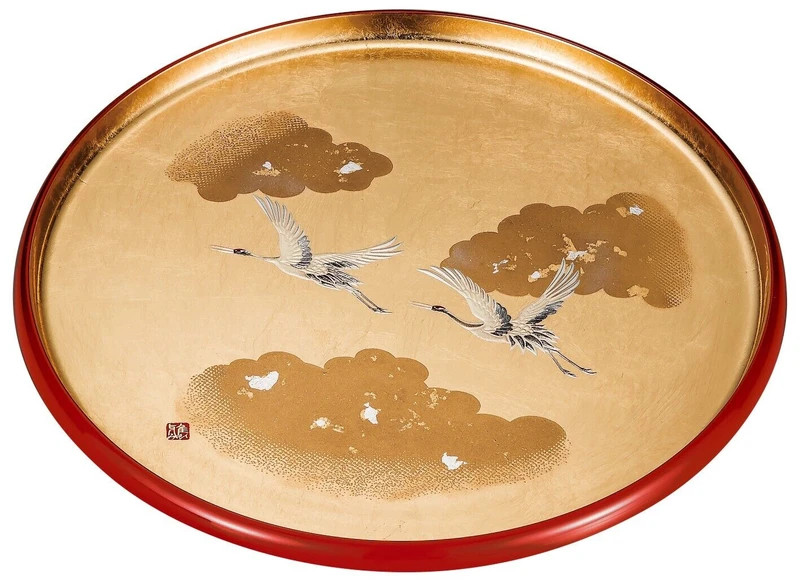
A pair of cranes painted facing each other is a quiet promise of a long life shared.
If you have ever picked up a Japanese piece and wondered why a particular shape appears on it — a pair of cranes, a scrolling vine, a small cluster of gourds — there is almost always an answer. These shapes are not chosen for prettiness alone. They are wishes — visible, deliberate, repeated for centuries because the people who chose them wanted to say something the words around the object could not.
This guide walks through seven of the most cherished motifs in Japanese craft — what each one means, when it has traditionally been given as a gift, and how to read its colours. The goal is not to choose for you, but to make the vocabulary easier to read, so that what you choose — for yourself or for someone else — carries the meaning you intend.

A Note Before We Begin — How to Read These Symbols
Long before commercial decoration, Japanese visual culture treated nature as a kind of vocabulary. A pine tree was not just a pine tree — it was endurance, because pines stay green through winter. A crane was not just a bird — it was long life, because the species reaches notable age and is famously monogamous. The scholar’s word for this is mitate (見立て), meaning to see one thing as another.
Many of the motifs in this guide arrived in Japan from China — the crane, the turtle, the scrolling vine, the three friends of winter. They came through scrolls, Buddhist temple decoration, and trade. But Japan rarely keeps a borrowed object unchanged. Over centuries, each motif was simplified, rendered in local materials, paired with native plants and animals, and slowly turned into something distinctly Japanese.
Two further things help when reading these motifs.
First, colours carry their own meanings. The same motif painted in red and white reads differently from one rendered in indigo, gold, or vermilion, and we note these shifts under each motif below.
Second, combination matters. A crane standing alone says long life. A crane painted with a pine says long life and endurance together. A crane with pine and turtle stacks three wishes into a single image. Many traditional pieces are layered this way — the more attentively you look, the more is being said.
To choose a piece with these motifs, then, is closer to choosing words than choosing wallpaper.
Tsuru (鶴) — The Crane That Promises a Thousand Years
Two cranes facing each other is one of the oldest written wishes in Japan.
The crane is the most immediately legible of the auspicious motifs. Two readings sit behind its symbolism. The first comes from Chinese tradition, where the crane is said to live a thousand years and to serve as a vehicle for sages travelling between heavenly realms. The second is a quieter, local observation: in nature, cranes form long pair-bonds and are often seen returning to the same partner across seasons. Over time, the two readings braided together — long life and faithful marriage — into a single motif. This is why cranes are so often painted in pairs, facing each other, sometimes with a single shared landscape between them.
Colour note. The classical reading uses red and white (紅白, kō-haku) — the colours of formal congratulation in Japan, the rising sun on white linen, the register most often seen at weddings, milestone anniversaries, and seasonal gifts. In gold, especially against black lacquer, the crane reaches the most formal register: imperial, ceremonial, restrained. In quiet indigo (藍, ai), it suggests a more inward kind of fidelity, closer to mature affection than wedding-day excitement.
In gift tradition. Cranes have long been chosen for weddings, milestone anniversaries, and long-life celebrations. In our collection, the motif appears on hand-painted Kutani teacup pairs from Ishikawa Prefecture, on Arita porcelain, and on lacquerware in the most formal sake services — including the Yamanaka lacquer tray shown above, with its gold crane drawn against deep black urushi.
For more on how the crane appears specifically within Arita ware — its painting techniques, its pairings with pine and bamboo — see our Arita Patterns guide.
Kame & Minogame (亀・蓑亀) — Ten Thousand Years on a Slow Back
If the crane carries a thousand years, the turtle carries ten thousand.
The turtle is the second pillar of Japanese longevity symbolism. Where the crane offers a thousand years, the turtle is said to offer ten thousand — and the two are often painted together as a complete wish for a long life lived patiently. The turtle’s slowness is part of its meaning: it is not the fast, athletic kind of longevity but the settled kind — the longevity of someone who has put down roots.
In Japanese craft, the turtle is often drawn with a flowing tail of seaweed trailing from its shell. This is a minogame (蓑亀) — a turtle so old that algae has grown on its back and become part of it. The seaweed-tail makes the message unmistakable: this is age as wealth, not age as decline.
The turtle also extends into pure geometry through the kikkō (亀甲) pattern — a hexagonal tiling drawn from the look of a turtle’s shell — which carries the same longevity wish in a more abstract, contemporary-feeling form.

Colour note. In green-glazed Oribe ware, the turtle reads as Vitality — ongoing, fresh life, the colour of moss on a temple step. In gold against a dark ground, it leans toward Wisdom and dignified longevity, the register most often seen on lacquer prepared for milestone birthdays. On clean white porcelain with quiet indigo line-work, it sits between the two — formal but not heavy.
In gift tradition. Turtle motifs are associated with milestone birthdays — kanreki (60), koki (70), beiju (88) — and with the opening of a new business or family workshop, where what one wishes the recipient is steady ground. The motif appears in our collection on Arita dishes (such as the turtle-shaped minogame piece above), on lacquer lidded boxes, and on tableware carrying the kikkō hexagonal tiling.
The hexagonal kikkō pattern, including its layering with other motifs, is covered in more detail in our Arita Patterns guide.
Karakusa (唐草) — The Vine That Never Stops Growing
A line that never ends, drawn around your morning rice bowl.
If the crane and turtle are the most immediately recognisable Japanese motifs, karakusa — the scrolling vine — is the most everyday. It runs along the rims of porcelain, spirals across textiles, frames lacquer trays, climbs the borders of formal screens. Most Japanese households use karakusa-decorated objects daily without thinking to name the pattern. Its symbolism is as continuous as its line: the vine that never breaks stands for unbroken continuation — of family, of relationship, of the household itself.
Karakusa travelled a long way to reach Japan. Its origins lie in the acanthus and palmette motifs of ancient Greece and Mesopotamia, carried east along the Silk Road through Persia and India. By the Nara period, in the eighth century, it had arrived in Japan with Buddhist temple decoration, where it found a particular home and never quite left. Over the centuries that followed, Japanese painters and lacquer-workers stripped the motif of its original specifics — losing the exact botany, keeping the gesture — until the scrolling line itself became the meaning. What Japan kept was not the leaf but the gesture, and Japanese aesthetics has always preferred the gesture to the literal.

Colour note. Karakusa is most often seen in deep crimson (赤, aka) — the colour of madder root, the dye that travelled the same Silk Road as the vine itself. The red carries warmth and vivid prosperity, and is the colour of countless old furoshiki wrapping cloths and the karakusa-zome shop noren once draped over every Japanese front door. In gold, layered over black lacquer, karakusa signals Prosperity at its most formal and appears on wedding registries and lifetime-anniversary pieces. In indigo (藍, ai), particularly on porcelain, the same vine reads more quietly — a patient kind of Faithfulness suited to everyday use.
In gift tradition. Karakusa is among the most widely given of Japanese motifs, traditionally chosen for weddings, housewarmings, and any occasion where the wish is that something — a household, a marriage, a lineage — continues unbroken. The motif appears in our collection on Arita pair yunomi, on textile furoshiki, and on Kyoto lacquer boxes.
The Arita-specific styling of karakusa is treated in our Arita Patterns guide.
Seigaiha (青海波) — Calm Waves That Keep Returning
The same wave, drawn over and over, becomes a wish for peace that does not end.
Seigaiha is a pattern of repeating semicircles arranged like overlapping waves. Like karakusa, its meaning lies in repetition: the wish here is not for a single dramatic happiness but for steadiness — the kind of peace that does not run out. The pattern’s geometric calm has made it one of the most quietly modern of all Japanese motifs; it sits comfortably on tableware, paper, and noren in the most contemporary households.
The pattern takes its name from a court dance of the same name — seigaiha, performed in the ancient bugaku tradition of Japanese imperial court music. When you see waves on a tea bowl or a tapestry today, you are looking at a frozen moment from that thousand-year-old dance.

Colour note. Seigaiha’s classical register is deep indigo (藍色, ai-iro) — the indigo of aizome, what nineteenth-century writers abroad began to call simply “Japan blue”. Here it evokes calm and stability, the historical reading of the pattern, traceable to the bugaku costume itself. In gold, the same pattern leans toward Prosperity, suitable for business openings and formal celebrations. On pure white textiles or paper, seigaiha sits at its most quiet — the wish present, but understated.
In gift tradition. Seigaiha is associated with housewarmings, weddings, and other moments of new beginning, where what is wished is steadiness rather than fanfare. The motif appears in our collection on indigo-dyed noren, on porcelain tableware (such as the hand-carved Arita seigaiha sake cup shown above), and on washi paper goods.
For other geometric Japanese motifs — shippō, asanoha, yagasuri — see our Arita Patterns guide.
Hyotan (瓢箪) — Six Gourds for a Life Without Illness
A wordplay carved into a thousand sake bottles: six gourds, no illness.
The hyotan — the gourd, often dried and used as a container — is one of the most affectionate motifs in Japanese craft. It carries no royal pretensions and no grand cosmology; it simply wishes the recipient good health, in a way that is characteristically Japanese: through a pun, a memory of war, and a small everyday object.
There are two stories braided into the hyotan motif.
The first is the wordplay. In Japanese, six gourds is written 六瓢 and pronounced mu-byō. By a happy coincidence, no illness — 無病 — is also pronounced mu-byō. For centuries, painters and lacquer-workers have hidden this pun in plain sight: six small gourds tucked into the corner of a tea bowl, six brushed onto the band of a sake cup, six embroidered onto a fukusa gift cloth. The pun is recognised at a glance by anyone who reads Japanese, and it remains one of the warmest greetings in the auspicious-motif vocabulary.

The second story is the warlord. Toyotomi Hideyoshi, the great unifier of late sixteenth-century Japan, used a thousand-gourd standard — sennari byōtan, 千成瓢箪 — as his personal banner. Each successful battle added another small gourd to the cluster. To paint a hyotan, then, is to layer a wish for health onto a cultural memory of triumph. The tones of modern hyotan motifs are usually quieter than that history sounds: the pieces feel domestic, almost intimate, despite their martial pedigree.
Colour note. The hyotan’s classical register is vermilion (朱, shu) — the lacquer red of torii gates, the most life-claiming colour in the Japanese palette. In gold over black lacquer, it leans toward Prosperity — a household with both health and means. On pure white porcelain, the form alone carries the wish without colour noise: an understated register suited to quieter occasions.
In gift tradition. Hyotan is the classical health-wishing motif of Japanese craft, given particularly for kaiki-iwai (recovery gifts), milestone-longevity celebrations, and as a quiet New Year piece. The motif appears in our collection on small lacquer sake sets, on Arita porcelain, and on Echizen lacquer owan painted with the six-gourd cluster.
Takarazukushi (宝尽くし) — A Treasure Chest of Wishes
When one symbol is not enough, the Japanese gather many — and call it a treasure-pile.
Takarazukushi is, in a sense, the most generous of the auspicious motifs: it is the one to reach for when no single wish feels sufficient. The pattern is a gathering of small auspicious objects — a treasure-pile, in the literal translation — assembled into a single decorative composition. Different painters, different schools, and different periods have varied the exact contents, but the spirit is consistent: all the kinds of fortune, none chosen above the others.
A typical takarazukushi composition might include:
- Uchide-no-kozuchi (打ち出の小槌) — the small mallet that produces whatever is wished for when struck
- Kakure-mino (隠れ蓑) — the cloak of invisibility, which protects from misfortune
- Hōju (宝珠) — the wish-fulfilling jewel, drawn from Buddhist iconography
- Makimono (巻物) — the rolled scroll, signalling wisdom and learning
- Chōji (丁子) — the clove spice, an emblem of imported wealth
- Fundō (分銅) — the weighted measure for gold and silver, meaning material prosperity
- Kagi (鍵) — the key, suggesting access to a storehouse of fortune
The motif is, fittingly, not minimalist. Where seigaiha’s strength is its restraint, takarazukushi’s strength is its abundance — the floral arrangement, one might say, of the auspicious-motif vocabulary.

Colour note. Takarazukushi is one of the few Japanese motifs where many colours at once is the correct answer — the riot is the meaning. The most common register is polychrome on a deep indigo or red ground, with gold accents. Over a gold-leaf lacquer base, it becomes the most formal kind of celebratory composition, carried on lacquer wedding sets and on the most formal Arita and Imari pieces.
In gift tradition. Takarazukushi has traditionally been chosen for opening celebrations of a new business, formal New Year gifts, and major life transitions — the moments where a single specific wish would feel too narrow. The motif appears in our collection on Kutani treasure-pattern chopstick rests, on lacquer lidded boxes, and on formal furoshiki.
For the deeper symbolism of individual treasures within takarazukushi, our Arita Patterns guide goes into more detail.
Shochikubai (松竹梅) — The Trinity That Holds the Others
Pine for endurance. Bamboo for grace. Plum for courage in the cold. Three plants, one wish.
Of the seven motifs in this guide — long life, ten thousand years, unbroken continuation, peaceful repetition, no illness, an abundance of fortunes — shochikubai is the one to which all the others quietly tend. It is the most formal motif in Japanese decorative art, and arguably the most loved.
The trinity is straightforward in its parts:
- Pine (松, matsu) stays green through winter and is therefore unchanging strength — the kind of fortitude that does not depend on weather.
- Bamboo (竹, take) bends in storms without breaking and grows quickly and straight, and is therefore resilience and upright integrity together.
- Plum (梅, ume) blooms first among Japanese flowering trees, often through late snow, and is therefore courage — the willingness to bloom before circumstances are obviously favourable.
What makes shochikubai a single motif rather than three separate ones is that the wish only completes when all three are present. To give a recipient just pine is to wish for endurance alone; to give shochikubai is to wish for endurance, grace, and courage at once — a complete description of a well-lived life.
The three plants come together as the Three Friends of Winter (歳寒三友, saikan no san-yū) — a Chinese painting tradition that crossed to Japan during the Heian period and was elevated, over centuries, into the highest formal motif in Japanese decorative art.

Something worth pausing on. In Chinese tradition, the Three Friends of Winter were a literati subject — admired in solitude, painted in monochrome ink as objects of scholarly contemplation. In Japan, the three plants migrated outward: onto the lacquer of weddings, the porcelain of formal meals, the gold-leaf folding screens of grand reception rooms. The shift mirrors a difference in temperament. Where China honoured the pine alone, Japan layered it into shared life — into objects passed between households, used at gatherings, kept in everyday cupboards alongside the tea cups. The same three plants, but pulled out of the scholar’s study and into the domestic year.
Colour note. The classical reading uses green for pine and bamboo and red for plum — the green of pine through late snow, the red of plum against the same — a Trinity of resilience expressed in two colours, found across Kutani polychrome ware, Imari, and Kyoto-style lacquer. In gold-on-black lacquer, shochikubai reaches its most ceremonial register — the lacquer of wedding sets, yuinō (engagement) gift exchanges, and the most formal sake services. On white porcelain with quiet indigo sometsuke, the same three plants speak more softly, suited to everyday use of an otherwise formal motif.
In gift tradition. Shochikubai is the motif Japan reaches for at its most important moments: weddings, yuinō, the start of a new era, the celebration of a long career. It is also the motif that, in three small plants, holds all the other wishes covered in this guide. In our collection it appears on Arita and Kutani ware, on Kyoto lacquer, and on formal furoshiki — across nearly every craft tradition we carry.
The Arita and Kutani interpretations of shochikubai are explored in our Arita Patterns guide.
Bringing It Together — Why These Motifs Still Matter
It is tempting to read these seven motifs as a finished list — seven discrete wishes, each in its place. But the longer one spends with traditional Japanese craft, the more one notices that the motifs overlap. A crane is often painted with a pine, and the pair carries both long life and endurance. A turtle drawn beside a stream of waves carries ten thousand years on calm seas. Shochikubai itself, the trinity that closes our list, includes the pine that stands at the heart of crane imagery — the wish circles back. The motifs were never meant to be filed and separated. They were meant to be layered.
Why do they still matter, four centuries on? Because the things people wish for one another — health, long life, a marriage that holds, a household that continues, a peace that does not run out — have not changed. The vocabulary that names those wishes happens to be old, but the wishes themselves are as immediate as a wedding next Saturday or a hospital discharge next month.
Bringing these motifs into a modern home does not require a tea ceremony or a tatami room. A morning rice bowl with a karakusa rim is enough. A noren with seigaiha at the kitchen entrance, a small hyotan sake set on a shelf — these are quiet ways of wishing, every day, what older households used formal lacquer to wish on grand occasions. The motif does the work whether the room around it is fifteenth-century or twenty-first.
If you have read this far, you can already read these symbols. The next time you receive a Japanese piece, take a moment to look — the giver was probably saying more than they thought to put into words.
A Note from the Shop
We curate Manekineko-Ai from artisan workshops scattered across Japan — Saga for Arita porcelain, Ishikawa for Kutani painting, Kyoto for lacquer and textiles, Shiga for Shigaraki, and many smaller villages whose names are not widely known outside their own prefectures. The pieces we carry, we choose because the maker can articulate, in plain words, why each motif appears on the piece and what the painter intended.
Each of the motifs in this guide is, in our shop, painted by hand. A karakusa drawn by one painter on Monday is not quite the same line drawn by the same painter on Friday — the curve breathes differently, the brush hesitates somewhere new. In Japanese craft tradition, this is not considered a flaw but a signature: the painter’s breath, made visible in the line. It is part of why a hand-painted piece feels alive, and a printed one does not.
The motifs in this guide are, in a sense, a vocabulary that artisans across Japan have been writing in for four hundred years. We are simply trying to make that vocabulary easier for our customers to read — so that what is given and what is received carries the meaning the painter intended.
— from Osaka, Team Manekineko-Ai
Pieces in Our Collection Carrying These Motifs
A few examples, drawn from the motifs above, of pieces currently in our shop. These are examples, not recommendations — the right piece is the one whose wish matches what you would like to say.
Arita Mug — Shochikubai in Soft Sometsuke. A hand-painted everyday mug from a workshop in Saga Prefecture, carrying the trinity of pine, bamboo, and plum in soft cobalt sometsuke. The most formal motif in Japanese decorative art, painted gently enough to be used for morning coffee. (See the piece)
Pair Yunomi — Karakusa in Red and Blue. A traditional pair of yunomi in karakusa — one in deep cobalt, one in iron-red, a meoto (his-and-hers) pairing that does not match too perfectly. The unbroken line that wishes for a household’s continuation, painted by hand in Saga Prefecture. (See the pair)
Echizen Owan — Mubyo Six-Gourd Pair. A pair of Echizen lacquer soup bowls with lids, hand-painted in Fukui Prefecture with the six-gourd cluster — the visual pun for mu-byō, “no illness.” A piece that quietly wishes the household’s health every time the lid is lifted. (See the pair)
Frequently Asked Questions
Q: Which motifs are traditionally considered the safest for a gift, when the recipient’s taste is not familiar?
Karakusa (唐草) and seigaiha (青海波) are widely considered the most universally welcomed of the auspicious motifs. Both carry meanings — continuity and peace — that suit nearly any household, and both pair gracefully with a wide range of home aesthetics. Shochikubai (松竹梅) is rarely wrong for occasions that lean ceremonial.
Q: Are there motifs that are traditionally avoided as gifts?
A few small etiquette notes are worth knowing. Motifs strongly tied to a single life stage — for example, koi nobori (carp streamers, associated with children’s day) — sit awkwardly when given to an adult outside that stage. Strongly Buddhist iconography is best avoided when the recipient’s faith is not known. And, as in any culture, motifs whose meanings shift in funeral contexts (white-only floral arrangements, for instance) should be approached with care. The seven motifs in this guide are all considered broadly auspicious in standard gift settings.
Q: Do these meanings still matter in modern Japan?
Yes, though differently across generations. Older Japanese readers will often recognise all seven motifs immediately and can name their meanings out loud. Younger consumers may not always articulate the symbolism, but they still feel its weight: shochikubai still appears at weddings, karakusa still wraps formal gifts, hyotan still shows up at recovery celebrations. The vocabulary persists, even in households where the dictionary is half-forgotten.
Q: Are these motifs only for special occasions?
Both, really. A few of these motifs — shochikubai and takarazukushi in particular — read most naturally in formal or celebratory contexts. The others (karakusa, seigaiha, kame, tsuru, hyotan) are entirely at home in daily use, and many Japanese households keep karakusa- or seigaiha-decorated tableware as their everyday set without any sense of incongruity. If anything, daily use is the more traditional way of living with these motifs; museum display is the exception.
Q: Can multiple motifs be mixed in the same room or table setting?
Yes — and traditional table-setting practice often does mix motifs intentionally. A turtle dish next to a crane teacup says long life and steady ground; a karakusa rim on a shochikubai-decorated bowl deepens the wish rather than confusing it. The general guidance is to keep the visual weight balanced — pairing a quiet pattern with a busier one, rather than two equally loud patterns — and to let the motifs agree in their wish. Pairings within the auspicious vocabulary almost always read coherently.
Q: How can hand-painted motifs be told apart from printed ones?
Hand-painted motifs show small variations between pieces — the brushstrokes are not identical, the line quality varies slightly, and the underside of the piece may show the painter’s signature or workshop mark. Printed motifs are uniform across pieces and lack the subtle line-weight variations of brush-applied paint. In Japanese craft tradition, those small irregularities are considered the painter’s signature rather than a flaw. A fuller treatment of the differences is in our Hand-painted vs Printed Kutani guide.
Q: Do the meanings change between ceramics and textiles?
The core meanings — long life, faithful marriage, unbroken continuation — are stable across material and region. What varies is the style of rendering: an Arita karakusa is painted with finer brushwork than a stencil-dyed yūzen karakusa on cloth, and a Kutani crane uses a different colour palette than a Kyoto lacquer crane. The meaning is shared; the dialect is local.
Q: Where can one read more about specific patterns or makers?
For pattern-by-pattern depth on Arita ware specifically, see our Arita Patterns guide. For the difference between hand-painted and printed work, see our Kutani guide. On each individual product page, we note the workshop and prefecture for the piece — for those who would like to read more about a particular maker, that is the place to start.
Closing — From Symbols to a Cat That Beckons
Seven motifs are only a beginning. Japanese auspicious vocabulary contains dozens more — asanoha for healthy growth, shippō for the harmony of seven treasures, yagasuri for protection, tomoe for guardianship — each with its own history and gift contexts. We will cover others in future guides.
There is one motif we have deliberately set aside in this article. The shop’s name — Manekineko-Ai — comes from the maneki neko, the beckoning cat that is among the most recognisably Japanese auspicious figures of all. Its symbolism, its surprisingly recent origin, the differences between left-paw and right-paw cats, and the colours that change its meaning are all worth their own treatment, which we will publish separately.
Each of these seven motifs is still being painted today — by artisans in Saga, Ishikawa, Kyoto, and many smaller workshops across Japan. To recognise them is to receive, and one day perhaps to send, wishes carried for centuries in a few quiet shapes.
Thank you for reading.
— from Osaka, Team Manekineko-Ai