
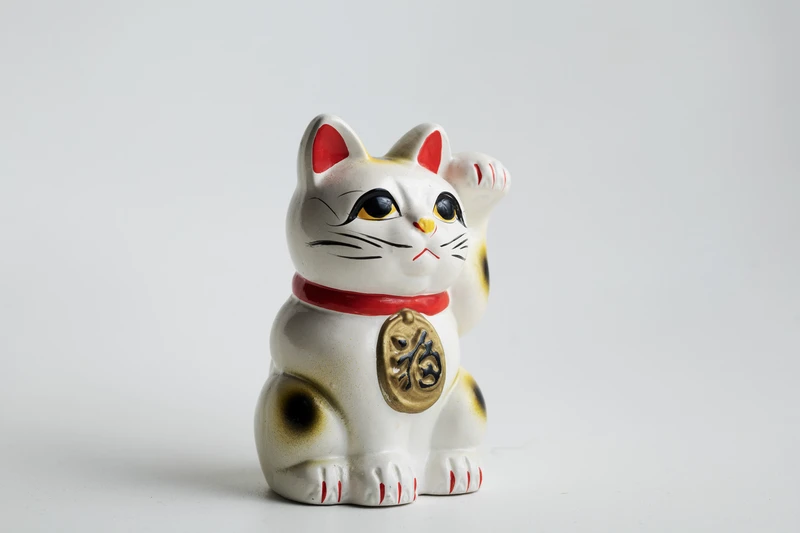
A small cat raises one paw at the entrance of a Japanese shop, and four hundred years of stories are folded into the gesture.
Most people know the maneki neko on sight — the porcelain cat with one paw raised, sitting on a shop counter or beside a temple gate, somehow signalling a wish without ever speaking. Far fewer know that the choice of paw, the colour of the fur, the small object the cat is sometimes holding, and even the region where the piece was made each carry meaning. The cat is not decoration. It is a sentence written in clay, in metal, in cloth.
This guide opens that sentence carefully. Two origin legends, one paw and then the other, four classical colours and the wishes they make visible, the items occasionally tucked between the cat’s paws, and the three craft traditions that today carry the figure most strongly. The aim is not to tell anyone which cat to choose, but to make the vocabulary easier to read — so that the cat one chooses, or receives, or gives, says what it is meant to say.
A Beckoning Cat, in One Paragraph
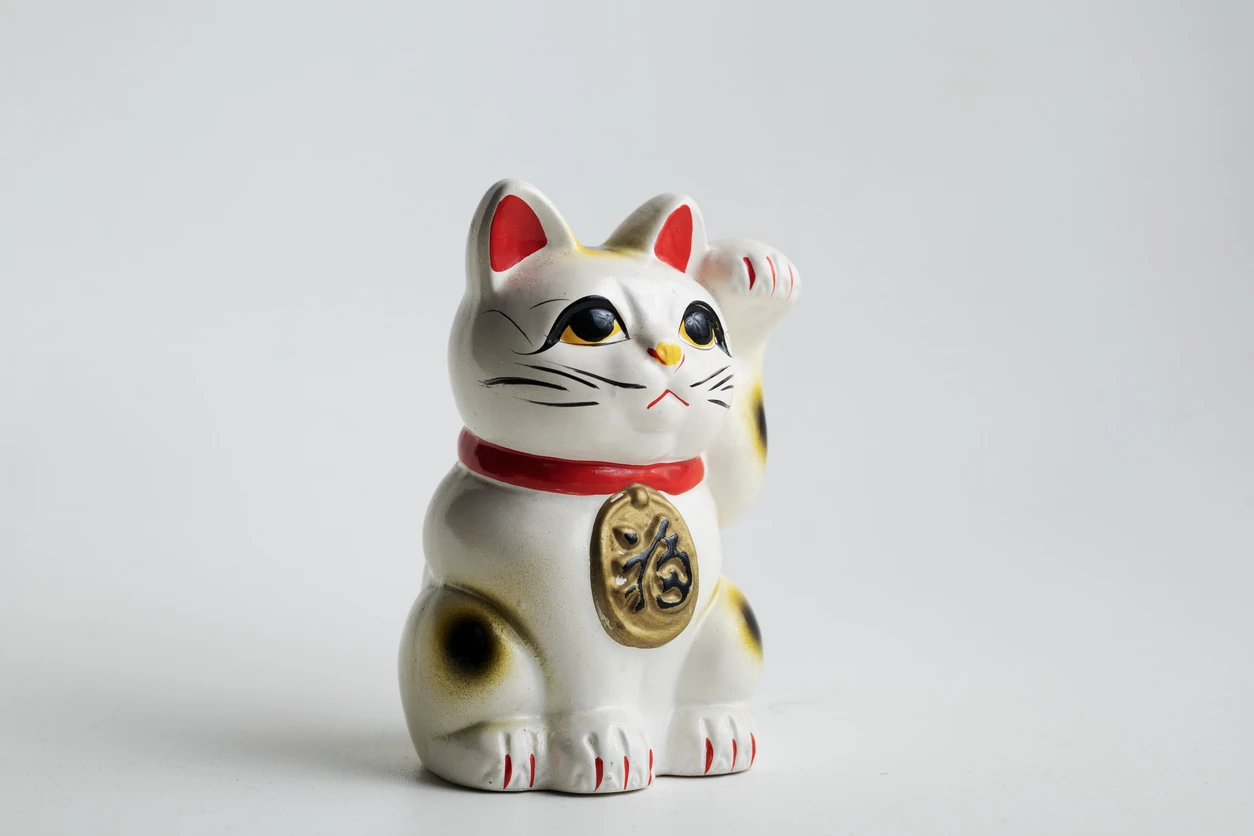
The maneki neko (招き猫, literally the beckoning cat) is a Japanese figure of a cat with one front paw raised, traditionally placed at the entrance of shops, restaurants, and homes to invite good fortune. Compared to many of Japan’s auspicious motifs — the crane, the turtle, the scrolling karakusa vine, all carried over from earlier centuries — the maneki neko is a relatively young arrival, taking its modern shape sometime in the late Edo and early Meiji periods, between roughly 1850 and 1900. It is the figure most closely associated, abroad, with the idea of Japanese luck, and the reason this shop carries its name. What the cat invites depends on which paw is raised and what colour the cat is — the layered grammar this guide will untangle.
Two Origin Legends — The Cat of the Samurai and the Cat of the Commoner
There is no single agreed origin for the maneki neko. The two legends that have travelled furthest are very different in setting and in temperament, and each says something distinct about what the cat became.
The Cat of the Samurai — Gōtoku-ji, Setagaya
The first legend belongs to a small temple in what is now western Tokyo. In the early seventeenth century, the temple of Gōtoku-ji was poor, its priest barely able to feed himself or the resident cat. One afternoon, the daimyō Ii Naotaka — a senior lord of the Tokugawa government and master of the powerful Hikone domain — was riding past the temple gate when a sudden storm broke. Sheltering under a tree across the road, the lord caught sight of the temple cat at the gate, raising one paw as though calling him in. He crossed to the temple. A moment later, lightning struck the very tree he had been standing beneath.
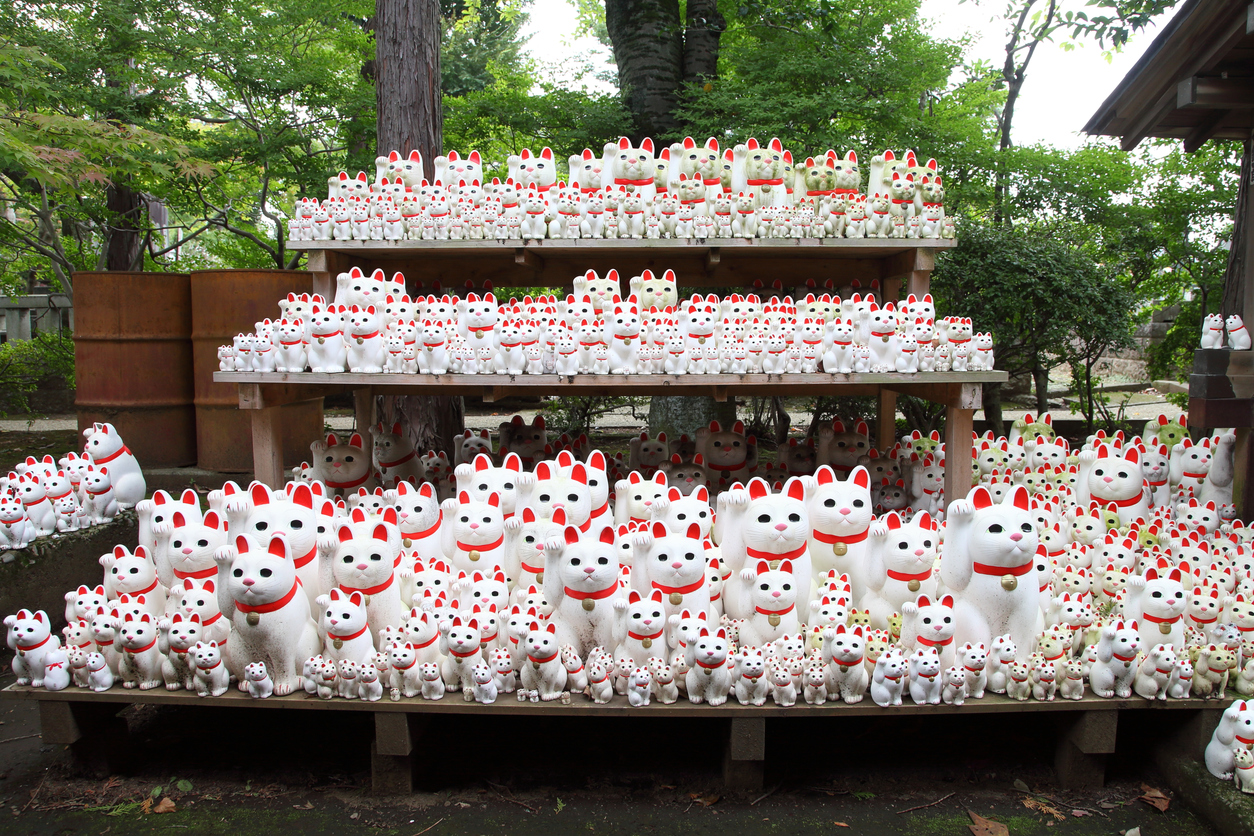
Saved, Naotaka returned the following days with rich offerings, took the temple under his family’s patronage, and Gōtoku-ji was rebuilt as the official prayer temple of the Ii clan. Today the temple is still in Setagaya, and its grounds are filled with thousands of small white right-paw cats left as offerings by visitors. In this story, the maneki neko enters Japanese culture through power — a cat who saves the life of a lord and is rewarded with a temple’s prosperity.
The Cat of the Commoner — Imado, Asakusa
The second legend belongs to a humbler quarter of old Edo. In the late Edo period, an old woman lived in poverty in the Imado neighbourhood of Asakusa, beside the Sumida River. Loving her cat but unable to feed both of them, she finally let the cat go. That night the cat appeared in her dream and told her to fashion its likeness in clay — a small statue, in the local Imado-yaki style — and offer it for sale. She did. The little cats sold faster than she could make them. Word spread. The pottery cat at the shrine of Imado-jinja became, in many tellings, the prototype from which the maneki neko as object descended.
Today Imado-jinja in Asakusa is known as a shrine of marriage and is regularly visited by couples who come to pray together at the small pair of cats — male and female — said to embody the tradition. In this story, the maneki neko enters Japanese culture through the ordinary — a cat who saves the life of a poor old woman and gives her a way to make a living.
One Cat, Two Japans
Whether either story is the origin matters less than the fact that both have endured. One cat saved a lord. Another cat saved a woman who had nothing. The maneki neko does not belong to a single class. It travels easily between the daimyō’s villa and the merchant’s storefront, between the priest’s temple and the elder’s tea-room. That breadth — the same paw raised in very different rooms — is part of what makes the figure so distinctly Japanese, and so portable across the centuries that followed.
Left Paw, Right Paw — and Why It Matters
The single most-asked question about the maneki neko is which paw to choose. The answer is short, and the reasoning behind it is satisfying.
A right paw raised invites fortune in the broad sense — money, prosperity, the kind of luck a shop counts at the end of the day. Right-paw cats are the most common choice for shops, offices, and any household that wants to draw financial well-being toward itself.
A left paw raised invites people — customers, friends, relationships, the kind of luck measured in who walks through the door. Left-paw cats are traditional in restaurants, hospitality businesses, and households that prize community over commerce.
Some cats raise both paws. These are less common in older traditions because, in Japanese, raising both hands is also the gesture of o-teage — a small idiom meaning I give up, I surrender. A maneki neko with both paws up risks reading not as a doubled invitation but as a dropped one. Modern artisans sometimes still make them — as playful pieces, or for households that want both kinds of luck without choosing — but a single-paw cat remains the more grounded form.
The height of the raised paw also reads. A paw raised high — what is sometimes sold as a long-paw style — invites fortune from far away, distant connections, large opportunities. A lower, gentler paw invites the closer, surer kind: regular customers, the friend who lives down the street, the steady income.

If the recipient is opening a shop, a right-paw cat is the traditional choice. If the recipient runs a place where people are welcomed for hospitality — a café, a guest-house, a tea-room — a left-paw cat fits more closely. For a household where neither maps neatly, either reads gracefully; the wish is what matters, not the strict rule.
Reading the Colors
A maneki neko’s colour is not decoration. It is the wish itself — chosen as deliberately as one would choose a word.
Calico (三毛, mike) — The Universally Welcomed Wish
The classical maneki neko is a calico — white-bodied, with patches of orange and black. Calico is also the rarest natural colouration of Japanese domestic cats: a male calico, owing to a quirk of feline genetics, occurs only about once in thirty thousand births. Old Japanese seafarers prized them as ship’s cats, believing the rarity itself carried protection. That folklore quietly underwrites the maneki neko’s calico tradition: the colouring is auspicious not just because it is pretty but because it is uncommon. A calico cat is a fitting choice for nearly any occasion — moving home, opening a business, a wedding, a quiet day — and is the colour to choose when the recipient’s situation is broad rather than specific.

White (白, shiro) — The Wish for a New Beginning
White carries the meaning of purity and new starts. In Shintō belief, white is the colour of the sacred — paper streamers at shrines, the priest’s outer robes, the cleared ground before a ceremony. A white maneki neko is therefore the cat to give for a new shop, a new home, a child’s coming-of-age — moments when the wish is to begin, cleanly. The thousands of white right-paw cats stacked at Gōtoku-ji are themselves a gesture of new beginning at every visit.
Black (黒, kuro) — The Quiet Guardian
The reading of black in Japan stands at a deliberate distance from its reading in much of the West. In Japanese aesthetics, black is the colour that protects. It is the colour of ink in a calligrapher’s brush, of the night sky watching over a sleeping household, of the glaze on a Bizen jar that the eye returns to. A black maneki neko is therefore not a cat of bad luck but a cat that guards against it — chosen for households facing illness, students preparing for examinations, anyone moving into a place that feels uncertain. It is the sentinel among the cats: quieter than gold, more affirmative than white. To give a black maneki neko is to wish strength rather than warning, and to receive one is to be told you are watched over.

Gold (金, kin) — The Wish for Prosperity
Gold is the most directly legible of the four classical colours. It speaks of money and of the kind of fortune that accumulates. A gold maneki neko is the cat for a new business, for a promotion, for the new year, for any occasion where the wish is unambiguously abundance. Where pottery dyes are limited, gold often appears as gilt over white or black underglaze — but in Takaoka, the four-hundred-year-old metalcraft tradition of Toyama Prefecture, gold appears at full weight: the cat itself is cast in gold-toned bronze, and the wish becomes literal in the metal.
Modern Wishes — Pink, Green, Yellow, and Beyond
Contemporary artisans have added colours for more specific wishes: pink for love and matchmaking, green for academic success and exam-passing, yellow for new connections in work and friendship, red (in some readings) for protection from illness, drawn from older colour magic where vermilion was used to ward off sickness. These are recent additions, but they extend the same logic: a colour for a wish, the wish made visible.
The Items in His Paws
Look carefully at a maneki neko’s paws and there is often a small object held there. Each is a deliberate piece of vocabulary chosen by the maker.
- Koban (小判) — An Edo-period gold coin, often inscribed with senman-ryō (千万両, ten million ryō) — a fortune so large it could not realistically have existed, and that is precisely the point. The koban is the most common item; it speaks directly to financial luck.
- Uchide no Kozuchi (打ち出の小槌) — The mallet of plenty, borrowed from Daikokuten, one of the Seven Lucky Gods. Strike it, the legend says, and wishes take form.
- Tai (鯛) — The red snapper, chosen for the pun in medetai (めでたい, auspicious, festive). A cat shown astride a tai is wishing the recipient celebration.
- Daruma — The figure of Bodhidharma. To hold a daruma is to wish perseverance, the strength to stand back up after every fall.
- Bell (鈴) — Drawn from the bells of Shintō shrines, which call the gods near and disperse misfortune.
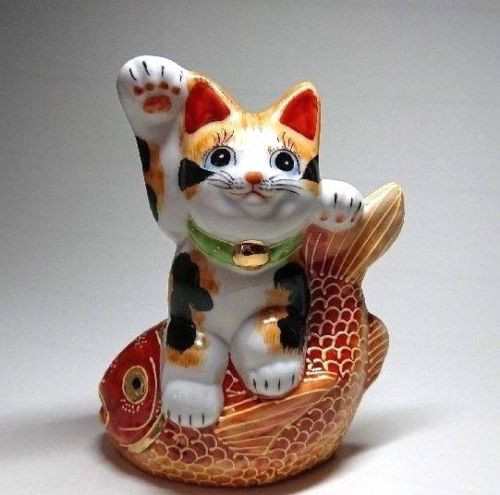
Reading these items is closer to reading words than to reading ornament. Each one was chosen by the maker for a particular wish.
The Three Dialects of Craft
The same cat, raising the same paw, can be cast in three quite different voices depending on where it is made. Three traditions today carry the maneki neko most strongly — and choosing among them is choosing how the wish is spoken.
Tokoname — The Voice of Earth
The town of Tokoname, on Aichi Prefecture’s Chita Peninsula, has produced the largest share of Japan’s maneki neko since the late nineteenth century. The pieces here are made of red clay, fired to that distinctive warm terracotta, and finished with simple glazes that let the texture of the earth show through. A Tokoname cat is the cat of the everyday: round-faced, steady-eyed, painted with the kind of brushwork that an artisan can repeat all morning without losing its quietness. It is the cat one finds at the entrance of an old shopping arcade, on the kitchen shelf of a grandmother in the countryside, on the counter of a soba restaurant — at home in the rhythm of an ordinary Japanese day.

Kutani — The Voice of Color
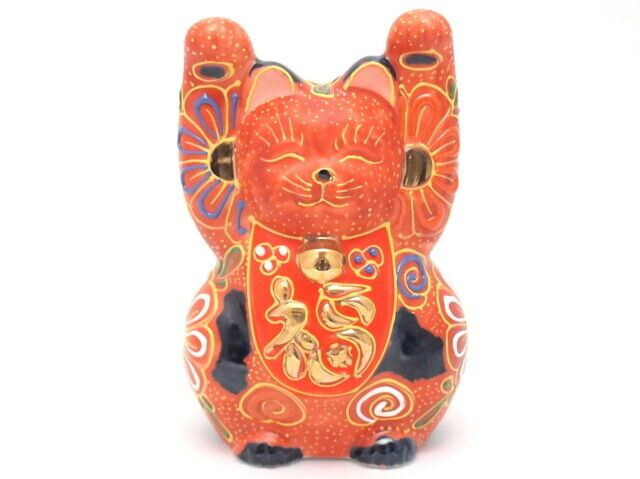
A Kutani maneki neko, made in the porcelain-painting tradition of Ishikawa Prefecture’s Kaga region, is a different creature altogether. Where Tokoname speaks, Kutani sings. The figures are porcelain rather than clay, painted in the classical Kutani palette of red, yellow, green, purple, and blue, often with passages of gold leaf laid over fine line-work. Faces are detailed enough to give each cat an individual expression. Backs and bellies are covered in painted kimono patterns — karakusa vines, seigaiha waves, plum blossoms, scattered treasures — so that a single piece compresses several auspicious motifs into one body. A Kutani cat is the cat of celebration, of the gift carefully chosen, of the room where a piece is meant to be looked at as well as lived with.
Takaoka — The Voice of Metal
Toyama Prefecture’s town of Takaoka has cast metalwork — bronze, brass, and copper — for over four hundred years, originally for temple bells and Buddhist altar-ware. In recent decades, Takaoka’s foundries have applied that metalcraft to figures including the maneki neko, producing cats that depart entirely from the porcelain tradition. A Takaoka cat is solid, weighted, cool to the touch. The metal softens with handling into a deep matte gold, white, or red, and the figure carries the same authority on a desk as a small bronze sculpture. Where Tokoname feels at home in a country kitchen and Kutani in a tatami room, a Takaoka cat is the cat that belongs in a modern apartment, an architect’s office, a study where porcelain would feel too ornamental.
The three voices share the same vocabulary — the raised paw, the chosen colour, the inviting gesture — but speak it in different accents. Other regions paint their own dialects too: Kyoto, in painted chirimen silk and papier-mâché hariko cats lighter than air; Seto, in glazed earthenware that rivals Tokoname in age; Arita, in fine porcelain finished with overglaze enamels. These three, however, carry the broadest weight of the contemporary tradition, and a household choosing its first maneki neko will most often find itself among them.
Find a maneki neko whose colour and paw match what you want to say — for fortune, for friendship, for protection, or simply as a quiet companion at the entrance of a home.
Maneki Neko in the Modern Home
A maneki neko traditionally sits at the entrance — the place where fortune is invited in. In a Japanese shop this means the counter near the door; in a home, the genkan (entry hall) facing outward, so that the cat can see, and call to, what is approaching from the street.
The figure also reads gracefully in other rooms. A small cat on an office desk wishes professional luck. A cat on a living-room shelf, often near the family altar, wishes the household’s well-being. A hashioki (chopstick rest) shaped as a maneki neko brings the wish to the kitchen table, three meals a day. The figure is generally not placed in the bathroom or directly on the floor — both, in Japanese sensibility, are spaces too low for a figure that is meant to be looking outward and welcoming.
Direction matters more than height. A maneki neko is meant to face the entrance, the door, the street — the line along which fortune travels. A figure facing inward calls fortune back into the room, which in some readings is welcome and in others reads as misdirection. A common compromise in shops is to angle the cat at forty-five degrees, where it can see both customer and counter at once.
A single cat is sufficient. Pairs are common, particularly in the Imado tradition, where male-and-female cats form a small family of luck. Households sometimes accumulate a small population of cats over the years, in different colours and from different regions — each cat acquired for a specific wish, all of them quietly working together.
As a Gift — When to Give One
A maneki neko is among the most natural gifts to give in Japanese tradition. The figure exists to wish, which is what a gift does. Aligning the cat to the occasion is a matter of matching colour, paw, and sometimes region.
For an opening of a new business, a gold cat with the right paw raised is the classic choice. A white cat fits nearly as well, particularly for a hospitality venue.
For a housewarming, a calico is the warmest choice — universally welcomed and unaligned to any single wish.
For a wedding, a pink cat or a pair of cats (one of each, in the Imado style) extends the wish toward partnership and lasting connection. Gold suits the celebration register too, particularly for a couple opening a household together.
For a recovery from illness, a red or black cat — the two protective colours — wishes strength and the dispersal of misfortune.
For a student preparing for examinations, a green cat with the left paw raised wishes academic success and the people (teachers, peers) who will help the journey.
For a milestone birthday — kanreki (60), koki (70), beiju (88) — a calico or a gold cat carries the dual wish of long life and abundance.
A maneki neko is not chosen for funerals or sympathy occasions; the figure’s purpose is to invite, which is the work of beginnings rather than endings. Within the long catalogue of beginnings, however, there is almost always a paw and a colour that fit.
Looking for a meaningful gift? Pieces chosen for new shops, new homes, weddings, and recoveries — each colour speaks a different wish.
A Note from the Shop
This shop carries the maneki neko in its name. There is a reason. Among Japanese auspicious motifs — the crane, the turtle, the karakusa vine, the seigaiha waves — the maneki neko is the one that has travelled furthest beyond Japan, the figure most likely to be recognised, on sight, by a customer in Boston or Berlin or Buenos Aires. And yet, abroad, the cat is most often understood as a single thing — Japanese lucky cat — when in fact, inside Japan, the figure is spoken of in degrees: the colour, the paw, the held object, the regional dialect of clay or metal or cloth.
We chose the name Manekineko-Ai (招き猫愛, love for the beckoning cat) because we believe the figure deserves its full vocabulary. The cat is not chosen for its prettiness alone. It is chosen for the wish it carries — for the recipient, for the household, for the giver themselves.
We curate the maneki neko from workshops in Aichi (Tokoname and Seto), Ishikawa (Kutani), Toyama (Takaoka), Saga (Arita), and Kyoto — each region speaking the figure in its own accent, each piece in our shop chosen because the maker can articulate, in plain words, what the cat is meant to invite. We often see customers choose a maneki neko not just for what it looks like, but for what it wishes — for them, or for someone they care about.
— from Osaka, Team Manekineko-Ai
Pieces in Our Collection Carrying These Motifs
A few examples, drawn from the maneki neko traditions covered in this guide. These are examples, not recommendations — the right cat is the one whose colour, paw, and voice match the wish one has in mind.

Takaoka Metalcraft Maneki Neko, Gold. A modernist reading of the classical figure, hand-cast in Toyama Prefecture by a four-hundred-year-old metalwork tradition. The body is solid bronze with a deep gold patina that will soften further with handling. A cat for a desk, a study, a quiet entrance where porcelain would feel too ornamental — and the most direct expression of the gold = prosperity wish, in metal that holds it at full weight. (See the piece)
Kutani Banzai Maneki Neko, Painted Porcelain. A hand-painted porcelain cat from Ishikawa Prefecture’s Kutani tradition, both paws raised in a gesture the maker calls banzai — ten thousand years, the cry of celebration. The body is decorated in classical Kutani five-colour painting, the face given a particular expression by the painter’s brush. The Kutani voice at its most singing: a cat for the gift carefully chosen, the celebration register, the room where the piece is meant to be looked at as much as lived with. (See the piece)

Kyoto Tapestry — Maneki Neko in Linen. A hand-painted linen wall hanging in the Kyoto textile tradition, with a black maneki neko at its centre. Linen and ink rather than clay — the same wish in a quieter, two-dimensional voice, suited to a wall above a doorway, a cabinet, a sliding panel. The black cat carries its protective register most clearly here, against the natural cream of the linen ground. (See the piece)
Frequently Asked Questions
Q: Which paw should I choose if I’m not sure?
A right paw is the safer default. It invites fortune in the broadest sense — money, prosperity, the general well-being of a household — and is the most common choice for first-time buyers. If the recipient runs a place where customers, guests, or visitors are central — a restaurant, a guest-house, a tea-room — a left paw fits more precisely. When in doubt, a right-paw calico is the version least likely to feel mis-aligned to the occasion.
Q: Is it inappropriate to give a black maneki neko?
Not at all — and the question itself is worth holding briefly. In much of the West, black cats carry an old association with bad fortune. The Japanese reading is the opposite: black is the colour that protects, the colour of ink in a calligrapher’s brush, of the night sky watching over a sleeping household. A black maneki neko is the guardian among the cats, traditionally given to a household facing illness, a student preparing for an examination, a person moving into a place that feels uncertain. To give one is to wish strength, not warning. To receive one is to be told you are watched over.
Q: Does maneki neko symbolism still matter in modern Japan?
Yes, though differently across generations. Older Japanese readers will distinguish at a glance between a right-paw and a left-paw cat, between a calico and a gold one, and will understand which is right for which occasion without thinking. Younger consumers may not always articulate the grammar, but they still feel its weight: shops still place white cats at openings, families still give gold cats for new ventures, students still receive green ones in examination season. The vocabulary persists, even in households where the dictionary is half-forgotten.
Q: Where should I place a maneki neko in my home?
Traditionally at the entrance, facing outward — toward the door, toward the street, toward whatever fortune may be approaching. In a Japanese home this is most often the genkan (entry hall). Smaller cats sit on office desks (for professional luck), on living-room shelves near the family altar (for the household’s well-being), or as hashioki on the kitchen table (where the wish is repeated three times a day). The figure is generally not placed in the bathroom or directly on the floor.
Q: Why are some maneki neko sold as pairs?
The pair tradition descends from the Imado origin legend, in which the original cats included both a male and female figure, together representing a complete household of luck. Pair cats today often carry a wedding or matchmaking register — given for engagements, weddings, or anniversaries — and are common at Imado-jinja in Asakusa, the Tokyo shrine associated with the legend. A single cat is equally traditional and is the more common form for shops and individual households.
Q: What’s the difference between a Tokoname and a Kutani maneki neko?
Material, voice, and register. A Tokoname cat is made of red clay, fired to terracotta, finished with simple glazes — the everyday cat, at home in a country kitchen. A Kutani cat is fine porcelain, painted in classical five-colour overglaze enamel, often with gold leaf — the celebration cat, suited to the room where a piece is meant to be looked at. The wish carried (a raised paw, a chosen colour) is the same; the accent in which it is spoken is different. For a fuller treatment of Kutani painting and how to recognise hand-painted work, see our Kutani guide.
Q: Are battery-powered or solar-powered waving cats authentic?
They are a modern variation on the figure, found in shops across Japan today. Authenticity in the maneki neko tradition rests less on whether the paw moves than on whether the cat is made by an artisan tradition — Tokoname clay, Kutani porcelain, Takaoka metal, Kyoto papier-mâché — rather than mass-produced plastic. A hand-painted ceramic cat with a still paw belongs more squarely to the tradition than an animated cat fabricated in volume.
Q: Can I buy a maneki neko for myself, or should it always be received as a gift?
A maneki neko is just as appropriate to choose for one’s own home as it is to receive as a gift. Inviting good fortune is not only something done for one another. It begins with the gesture of deliberately making a space in one’s own life for the wishes the cat carries — a quiet act of self-care that the tradition has always recognised. The most traditional placements are, after all, in shops and homes that the owner themselves chose. Receiving a maneki neko as a gift carries a particular warmth — the giver’s wish doubled by the cat’s — but choosing one for oneself is its own quiet act. The cat does the same work either way.
Closing — From One Cat to a Whole Vocabulary
The maneki neko is, in one sense, complete on its own — a single figure carrying a full wish, a small ceramic or bronze sentence one can place at the door and forget about and still receive its quiet attention. In another sense, the cat is part of a much larger vocabulary: the cranes and turtles and pines and waves that Japanese craft has been writing in for centuries. Seven Lucky Japanese Motifs — the previous guide on this journal — covers seven of those motifs together, and reading the cat alongside them is part of how its place in the tradition becomes clear.
Each of the maneki neko in our shop is made by hand — clay shaped, glaze laid, paint brushed, metal cast — by artisans in Aichi, Ishikawa, Toyama, Saga, and Kyoto. To recognise the cat by its full vocabulary is to receive, and one day perhaps to send, a wish that has been carried in a few quiet shapes for hundreds of years.
Thank you for reading.
— from Osaka, Team Manekineko-Ai