
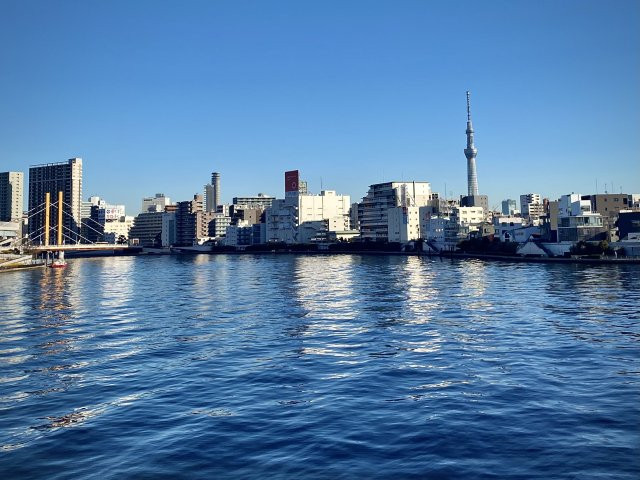
East Tokyo. The Sumida River bends, and the streets still carry the scale of a nineteenth-century working-class neighbourhood. In the small workshops along these streets, one sound dominates the day: the steady, low rasp of a grinding wheel cutting clear glass.
The cut glass of Tokyo has remained almost entirely concentrated in a single neighbourhood for nearly two hundred years.
This is Edo Kiriko (江戸切子) — the cut-glass craft that took root here in 1834, when a glass merchant named Kagaya Kyubei adopted European cutting techniques and began applying them to glass made in his own neighbourhood. What started as imitation became, within two generations, something distinctly Tokyo: harder-edged than European cut glass, more geometric, more disciplined, and quietly carrying patterns the country had been refining on textile and ceramic for centuries.
Edo Kiriko is one of the few Japanese crafts to have remained almost entirely concentrated in a single neighbourhood for nearly two hundred years. The workshops in Sumida and Kōtō wards still cut by hand, often by the third or fourth generation of the same family. The patterns they cut are the same patterns their grandfathers cut. The difference is that the cups now most often hold cold sake.
This guide is for the reader who has arrived at Edo Kiriko through that connection — through the discovery, in our recent guide to Japanese sake sets, that summer's chilled sake (花冷え, hanabie; 雪冷え, yukibie) calls for glass rather than ceramic. The aim of these pages is to make the patterns on those glasses readable.
Five patterns. Three colours. One craft. The rest is yours.
Kagome (籠目) — The Basket Weave
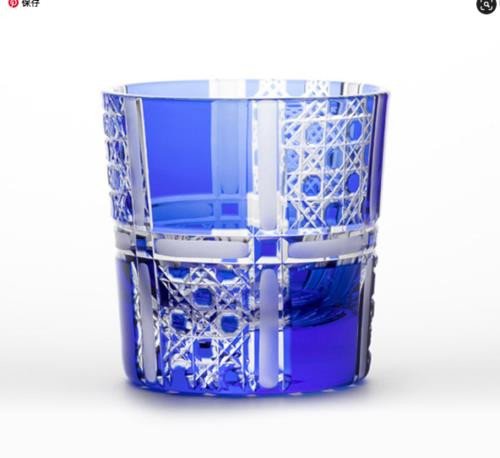
The hardest cut in the vocabulary — and the test by which Sumida workshops judge whether an apprentice's hand is ready to sign work.
Kagome is the basket weave. Three sets of parallel lines cross at sixty degrees and repeat until the glass becomes a lattice. The name comes from kago (籠), the woven bamboo basket, and the pattern carries the basket's old meaning: protection. The six-pointed stars at every intersection were believed to repel evil — the same six-pointed-star geometry that appears, half a world away, on the flag of Israel and on Mediterranean amulets. Farmers in northern Japan placed kagome baskets at their doorways for similar reasons.
It is the hardest cut in the vocabulary. Three sets of straight lines, each running the full circumference, each crossing the other two at an exact angle. A misjudged angle accumulates across the lattice — the eye reads the weave as a single rhythm, and small errors compound where the lines meet. For nearly two centuries, the kagome has been the test by which Sumida workshops judge whether an apprentice's hand is ready to sign work.
A kagome guinomi is a piece for slow evenings. It pairs with sake that has weight — a junmai with body, a chilled-but-not-too-cold summer pour. More than any other pattern, the kagome carries the name of the neighbourhood that made it.
In our collection: Edo Kiriko Guinomi — Kagome & Ichimatsu, Cobalt Blue
Yarai (矢来) — The Bamboo Fence
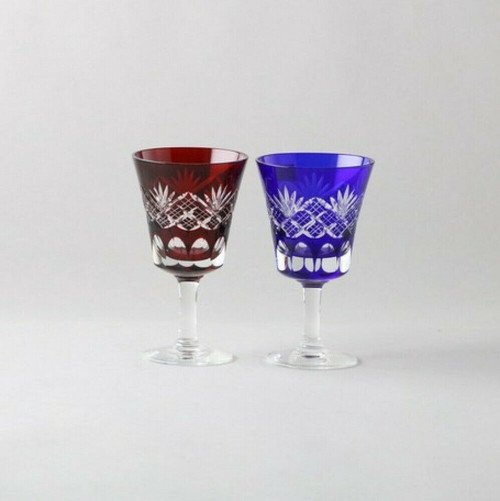
A cut that demands speed and confidence rather than precision — the cleanest expression of the cutter's individual hand.
Yarai is the bamboo fence. Diagonal lines crossing at a single fixed angle, forming a regular grid of slim diamonds across the surface. The name comes from the bamboo fence (yarai-gaki) that surrounded the residences of the samurai class during the Edo period. The meaning is straight: protection, structure, the disciplined edge of a defended household.
The cut is technically simpler than the kagome — only two angle-fixed cuts, not three — but it demands speed and confidence rather than precision. A yarai that hesitates wavers. A yarai that commits has the clean authority of a drawn sword. This is the cut where the cutter's hand is most visibly individual, and it is often where younger cutters are first allowed to sign their work.
A yarai cup is a piece with a backbone. It pairs with chilled junmai-shu of higher acidity — sake whose structure is clearly drawn — and crosses naturally to whiskey for the late evening. There is a reason yarai is one of the most common cuts on Edo Kiriko ware that moves between sake and spirits.
In our collection: Edo Kiriko Tsurugi Yarai — Wine Cup Goblet, Set of 2
Shippou (七宝) — The Seven Treasures, Linked
Overlapping circles signifying that the seven treasures — and by extension good relationships — are bound together, each enriching the others.
Shippou is, on the surface, the simplest pattern: overlapping circles, each circle's edge passing through the centre of its neighbours, forming a chain of four-petalled flower-shapes where the curves meet. The name shippou — "seven treasures" — refers to the seven precious materials of Buddhist scripture: gold, silver, lapis lazuli, crystal, mother-of-pearl, agate, coral. The interlocking circles signify that these treasures are bound together, each enriching the others.
The pattern arrived in Japan through Buddhist textile and lacquer long before it appeared on glass. Readers of our seasonal patterns guide will recognise the shippou-tsunagi on noren curtains, formal kimono obi, and New Year's jūbako boxes. When Edo Kiriko cutters adopted the pattern in the late nineteenth century, they were translating an existing visual vocabulary into glass, not inventing one.
The meaning shippou carries is the gentlest in the Edo Kiriko vocabulary: en-musubi (縁結び, the binding of good relationships) and enman (円満, the roundness of a household's harmony). It is the pattern most often given as a wedding gift, a fiftieth-anniversary gift, or a graduation gift to a young person leaving home. The seven-treasure metaphor is not lost on modern Tokyo: the pattern is also the kiriko cup most often chosen for retirement ceremonies, where the seven treasures stand in for the colleagues who made the career possible.
The shippou cup pairs with a balanced junmai or a gentler honjozo — its visual softness reads better with sake that does not need to compete. More than any other kiriko cup, the shippou is the form most often given in pairs.
Kiku-tsunagi (菊繋ぎ) — The Chrysanthemum, Linked
To wear a single chrysanthemum is to gesture toward the throne; to chain chrysanthemums together is to gesture toward the order beneath the throne.
Kiku-tsunagi is the chain of chrysanthemums. Each flower is rendered as a sixteen-petal starburst — the classical Japanese number of chrysanthemum petals, the seal of the Imperial Household — and linked to its neighbours in a regular grid. To wear a single chrysanthemum is to gesture toward the throne; to chain chrysanthemums together is to gesture toward the order beneath the throne — the long continuity of seasons, ceremonies, and quiet duty.
The pattern appears regularly on Edo-period samurai armour, on the inner sleeves of formal kimono, and on the lacquer trays used at official ceremonies. Its arrival on glass came relatively late in the Edo Kiriko tradition — but once it arrived, it stayed.
In modern Tokyo the kiku-tsunagi reads as the most autumnal of the cuts. It is the cup brought out at kanreki (還暦, the sixtieth-birthday celebration), at the formal evening meal of mid-September, at kiku-no-sekku (菊の節句, the chrysanthemum festival of the ninth day of the ninth month). It is also, increasingly, the pattern chosen by women in their thirties and forties as a quiet personal piece — perhaps because the chrysanthemum's strength is not loud, and a chain of them on a small kiriko cup is a kind of quiet permission.
The kiku-tsunagi pairs with a hanabie-chilled junmai in the late evening of a September day, drunk slowly enough that the chrysanthemums on the cup are still being looked at while the sake is being held in the mouth.
Sakura (桜) — The Cherry the Modern Cutter Returned To
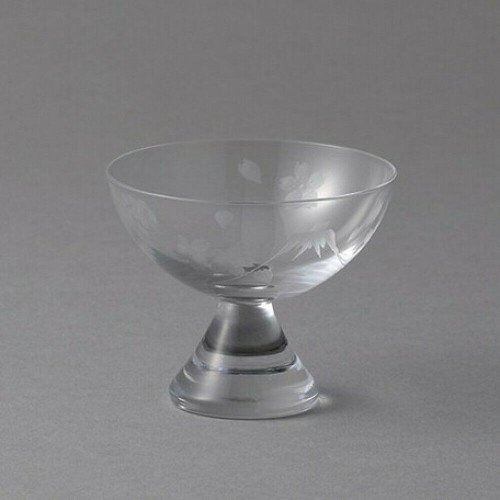
A cup for moments — for a wedding, for a daughter's graduation, for the first cup poured to a friend who has just moved into a new home in April.
Sakura is the most modern of the patterns. Edo-period kiriko did not include the cherry blossom — the cherry was a textile and lacquer motif, not a glass one. Sakura on Edo Kiriko is a twentieth-century decision, made by individual cutters who wanted to translate Japan's most universally beloved seasonal image into the harder grammar of cut glass.
The result gently breaks the geometric discipline of the older cuts. Five soft petals where the older patterns prefer straight lines; curves where the wheel prefers angles. The cutter, in cutting a sakura, allows the geometry to relax just enough to let the season into the glass.
That small relaxation is the cup's meaning. A kagome cup is a piece for serious evenings. A sakura cup is a piece for moments — for a wedding, for a daughter's graduation, for the first cup poured to a friend who has just moved into a new home in April. The sakura signals an occasion in a way the geometric patterns signal a life.
The sakura cup pairs with a chilled ginjo for hanami in early April, or a yukibie daiginjo for the New Year's first cup. It is taken out for the moment, not for the year.
In our collection: Edo Kiriko Guinomi — Fuji & Sakura, Cut Glass
Reading the Colour — Lapis, Cranberry, Amethyst
The colour of an Edo Kiriko piece is not a glaze. It is a layer. The technique, kabuse-garasu (被せガラス), dips a clear glass piece in molten coloured glass to form a thin, even outer skin. When the cutter cuts, he cuts through the coloured layer to expose the clear glass beneath. The pattern is the white space where the colour has been removed; the ground is the colour that remains. This is why the patterns on Edo Kiriko are, almost universally, lighter than the surrounding ground.
Three colours dominate the tradition.
Lapis blue (瑠璃, ruri) is the oldest. The deep blue of lapis lazuli arrived through the same trade routes that brought Buddhist art to Japan a millennium ago; on glass, it carries the same gravity. Lapis kiriko is the formal register — the cup brought out for elders, for tea-ceremony hosts, for the first poured cup of the new year.
Cranberry red (紅, beni) is the festival register. The deep, slightly purplish red of beni — the traditional pigment used in lipstick and in the inner lining of kimono sleeves — translates onto kiriko as joy held with restraint. Beni kiriko is the cup for a wedding's late evening, for a daughter's twentieth-birthday celebration, for the cup poured to a guest whose visit is itself a celebration.
Amethyst purple (紫, murasaki) is the modern entry. Purple was, in the classical Japanese colour hierarchy, the most prestigious of all colours — reserved for the emperor and for the highest ranks of the court. Its arrival on Edo Kiriko democratised it: the modern murasaki kiriko is a piece that quietly invokes the older meaning without performing it. Many drinkers, after years of choosing lapis or cranberry, settle on amethyst.
A small note on absences. Two of the most beloved Japanese patterns — asanoha (麻の葉, hemp leaf), discussed at length in our seasonal patterns guide, and kikko (亀甲, tortoise shell hexagon) — appear almost never on Edo Kiriko. Both are everywhere in Japanese textile and ceramic tradition; both are essentially absent from cut glass. The reason is partly technical (the asanoha's six-pointed geometry sits awkwardly on a curved glass surface) and partly historical (the Edo-period kiriko vocabulary did not absorb them, and later cutters did not return to them). It is a small fact, but worth knowing — the absence of a pattern is sometimes as much a tradition as its presence.
Edo Kiriko and the Chilled Sake of Summer
In the older Japanese sake tradition discussed in our sake set guide, the eight named temperatures of sake — from atsukan through yukibie — call for different vessels at different parts of the year. Three of these temperatures fall into the cold band (5°C to 15°C): suzubie (涼冷え, "cool-chilled"), hanabie (花冷え, "flower-chilled"), and yukibie (雪冷え, "snow-chilled"). Each calls for glass.
Edo Kiriko is the form of glass the modern Japanese drinker most often reaches for in this band. The reasons are partly aesthetic — cut glass throws light at the angles that ceramic and lacquer cannot — and partly practical. The thin walls keep chilled sake cold for the few minutes a small pour is in the cup. The pattern catches whatever light is in the room and directs it toward the surface of the liquid. The colour layer cools the eye in a way that reading clear glass does not.
This is why, in modern Tokyo, the kiriko cup has come to be associated specifically with the summer months. A kagome guinomi in lapis is the cup for the August evening when the air has finally settled and a chilled junmai is poured slowly. A sakura kiriko is the cup for early April. A kiku-tsunagi kiriko in cranberry is the cup for the brief weeks in autumn when the sake is still chilled but the air has begun to cool. The kiriko has its own quiet seasonal calendar within the larger calendar of Japanese sake.
A small practical note. Edo Kiriko cut glass is best hand-washed in warm — not hot — water with a soft cloth. Cut surfaces should be dried with a lint-free cloth that does not catch on the edges. Avoid sudden temperature changes; the thin walls do not forgive them. Treated this way, a piece will last a working life and arrive at the next generation in better condition than most modern ware.
A Note from the Shop
This article maps the five most enduring Edo Kiriko patterns and the colour palette they sit within. It is meant as a beginner's map for the reader who has come to kiriko through the chilled-sake door, and who would like the patterns on the glass to read as the small, deliberate vocabulary they are.
There are, of course, more. The Edo Kiriko tradition includes nanako (魚子, fish-roe stipple), yaebashi (八重菱, layered rhombus), tatewaku (立涌, rising-steam), kenbishi (剣菱, sword-rhombus), and several others — most of which appear on small specialist pieces rather than on everyday sake ware. We will explore the rarer cuts in dedicated essays in the months to come.
Pieces in our collection carrying these patterns can be found grouped by motif and by colour. These are examples, not recommendations. The choosing is yours.
— from Osaka, Team Manekineko-Ai
Pieces in Our Collection
A small selection from the Edo Kiriko range. These are examples, not recommendations.
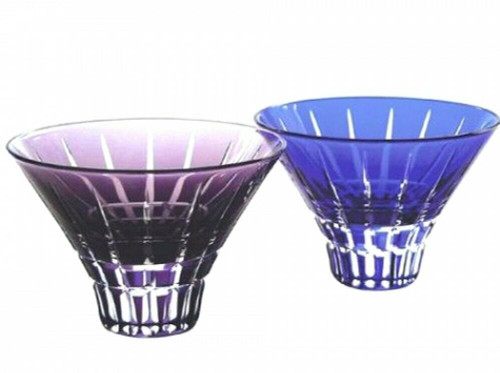
Pick 1 — Guinomi Pair, Amethyst & Lapis. A pair of small, gently flared guinomi cups — one in amethyst purple, one in lapis blue. Vertical lines run from rim to base, opening above a small block-cut grid at the foot. The pair places two of the three classical Edo Kiriko colours side by side in a single set, and reads as a quiet study in how the same craft turns out two registers of evening at the same table. (See the pair)
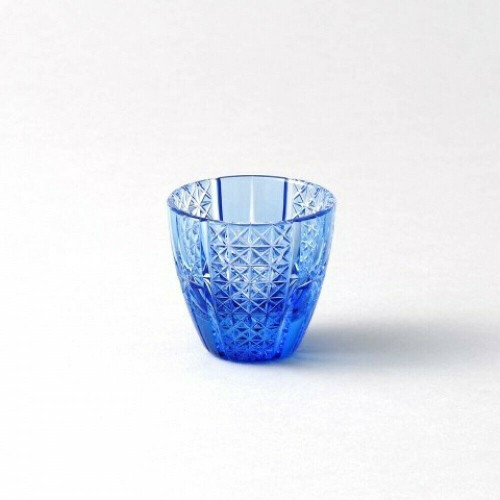
Pick 2 — Nanako Guinomi, Crystal Blue. A small, gently rounded guinomi cut so densely in the fine nanako (魚子, fish-roe stipple) that the entire surface reads as a worked field of light. The blue is a deep crystal that darkens toward the base; vertical accent lines lift the rhythm of the stipple at regular intervals. The piece arrives in a wooden box and reads less as tableware than as a small instrument made for one drinker's slow pour. (See the piece)

Pick 3 — Nanako Guinomi, Crystal Deep Green. The same cup as above, in deep forest green — a colour rarely seen in the older kiriko vocabulary, and one that has appeared more recently as cutters have begun working outside the classical lapis-cranberry-amethyst triad. Same fine nanako field, same vertical accents; only the colour is moved. Held next to the blue, the pair reads as a small lesson in how a single cut behaves across two different layers of light. (See the piece)
Frequently Asked Questions
Q: What is Edo Kiriko glassware?
Edo Kiriko (江戸切子) is a Japanese cut-glass craft that originated in 1834 in Tokyo's old downtown, in the neighbourhoods now known as Sumida and Kōtō wards along the Sumida River. It is made by the kabuse-garasu technique: a layer of clear glass is dipped in molten coloured glass to form a thin outer skin, and the cutter cuts through the coloured layer to expose the clear glass beneath. The patterns are geometric, drawn from the older Japanese textile and lacquer traditions, and the craft is one of the few in Japan to have remained almost entirely concentrated in a single neighbourhood for nearly two hundred years.
Q: Where are Edo Kiriko glasses made?
In Tokyo's old downtown, primarily in Sumida ward and the neighbouring Kōtō ward, along the eastern bank of the Sumida River. The craft has been geographically concentrated there since 1834, when Kagaya Kyubei first adapted European cutting techniques in his glass workshop. Several established workshops continue the tradition in the same area today, many run by families now in their third or fourth generation of cutters. Under the Japanese government's Traditional Crafts designation (granted to Edo Kiriko in 2002), the name "Edo Kiriko" is restricted to pieces produced in this area.
Q: Why are Edo Kiriko glasses so expensive?
Edo Kiriko pieces are cut by hand, one cup at a time, by artisans who typically apprentice for a decade or more before being permitted to sign their work. Each piece carries hours — sometimes a full working day — of cutting at a wheel, and the most demanding patterns (the kagome especially) require a level of precision that machine cutting cannot replicate. The price reflects both the cutter's hours and the long training that produced the hands behind them. A simpler everyday piece may sit in the lower thousands of yen; a signed piece by an established workshop, several times that; a museum-grade piece by a recognised master, considerably more. The cost is the cost of the hand.
Q: What is the value of Edo Kiriko?
The value of an Edo Kiriko piece rests on three layers. The first is the craft itself: each piece is hand-cut by a named artisan in one of a small number of Tokyo workshops, and the patterns require years of training to execute properly. The second is cultural continuity — Edo Kiriko is one of the few Japanese crafts to have survived nearly two centuries in a single neighbourhood, with families now in their third or fourth generation of cutters. The third is the patterns themselves: kagome, yarai, shippou, kiku-tsunagi — these are not decorations but visual vocabulary, each pattern carrying meaning long before glass was cut into them. To own a piece is to hold a small intersection of all three.
Q: What is the difference between Edo Kiriko and Satsuma Kiriko?
Both are Japanese cut-glass traditions, made in different places. Edo Kiriko, made in Tokyo's old downtown since 1834, uses a thin colour layer and emphasises geometric patterns with sharp, clean cuts. Satsuma Kiriko, made in Kagoshima in the south, uses a thicker colour layer that creates a softer gradient at the cut edges (called bokashi); the patterns are often more flowing. Edo Kiriko is harder-edged and more disciplined; Satsuma is more dreamlike. Both are excellent — though for a first piece that finds a home in the rhythm of an everyday Tokyo evening, the Edo Kiriko is the one we would quietly suggest holding first.
Q: How do I tell a hand-cut Edo Kiriko from a machine-made imitation?
A hand-cut piece has small, intentional irregularities in its lines — patterns that breathe rather than march. The cuts have a slight unevenness in depth that the eye reads as warmth. A machine-made piece is too consistent: the lines are all the same depth, and the rhythm of the pattern feels mechanical. The clearest test is not the eye but the hand: hold the cup loosely in your palm and run a fingertip along the cut surfaces. A hand-cut piece carries a faint, uneven rhythm under the finger — the small wavering a single cutter leaves behind on the wheel. A machine cut feels uniform and slightly cold, the way a printed line feels different from one drawn by hand. A second, more practical check: pieces from established workshops are usually signed on the underside, with the workshop's name or stamp. Such a mark is not a guarantee of quality, but it is a clear signal that the piece left a named workshop rather than a factory line.
Q: Which pattern is best for a first piece?
There is no single right first pattern — they are different in register rather than in quality. For a quiet, formal piece, the kagome or shippou. For a piece with backbone, the yarai. For a piece tied to a specific occasion, the sakura. For an autumn or milestone piece, the kiku-tsunagi. Many drinkers begin with one and discover, over years, which they return to most.
Q: Can I use Edo Kiriko for whiskey or beer, or is it only for sake?
Edo Kiriko has long since crossed beyond sake. Whiskey rock glasses and beer glasses cut in the Edo Kiriko tradition are among the most popular forms in the modern Tokyo workshops, and many of the patterns above — yarai, kagome, kiku-tsunagi — appear as often on a whiskey tumbler or a tall beer glass as on a small sake guinomi. The shared register is the chilled drink: glass holds cold beautifully, and the cut patterns animate any liquid that catches light. The kagome that suits a chilled junmai in August will suit a single-malt on the rocks in November, and a beni-coloured yarai beer glass on a summer evening is one of the small pleasures of contemporary Tokyo life.
Q: How should I care for an Edo Kiriko piece?
Hand-wash in warm — not hot — water with a soft cloth and mild detergent. Dry with a lint-free cloth that does not catch on the cut edges. Avoid prolonged soaking, abrupt temperature changes, and the dishwasher. Stored on its side or upright in a dust-free cupboard, a piece will outlive its first owner.
Q: Are Edo Kiriko cups suitable as a gift?
Yes — and the pattern carries the wish. Shippou for weddings and anniversaries. Sakura for births, graduations, and spring beginnings. Kiku-tsunagi for retirements and milestone birthdays. Kagome for elders and protective wishes. Yarai for the friend who values discipline and a clean line. The colour is also part of the giving: lapis for the formal occasion, cranberry for the festival, amethyst for the personal gift.
Closing — The Cut and the Light
Edo Kiriko is, in the end, a craft of subtraction. The colour is added; the pattern is cut away. What is left is not the pattern but its negative — the clear glass exposed by the cut, the light travelling through the cleared lines and emerging on the far side of the cup as a different light than the one that went in. To choose a kiriko piece is to choose, in a small way, what kind of light you want at your table.
There is a quiet detail that takes most owners a few months to discover. Lift a kiriko cup and look down through its base: the cuts that ran across its sides converge there into a small kaleidoscope, the geometric patterns refracted through the colour layer and shifting as the cup turns. The pattern visible from outside is not the same pattern that meets the eye from below. The cup carries, in other words, a second face — and that face is the one its owner sees more than anyone else.
The five patterns walked through above — kagome, yarai, shippou, kiku-tsunagi, sakura — are the established vocabulary, but the form is still being added to. New cutters in the Sumida workshops are introducing patterns their grandfathers did not cut: snowflakes, rain-traces, contemporary geometric patterns that owe more to mid-century design than to Edo tradition. The cut glass of Tokyo is still a living language.
For more on how Edo Kiriko fits into the wider Japanese sake tradition, see our beginner's guide to Japanese sake sets. For the seasonal motifs that move between textile, ceramic, lacquer and now glass, see our guide to Japanese seasonal patterns.
Thank you for reading.
— from Osaka, Team Manekineko-Ai