
Every motif painted on Arita-yaki carries a meaning — a wish for long life, a symbol of good fortune, a quiet reference to a Chinese classic or a Japanese poem. This guide walks you through what the patterns mean, and which to choose for a wedding, a birth, a retirement, or for the morning you simply want a beautiful cup.
Most people choose an Arita piece on pure beauty.
A soft blue line on white porcelain. A balanced composition you want to return to. Something that feels right in the hand.
For four centuries, the painters of Arita have not just drawn pretty things. They have written, in pictures, the ideas that mattered to the people who bought their work.
Once you can read a few of these symbols, choosing an Arita piece becomes something more than an aesthetic decision. You begin to choose a piece because of what it says — and if the piece is a gift, because of what it says to the person who receives it.
A Quick Note on Sometsuke (and Why It Was Called Imari)
Most of the patterned Arita you will encounter is painted in sometsuke (染付) — cobalt-blue painting applied before the piece is glazed and fired. The cobalt fuses permanently beneath the glaze, which is why old sometsuke from the Edo period still looks bright today. Sometsuke was the foundation of Arita’s international reputation in the 1600s and remains, to this day, the most recognizable Arita style.
You will also find colorful overglaze Arita — iro-e (色絵) — painted in red, green, yellow, and gold over the finished glaze. Many of the same motifs appear in both sometsuke and iro-e, and the meanings stay the same whether the painting is blue-and-white or full color.
Among the historic kilns of Arita, the Kakiemon studio — founded by Sakaida Kakiemon I in the mid-1600s — became famous for its delicate red overglaze on a distinctive milky-white porcelain body called nigoshide (濁手). The Kakiemon style was so admired in Europe that it directly influenced the early Meissen and Chantilly porcelain factories. Pieces from the Arita kilns were shipped abroad from the nearby port of Imari, which is the reason this porcelain came to be known as “Imari ware” in European collections, even though it was made in Arita.
The same vocabulary of motifs appears across other Japanese porcelain traditions too — in the bolder five colors of Kutani-yaki and the refined gold work of Kiyomizu-yaki. The meanings stay constant; only the brush changes.
Plant Motifs in Arita Ware and Their Meanings
In Japanese decorative tradition, plants are rarely just plants. Each flower, tree, or leaf carries a long-established set of associations — and some of them are so embedded in the culture that a painter does not need to explain. The motif does the work.
Matsu (松) — Pine
Pine is the emblem of long life. It stays green through winter, endures storms, and can live for centuries. A pine motif on a tea bowl or sake cup is a quiet wish for the owner’s longevity. Pine is especially popular for New Year’s pieces, retirement gifts, and celebratory meals.
You will often see pine painted in a soft brush style — clusters of needles arranged in fan shapes, sometimes with a twisted trunk visible below.
Take (竹) — Bamboo
Bamboo bends but does not break. The Japanese see in this a model of resilience and flexibility of spirit. Bamboo also grows remarkably fast, and its hollow stalks are associated with humility — an empty heart, in the Zen sense, open to truth.
Bamboo appears on its own or in combination with other plants. In sometsuke, it is often drawn as bold vertical strokes with small triangular leaves — one of the most satisfying brush patterns in the tradition.
Ume (梅) — Plum Blossom
Plum is the flower of courage and perseverance. It blooms in late winter — often pushing through snow — before any other flower in the year. For centuries, scholars and poets have taken plum as a symbol of inner strength and quiet endurance.
A plum motif is traditional for pieces given in late winter or early spring, and is a thoughtful choice for someone beginning something difficult — a new job, a recovery, a return home.
Shochikubai (松竹梅) — Pine, Bamboo, and Plum Together
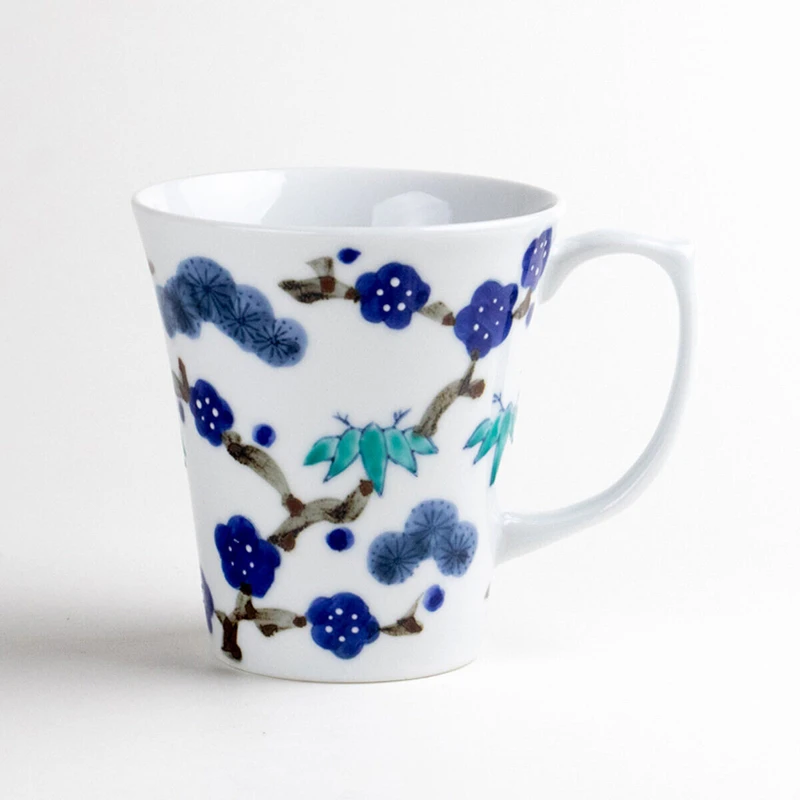
This is the most celebrated plant combination in Japanese decorative art. Together, pine (longevity), bamboo (resilience), and plum (courage) form a triad of virtues and are considered one of the most auspicious motifs a piece can carry.
Shochikubai is the standard choice for wedding gifts, anniversaries, and the opening of a new business. If you see all three painted together on an Arita bowl or plate, the piece is meant for a celebration.

See pine, bamboo, and plum pieces in our collection →
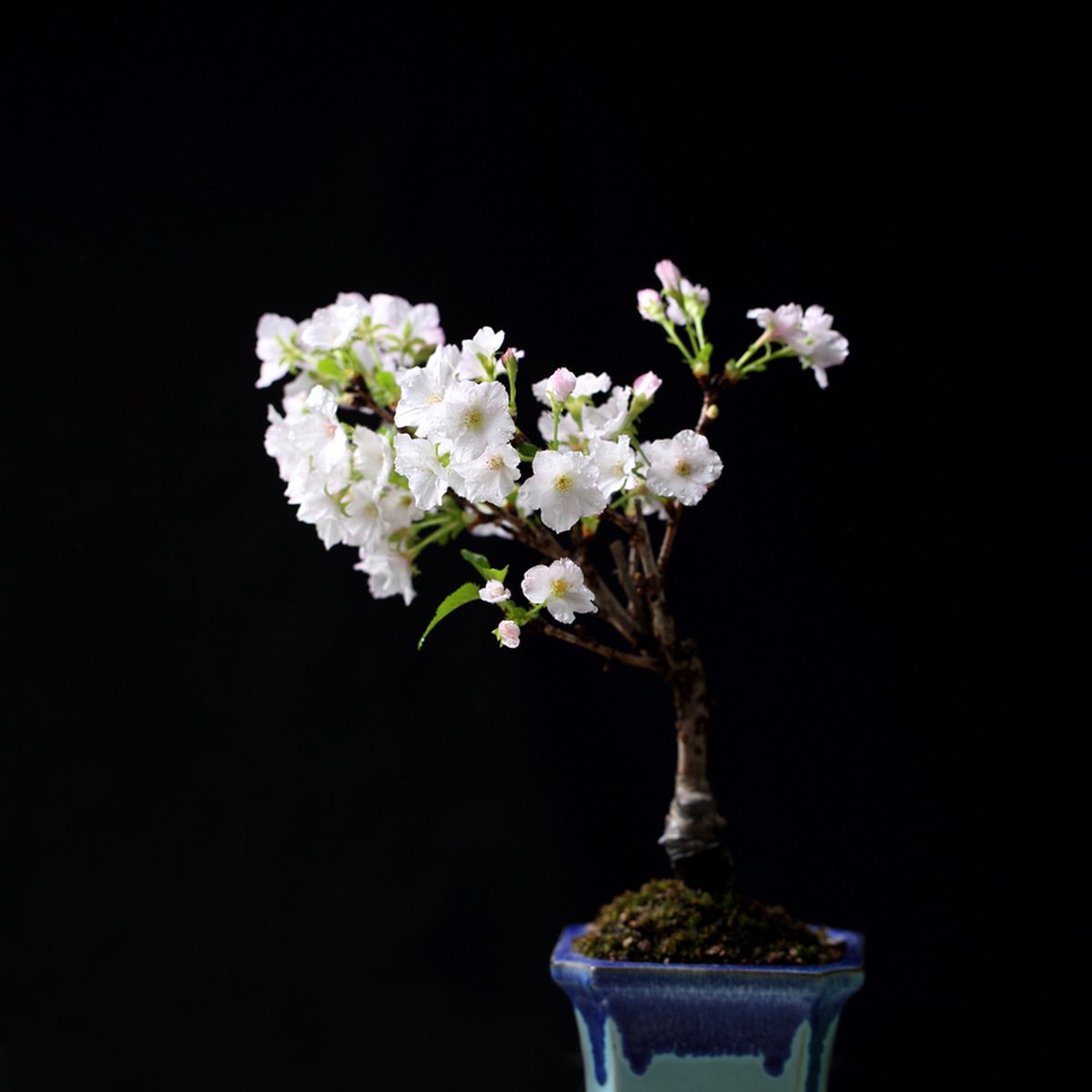
Sakura (桜) — Cherry Blossom
Sakura carries a gentler meaning than its fame abroad might suggest. In Japan, cherry blossom is associated with beauty that does not last — mono no aware, the bittersweet awareness of impermanence. The samurai of the Edo period adopted sakura as a personal emblem for exactly this reason: a meaningful life was understood as a brief, vivid one, like a blossom that falls at its peak. Today, sakura motifs celebrate the season, the present moment, and the preciousness of things that pass.
Cherry blossom pieces suit springtime meals and gatherings, and make thoughtful gifts for someone marking a transition.
Botan (牡丹) — Peony
The peony is the “king of flowers” in Chinese and Japanese tradition, associated with wealth, nobility, and prosperity. A peony motif is bold — luxuriant petals, often drawn with fine line work and deep cobalt pooling in the centers.
Botan is a classic choice for formal dinners, for gifts that wish material success, and for pieces that are meant to hold the center of a table.
Kiku (菊) — Chrysanthemum
The chrysanthemum is the emblem of the Japanese imperial family and carries associations with nobility, longevity, and purity. Kiku blooms in autumn and is the traditional flower of the ninth month. Its sixteen-petal form is one of the oldest motifs in Arita, dating to the very first export pieces sent to Europe in the 1660s.
A kiku piece is a good choice for autumn occasions, formal gifts, and as a neutral “classical” motif that suits most tables.
Karakusa (唐草) — Scrolling Vines
Karakusa means “Chinese grass” and refers to flowing, scrolling vine patterns that cover the surface of a piece. The motif traveled from Central Asia through China to Japan more than a thousand years ago and has been a staple of Arita since the kilns opened.
Because vines grow and connect endlessly, karakusa is associated with prosperity, continuity of the family line, and the wish for descendants who flourish in turn. It is one of the safest motifs for a gift — auspicious without being tied to a specific occasion.
Zakuro (石榴) — Pomegranate
The pomegranate, with its many seeds, is the traditional symbol of fertility and of a household blessed with many children. Zakuro is a warm gift for new parents, a wedding, or a new home.
It is also one of the Arita motifs that speaks clearly to its Chinese origins — pomegranate was painted on Chinese porcelain for centuries before Japanese kilns began working in the form.
Animal Motifs in Arita Ware and What They Symbolize
Animals in Arita painting almost always carry specific meanings. Some come from Chinese cosmology, some from Japanese folklore, and some from Buddhist tradition. A few you will meet again and again.
Ryu (龍) — Dragon
The dragon in Japanese and Chinese tradition is nothing like the dragon of Western fairy tales. It is a water spirit — a bringer of rain, a guardian of rivers and storms. It is associated with power, wisdom, and good fortune.
A dragon on an Arita plate or sake vessel is traditional for men, for power-related gifts, and for pieces meant to impress at the head of a table. In sometsuke, dragons are often drawn coiling through clouds, with the fine scales indicated by small comma-shaped strokes.
Tsuru (鶴) — Crane
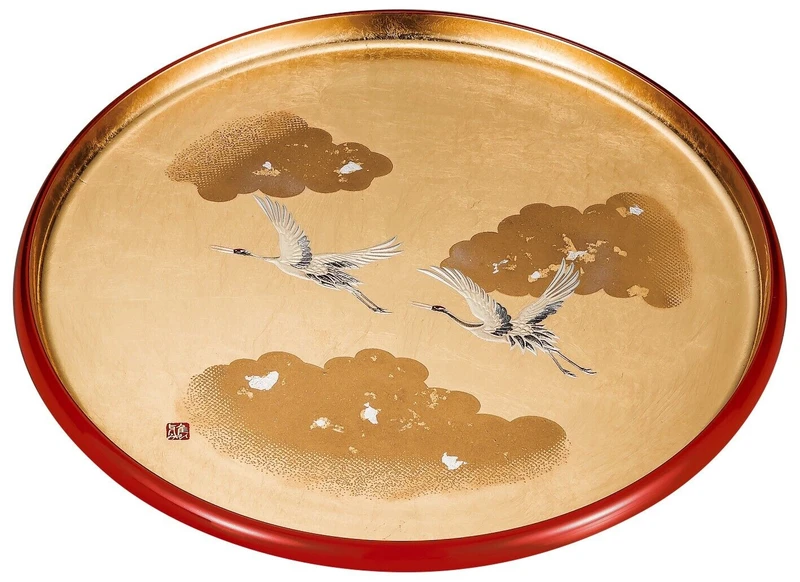
The crane is the Japanese symbol of longevity and fidelity. Cranes are believed to mate for life and are said to live for a thousand years — the “thousand-year crane” is a stock figure in Japanese literature. The image of a crane in flight carries associations of good fortune, a good marriage, and long life.
Tsuru is one of the most beloved motifs for wedding gifts and for milestone celebrations. A pair of cranes is a specific wish for a happy marriage.
Kame (亀) — Turtle
The turtle is the cousin of the crane in longevity symbolism. The Japanese proverb tsuru wa sennen, kame wa mannen — “the crane lives a thousand years, the turtle lives ten thousand” — pairs the two as a complete wish for long life.
In Arita painting, the turtle is often drawn with a flowing tail of trailing green or blue, which represents seaweed and signals that this is the minogame — the “seaweed-tail turtle” of legend, who has lived long enough to grow a tail.

Ho-o (鳳凰) — Phoenix
The phoenix is a rare and dignified creature from Chinese myth, said to appear only in times of peace and virtuous rule. It combines features of pheasant, peacock, and swallow, and is associated with the empress, with renewal, and with the harmony of opposites.
When the phoenix is painted alongside a dragon, the pair symbolizes the union of empress and emperor — and by extension, the harmony of a marriage. Phoenix-and-dragon pieces are among the most highly regarded wedding gifts in the Japanese decorative tradition. On their own, phoenix motifs on Arita are usually reserved for formal pieces — large plates for display, ceremonial sake vessels, wedding sets. A phoenix is a gift of high honor.
Koi (鯉) — Carp
The carp is the symbol of perseverance and of rising in the world. Chinese legend tells that a carp who swims up a waterfall will transform into a dragon — and from this came the association of koi with ambition, career success, and determination.
Koi motifs are traditional for Boys’ Day (Tango no Sekku, May 5th) and for gifts marking career milestones. A carp swimming against a current is a particularly pointed wish.
Browse pieces with crane, dragon, and phoenix motifs →
Sky and Water Motifs in Arita: Clouds, Waves, and Moon
Some Arita pieces are painted not with single symbols but with atmosphere — clouds, waves, mist, moonlight. These work less as explicit symbols and more as settings for the other motifs. But they have meanings of their own.
Kumo (雲) — Clouds
Clouds frame the painted world. In Arita, clouds are often used to separate scenes on a large plate — a dragon in one cloud-edged compartment, a landscape in another. Clouds also represent the higher realms, the dwelling of the immortals, and the unseen spirit world that sits just beyond the visible.
Nami (波) — Waves
Waves are associated with power, renewal, and the ceaseless motion of life. The most famous wave pattern in Japanese design, seigaiha (see below), comes from an older sometsuke tradition. A single dramatic wave — cresting, breaking, full of foam — is a modernist favorite on contemporary Arita and carries associations of strength in the face of change.
Tsuki (月) — Moon
Moon motifs are rare on sometsuke but beautiful when you find them. The moon is traditionally associated with autumn (especially the meigetsu, the harvest moon of the ninth month) and with quiet contemplation. A piece painted with a moon rising behind pine branches is a classic autumn motif.
Classical Geometric Patterns in Arita Ware
Not every Arita piece has a single painted scene. Many have geometric or repeated patterns covering part or all of the surface. These patterns are ancient — several of them predate Arita-yaki by centuries — and carry their own associations.
Seigaiha (青海波) — “Blue Sea Waves”
Concentric semicircles overlapping like fish scales, painted to represent the surface of the sea. Seigaiha is one of the oldest patterns in Japanese decorative art and has been used continuously since the eighth century. It carries associations of peaceful seas, safe voyages, and the endlessly renewing rhythm of life. A beautiful motif for tea things, for travel gifts, and for pieces meant to be restful to look at.
Asanoha (麻の葉) — “Hemp Leaf”
A six-pointed geometric pattern resembling the star-shaped leaf of the hemp plant. Because hemp grows straight and fast, asanoha is a traditional motif for babies and children — painted on cloth for a newborn’s first clothing, and on small Arita pieces given at birth celebrations.

Shippo (七宝) — “Seven Treasures”
Interlocking circles that form four-pointed stars where they meet. The name means “seven treasures” and the motif is associated with harmony, good relationships, and prosperity. Shippo is a safe choice for wedding and anniversary pieces.
Kikko (亀甲) — “Turtle Shell”
A hexagonal pattern derived from the shape of a turtle’s shell, and carrying (like the turtle itself) associations with longevity. Kikko is often used as a background pattern on the rims of plates, with a painted scene in the center.
Komon (小紋) — Fine Repeated Motifs
On many everyday Arita pieces, the painter fills a border or the full surface with very small, finely-drawn repeated motifs — tiny chrysanthemums, small cross-hatches, miniature cranes. These finely-scaled patterns are called komon and are a hallmark of careful Arita work. Looking closely at a komon border is often the fastest way to tell an attentive hand-painted piece from a mechanically printed one.
The eye learns this distinction quickly with practice — and once it does, you see it everywhere. (For the simple fingertip test that confirms a hand-painted piece, see our guide to Hand-Painted vs. Transfer-Printed Japanese Ceramics.)
How to Choose Arita Ware Patterns for Gifts and Occasions
Once you can read a few of these symbols, choosing a piece as a gift becomes much easier. Here are some traditional pairings — not rules, but useful starting points.
- A wedding. Shochikubai (pine-bamboo-plum), a pair of cranes (tsuru), or a phoenix-and-dragon piece. A pair of sake cups with matched motifs is a gift with weight.
- A housewarming. Shippo (seven treasures), karakusa (scrolling vines), or peony (botan). These say “prosperity and harmony in this new home.”
- A birth. Asanoha (hemp leaf) for a newborn; zakuro (pomegranate) for parents wishing for more children. Kiku for a daughter born in autumn.
- A retirement or milestone birthday. Pine, crane, or the minogame turtle. The longevity symbols are the traditional choice.
- A new business or career move. Koi (carp), for perseverance and ambition. Peony, for prosperity.
- A farewell or transition. Plum (ume), for quiet courage. Sakura, to acknowledge the beauty of the moment.
- For yourself, without occasion. Karakusa — the endlessly scrolling vine. No wrong time, no wrong reason.
In practice, many customers don’t begin with the meaning. They begin with a feeling — and only later discover that the motif says exactly what they wanted to express.
What to Look for on Your Next Arita Piece
When you hold an Arita piece in your hand, there is more to see than beauty.
Turn it over. The underside often carries a mark — sometimes a kiln seal, sometimes a fuku (福, “good fortune”) mark, occasionally the signature of the painter. On fine pieces, these marks are written freehand in cobalt blue and carry small variations from piece to piece.
Look at the composition. A well-painted Arita piece uses empty white space as a deliberate part of the design. The Japanese term yohaku no bi — the beauty of empty space — applies here. A motif set off by generous white often has more presence than a fully-covered surface.
Notice where the motif has been placed. On a bowl, an important motif is often painted to face the person holding the bowl — visible when they bring the bowl to their lips. On a plate, the main motif usually sits in the central field, with border patterns framing it.
Most of all, notice which motif you return to. A pine that you find yourself looking at every morning is worth more than a phoenix you set on display once a year.
Editor’s Picks
Three pieces chosen not only for their beauty, but for how naturally they fit into everyday life — three different ways an Arita motif can quietly join a home.
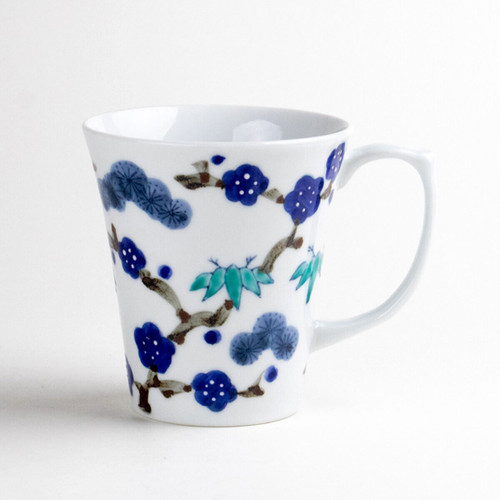
Arita Mug — Shochikubai in Soft Sometsuke. A hand-painted pine-bamboo-plum mug in soft cobalt blue — the most auspicious triad in Japanese decorative art, painted gently enough that you can drink coffee from it every morning. Shochikubai belongs traditionally to weddings and celebrations, and there is something quietly cheerful about starting an ordinary day with that wish on the rim of your cup. The cobalt tone here is soft and watery, closer to brush ink than to a graphic — the mark of a sometsuke painter who works lightly — and the mug shape is comfortable in either hand. A beautiful first Arita piece for someone curious about the tradition, and a thoughtful housewarming gift for a friend starting a new chapter. (See the piece)
Pair Yunomi — Karakusa in Red and Blue. A pair of hand-painted yunomi (everyday tea cups) painted in karakusa — the scrolling-vine motif that quietly wishes for prosperity and the continuation of a family line. One cup in deep cobalt, one in iron-red, so they sit together as a meoto (his-and-hers) pair without matching too perfectly. This is the gift we most often recommend for a wedding or for a couple moving into a new home: the meaning is gentle, the design is welcoming, and the size is right for green tea twice a day. A pair that grows quietly into a household.
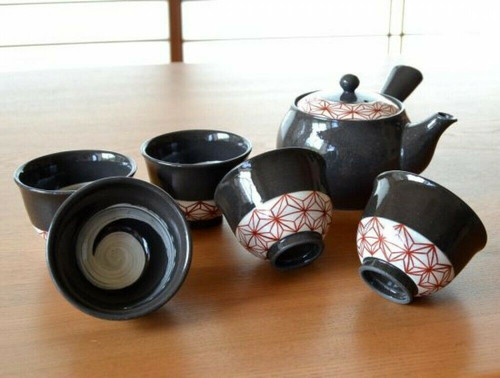
Tea Set — Asanoha in Black and Red. A kyusu (teapot) and matching yunomi finished in the asanoha (hemp-leaf) pattern — but rendered in striking black and red rather than the usual blue-and-white sometsuke. The traditional meaning of asanoha is the straight, fast growth of hemp, and the motif has long been chosen for newborns and children; in this contemporary palette, the meaning shifts gently outward to a quiet wish for growth and strength in any new beginning. A handsome gift for a new home, a graduation, or anyone who pours green tea more than once a day. The kyusu is the star of the set — the asanoha repeats around its body in small, precise points that catch the light at every turn. (See the set)
Quick Terms
- Arita-yaki (有田焼) — Porcelain from the town of Arita in Saga Prefecture, produced since the early 1600s. Japan’s oldest porcelain tradition.
- Imari ware — A historical European name for export-grade Arita porcelain, taken from the port of Imari. Today, “Imari” often refers to the more ornate red-and-gold overglaze export style.
- Kakiemon (柿右衛門) — A celebrated Arita kiln tradition founded by Sakaida Kakiemon I in the mid-1600s; known for fine red-and-white iro-e on a milky white nigoshide body.
- Sometsuke (染付) — Underglaze cobalt-blue painting; the design is applied before glazing and sealed beneath the glass when fired.
- Iro-e (色絵) — Overglaze painting in multiple colors; applied on top of the finished glaze and fired a second time.
- Karakusa (唐草) — Scrolling vine pattern; a symbol of continuity, prosperity, and family lineage.
- Shochikubai (松竹梅) — The pine–bamboo–plum combination, the most auspicious triad in Japanese decorative art.
- Seigaiha (青海波) — Overlapping semicircle wave pattern.
- Asanoha (麻の葉) — Six-pointed hemp-leaf pattern; traditional for children.
- Shippo (七宝) — Interlocking circle pattern meaning “seven treasures.”
- Yohaku no bi (余白の美) — The beauty of empty space; a governing aesthetic principle in Japanese design.
- Fuku (福) — “Good fortune”; a wishing mark often painted on the underside of older Arita pieces.
FAQ
Q: What is the most common motif on Arita-yaki?
Karakusa (scrolling vines) and various plant motifs — especially peony, chrysanthemum, and plum — appear most often. Among everyday pieces made for the home market, karakusa is probably the single most common.
Q: Are the meanings of sometsuke motifs the same across all Japanese porcelain?
Largely yes. The motifs in Arita draw on a shared vocabulary with Kutani, Kiyomizu, and Imari pieces, and many of them came originally from Chinese decorative tradition. A crane means longevity whether it is painted in Arita blue-and-white or Kutani five-color. Regional differences are mostly in style, not in meaning.
Q: Is blue-and-white Arita the same as “Imari ware”?
The terms overlap. “Imari” was originally the name of the port from which Arita pieces were exported — so the same piece might be called “Arita” in Japan and “Imari” in Europe. Today, “Imari” often refers specifically to the more ornate export style with red and gold overglaze over underglaze blue, while “Arita” covers the full range of porcelain from the Arita kilns, including simple everyday sometsuke.
Q: What about Kakiemon ware — is it different from Arita?
Kakiemon is a specific style and family of kilns within Arita, not a separate region. The Kakiemon studio is renowned for iro-e overglaze painting in red, green, and yellow on a distinctive milky-white porcelain body called nigoshide — paler and warmer than standard Arita white. When you see “Kakiemon,” think of it as the most refined branch of the Arita tradition, and the one that most directly influenced early European porcelain.
Q: How do I know the motif on my Arita piece is genuinely hand-painted and not printed?
Touch will not tell you. Sometsuke (blue underglaze) sits beneath the glaze, so hand-painted and transfer-printed pieces both feel perfectly smooth. Look instead at the lines: hand-painted cobalt shows slight variation in thickness and depth of blue, soft bleeding at the edges, and small differences between two pieces of the same pattern. Transfers are uniform from piece to piece, and the dots of a printing screen can sometimes be seen under magnification. For a fuller explanation, see our guide to Hand-Painted vs. Transfer-Printed Japanese Ceramics.
Q: Is it rude to give a piece with a meaning I don’t fully understand?
Not at all. The meanings of these motifs are well-established in Japanese culture but are rarely “read” consciously when a piece is given as a gift. Choosing a piece because you love how it looks — and then learning what it means — is a perfectly good sequence. A thoughtful gift is still a thoughtful gift.
Q: Do all Arita pieces have hidden meanings?
Most traditional motifs do, yes. But modern Arita studios also produce minimalist and contemporary work that uses purely abstract design — bands of cobalt, gradients, geometric experiments. These pieces carry the weight of the tradition without a specific symbol, and are chosen more often for visual harmony with a modern interior.
Q: Can I mix motifs at the same table?
Yes — in fact, a mixed table is the traditional Japanese approach. A meal is rarely served on a matched set; instead, each small dish is chosen for its own reason, and the variety is part of the pleasure. A crane dish next to a plum dish next to a plain blue bowl is a perfectly correct composition.
In Closing
The beauty of an Arita piece is the first thing you notice.
The meaning is what you come back to — the quiet pine on a tea bowl someone gave you, the pomegranate on a dish that is somehow always the one your family reaches for, the karakusa that ties a whole cupboard together without anyone noticing.
Choose the piece you love first. The meaning has a way of finding you.
And if you’re choosing for someone else, that instinct matters even more. The right piece is often the one that quietly feels like it belongs to them.
For the ware itself — what makes Arita porcelain what it is, and how to choose a piece — see our guide to Arita ware.
Browse our Arita collection — and find the piece that quietly belongs in your home.
— from Osaka, Team Manekineko-Ai
PIECES IN THIS ARTICLE
Two pieces from this article
CONTINUE READING
MORE IN MOTIFS →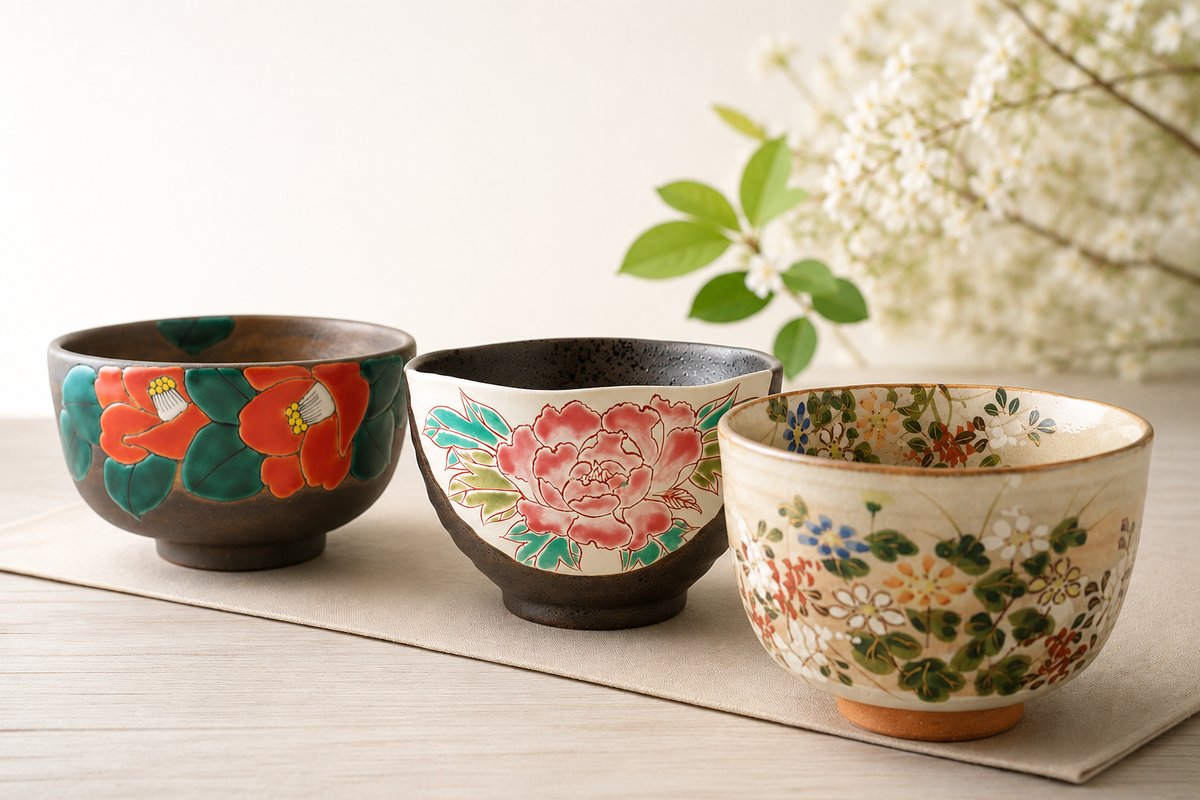 MOTIFS, SYMBOLS & AESTHETICS
Camellia, Peony, and Chrysanthemum: Three Flowers That Carry Japan’s Best Wishes
Camellia, peony and chrysanthemum: three flowers that carry Japan's best wishes, by color and season.
MOTIFS, SYMBOLS & AESTHETICS
Camellia, Peony, and Chrysanthemum: Three Flowers That Carry Japan’s Best Wishes
Camellia, peony and chrysanthemum: three flowers that carry Japan's best wishes, by color and season.
 MOTIFS, SYMBOLS & AESTHETICS
Seasonal Patterns in Japanese Craft: Sakura, Momiji, Yukiwa & The Year Read in Motifs
Ume, sakura, asanoha, ryusui, momiji, moon-and-rabbit and yukiwa, read as a calendar in motifs.
MOTIFS, SYMBOLS & AESTHETICS
Seasonal Patterns in Japanese Craft: Sakura, Momiji, Yukiwa & The Year Read in Motifs
Ume, sakura, asanoha, ryusui, momiji, moon-and-rabbit and yukiwa, read as a calendar in motifs.
 MOTIFS, SYMBOLS & AESTHETICS
Seven Lucky Japanese Motifs Explained: Meaning, Symbolism & Gift Traditions
Cranes, turtles, scrolling vines, calm waves, gourds, gathered treasures and pine-bamboo-plum, and the wish each one carries.
MOTIFS, SYMBOLS & AESTHETICS
Seven Lucky Japanese Motifs Explained: Meaning, Symbolism & Gift Traditions
Cranes, turtles, scrolling vines, calm waves, gourds, gathered treasures and pine-bamboo-plum, and the wish each one carries.