
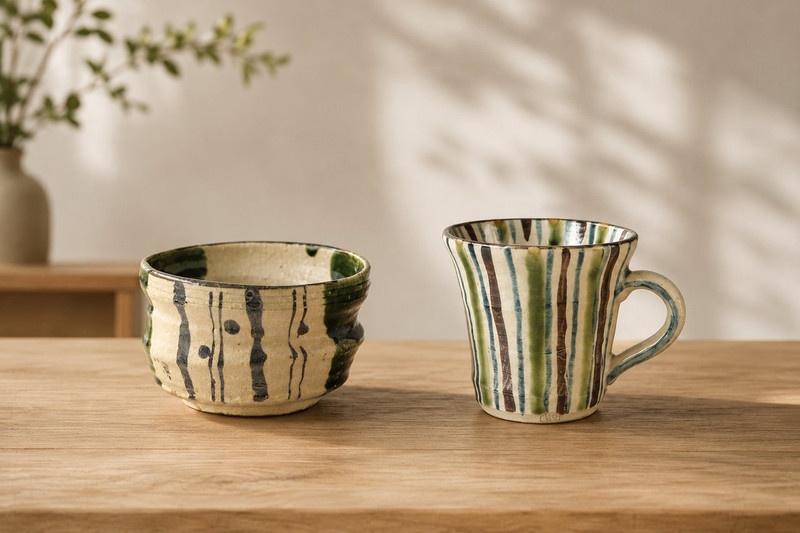
Handmade and factory-made are not a hierarchy. They are answers to different questions — and once you can tell them apart, you can choose the right one on purpose.
There is a quiet assumption that follows the word "handmade" around: that it is simply better, and that "factory-made" is what you settle for. It is worth setting that assumption down before we begin, because it is not true, and believing it will lead you to buy the wrong things for the wrong reasons.
Japan makes some of the most beautiful handmade tableware in the world. It also makes some of the best factory tableware in the world — and most of what sits on a Japanese table, in homes and good restaurants alike, is the latter. The two are not a hierarchy. They are answers to different questions. A hand-thrown tea bowl and a production rice bowl are both honest objects; they were simply made for different lives.
This guide does two things. First, it shows you how to actually tell the two apart — the concrete, in-the-hand signs, so the word on the label is not your only information. Second, it helps you decide which one you actually want for a given purpose, which is a different and more useful question than which one is "better."
On this page
1. What "Handmade" and "Factory-Made" Really Mean
The first thing to understand is that these are not two boxes but a spectrum, and most tableware lives somewhere along it rather than at either end.
At one end is the fully handmade piece: clay thrown on a wheel or shaped by hand, glaze applied by hand, decoration painted with a brush, each piece passing individually through a person's hands and a kiln. No two are exactly alike, because they cannot be.
At the other end is the fully industrial piece: liquid clay poured into moulds (slipcasting) or pressed by machine, decoration applied by transfer print or machine, fired in continuous kilns by the thousand. Every piece is, by design, identical to the next.
In between sits the large and honest middle where most good Japanese tableware actually lives: workshop production. A regional pottery town like Mino or Hasami may cast or press the body by efficient methods, then have a person trim, glaze, or finish it by hand. This is neither "handmade" in the artisan sense nor "factory-made" in the soulless sense — it is skilled, semi-industrial making, and it is the engine of everyday Japanese ceramics.
Holding this spectrum in mind changes the question. You are rarely choosing between "art" and "product." You are usually choosing where on the spectrum a piece sits, and whether that suits what you want it for.
2. How to Tell Them Apart
Here is the practical heart of the guide. None of these signs is decisive alone, but together they tell you reliably what you are holding.
Turn it over and read the base. This is the single most informative thing you can do. A wheel-thrown piece usually shows a faint spiral at the centre of the foot, left by the potter's fingers as the piece came off the wheel, and trimming marks where the foot ring was cut. A slipcast piece often shows a faint seam line where the two halves of the mould met, and a base that is smooth and uniform with no spiral. A pressed factory piece tends to be perfectly even, sometimes with a printed backstamp and no tool marks at all.
Look for throwing lines. Run a finger up the inside wall of a bowl or mug. Hand-thrown pieces carry faint horizontal throwing rings — the rhythm of the wheel — and slight, living variation in the thickness of the wall. Slipcast and machine-pressed pieces are uniformly smooth and uniformly thick, because a mould has no fingers.
Read the decoration closely. This is where transfer prints give themselves away. Hand-painting shows actual brushstrokes: variation in the thickness of a line, places where the brush loaded and ran dry, soft blending at the edges of a colour. A transfer print has none of that — its lines are mechanically even, and on close inspection (a loupe helps) you can often see the pattern is built from a fine field of tiny dots or stippling, left by the engraved plate the print was made from. Traditional Japanese blue-and-white (sometsuke) painted by hand in cobalt gosu shows the brush; a printed imitation shows the dots.
Weigh it in your hand. A hand-thrown piece usually carries a reassuring heft at its base — the extra clay a potter leaves to support the walls during throwing — which gives it a grounded centre of gravity. Many factory pieces feel either uniformly light or slightly top-heavy by comparison. Weight alone proves nothing, but combined with the base and the walls it confirms a picture.
Compare two of the same. If you can hold two pieces from the same line, look at how alike they are. Two handmade pieces will differ in small, honest ways — a slightly different lean, a glaze that pooled differently. Two factory pieces will be, for practical purposes, identical. Neither is a fault; it is the signature of the method.
Check the mark and the box. Artist-made pieces often carry an impressed or painted kiln or maker's mark, and serious ones come in a signed wooden box (tomobako, 共箱). Production ware usually carries a printed backstamp, sometimes simply the kiln town's name — "美濃焼 / Mino ware, Japan."
Let price be a guide, too. In Japanese tableware, price often reflects the method and the effort quite honestly. A piece a person made one at a time, judging each step, carries the hours and care in its price. A piece made efficiently by the thousand costs less because the region is genuinely good at making it — not because corners were cut. Both prices are honest; they are simply prices for different things.
A note on lacquerware
For lacquer, the key distinction is real urushi (本漆) versus a synthetic coating such as urethane or cashew. A few honest checks: real urushi has a deep, soft sheen with a translucent depth — you seem to look into the surface — where synthetic coatings give a flatter, sharper gloss; against the lips a true urushi bowl feels soft and faintly warm rather than plasticky. Japanese lacquerware often lists the coating type on the product information — urushi (漆), uretan (urethane), or kashū (cashew) — so that is the first thing worth checking. And a useful tell: a piece clearly marked as dishwasher- and microwave-safe is, in most cases, synthetic-coated, because real urushi is not. As with ceramics, none of these is decisive alone, but together they are reliable — and, as ever, the price register tells you a great deal.
3. The Honest Case for Factory-Made
It would be easy to treat this section as the consolation prize. It is not. For most people, most of the time, well-made factory tableware is exactly the right thing to own, and there is real pride in it.
Consider what a region like Mino actually does. By some industry counts it produces around half of all Japanese tableware, and it does so by being, after centuries of practice, extraordinarily good at putting durable, true-glazed, well-shaped vessels onto ordinary tables at a friendly price. The cleanly glazed rice bowl from a Mino workshop is not a failed tea bowl; it is a successful answer to a different and equally worthy problem — how to give everyone good vessels for daily life. That is not a lesser ambition than the tea master's. In many ways it is a larger one.
Factory and workshop tableware also has plain practical virtues. It is consistent, so you can replace or extend a set. It is often dishwasher- and microwave-tolerant. It is forgiving of daily knocks. And because Japan's production regions are so skilled, even inexpensive pieces tend to be genuinely well made. For the bowls and plates you will actually eat from every day, this is not settling — it is choosing well.
4. The Case for Handmade
What, then, are you paying for when you buy the handmade piece?
You are paying for variation — the fact that this bowl is the only one exactly like it, that the glaze ran where the fire and gravity decided rather than where a machine specified. You are paying for a person's decisions, made one at a time: this curve, this thickness, this scorch left rather than sanded away. And you are paying for the particular pleasure of an object that shows its making — the throwing lines, the uneven blush of a glaze, the slight weight that means a hand judged it.
A handmade piece also tends to take on a different character with use. A hand-glazed tea bowl, a hand-finished lacquer cup — these are objects that deepen with use, that reward attention, that become more yours over years. They are made to be lived with closely rather than simply used. That is worth paying for when it is what you actually want — and worth not paying for when what you need is four matching bowls for weeknight dinners.
5. So Which Should You Choose?
The useful question is never "which is better," but "what is this for?"
For daily life, choose well-made production ware. The bowls, plates, mugs, and cups you reach for every day should be durable, replaceable, comfortable, and unworried about a dishwasher. This is the factory and workshop end of the spectrum, and choosing it is not a compromise — it is the right tool for the job, and it leaves your budget for the pieces that deserve it.
For the piece you contemplate, choose handmade. The tea bowl you use on a quiet morning, the sake cup that makes an evening feel deliberate, the one dish you set out when guests come, the gift meant to last and to mean something — these are where a handmade object earns its price, because here you are not just using the thing, you are living with it.
And feel free to mix the two on one table. This is, in fact, the most Japanese answer of all. A single hand-thrown bowl among everyday production plates lifts the whole setting; a beautiful factory dish carries a handmade cup without embarrassment. A table does not need to be all one thing. It needs to be used, and enjoyed.
6. Frequently Asked Questions
Q: Is handmade pottery always better than factory-made?
No. It is different, not better. Handmade pieces offer uniqueness and the character of a maker's hand; factory and workshop pieces offer consistency, durability, value, and everyday practicality. The "better" one is the one suited to what you want it for.
Q: What is the quickest way to tell if a ceramic piece is handmade?
Turn it over and look at the foot. A faint spiral and trimming marks suggest it was thrown on a wheel; a smooth base with a faint seam line suggests it was slipcast in a mould. Then check the inside walls for throwing rings and the decoration for brushstrokes versus printed dots.
Q: How can I tell hand-painted decoration from a transfer print?
Look closely, ideally with a loupe. Hand-painting shows brushstrokes — varying line thickness and soft blended edges. A transfer print is mechanically even and is often built from a fine field of tiny dots or stippling left by the engraved plate.
Q: Is mass-produced Japanese tableware low quality?
Not at all. Japan's production regions, such as Mino and Hasami, are so skilled that even inexpensive pieces are usually well made — true glazes, durable bodies, refined shapes. Mass production here means efficiency, not cut corners.
Q: How do I tell real urushi lacquer from a synthetic coating?
Real urushi has a deep, soft, almost translucent sheen and a soft feel; synthetic coatings look flatter and glossier. The coating type is often listed on the product information (urushi / urethane / cashew), so check there first, and remember that anything clearly marked dishwasher- or microwave-safe is, in most cases, synthetic, since real urushi is not.
7. Editor's Picks — One of Each, Both Honest
Three pieces from our collection that show the spectrum this guide describes — one made for contemplation, two made for daily life, and none the lesser for it.
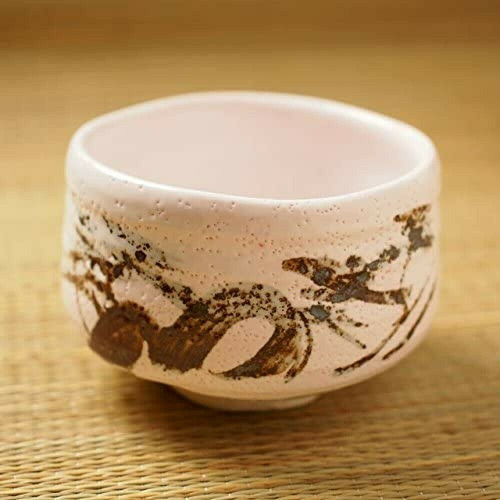
Pick 1 — Momoyama Shino Matcha Tea Bowl (handmade, a piece to live with). A matcha bowl in the Shino style, with the thick, warm-white feldspar glaze applied by hand and the slight, living irregularities that mark a piece made one at a time. This is the kind of object to choose when you want to live with a piece rather than simply use it — a quiet morning bowl that rewards attention and takes on character over the years. (See the tea bowl)
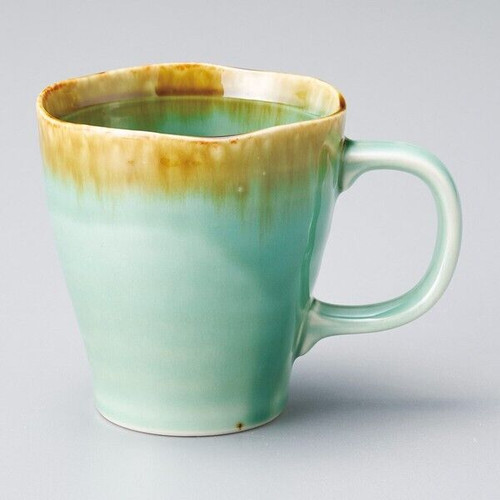
Pick 2 — Hisui Emerald Green Mino Mug (everyday, for every morning). A production mug from the Mino kilns in a deep emerald hisui glaze — exactly the kind of well-made, friendly-priced, dishwasher-tolerant piece that makes the case for good factory tableware. Reach for it every single morning without a second thought; that is what it is for, and it does it beautifully. (See the mug)
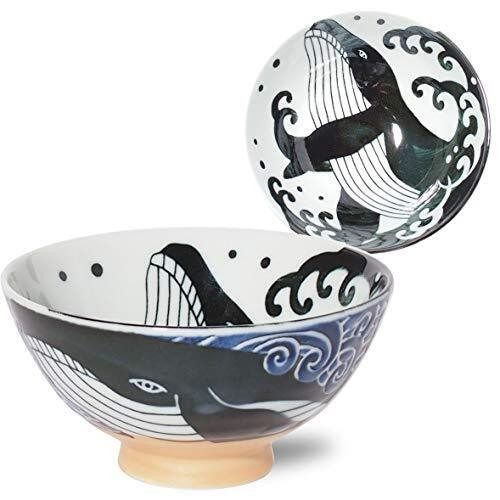
Pick 3 — Shironami Whale Rice Bowl (everyday, beautifully made). A Mino production rice bowl, light to lift and comfortable in the hand, with a quiet white-wave pattern and a small whale along the rim. It shows how much character a well-made factory piece can carry while still being durable, replaceable, and easy to live with — the honest workhorse of the everyday table. (See the bowl)
8. Closing
The line between handmade and factory-made is worth learning to read — not so you can sort objects into better and worse, but so you can choose with your eyes open. Turn the piece over, look at the foot and the brushwork, feel its weight, read the price honestly. Then ask the only question that matters: what is this for? Buy handmade for the pieces you want to live with, and well-made production ware for the life you actually live. A good table, like a good shelf in a good shop, has room for both.
If you would like help deciding which is right for a particular use — a daily set, a first handmade piece, a gift — we are always glad to help.
— from Osaka, Team Manekineko-Ai