
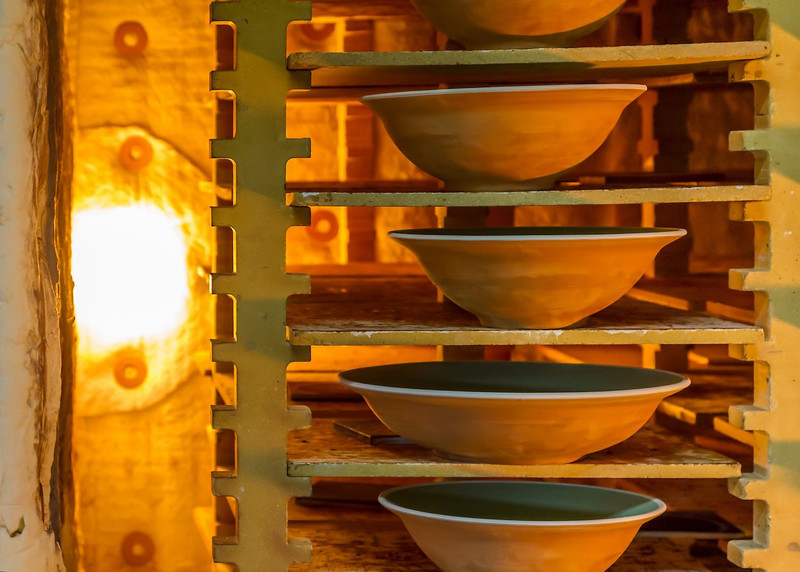
What does Mino ware look like? It looks like the Japanese table itself — in every era, including this one. There is a good chance it already looks like yours.

Here is a quiet fact to begin with: if you have ever eaten from Japanese tableware — in a restaurant, at a friend's house, from a set bought at a Japanese shop — you have very likely eaten from Mino ware without knowing it. This guide is about why that is true, and why it is the most interesting thing about Japan's most common ceramic.
On this page
2. Where Mino Is — and the Word-Trap Next Door
3. Thirteen Hundred Years, Briefly
4. The Four Momoyama Glazes
5. The Workhorse — What Mino Ware Means Today
6. How to Read a Mino Piece
7. Choosing and Living With Mino Ware
8. Quick Terms
9. Frequently Asked Questions
10. Editor's Picks — Three Mino Pieces
11. Closing
1. The Most Common Japanese Ceramic Nobody Names
Mino ware (Mino-yaki, 美濃焼) is produced in the eastern hills of Gifu Prefecture, in central Japan, and it is often said to account for roughly half of Japan's ceramic tableware production — by some industry counts, even more. The rice bowl in a Tokyo ramen shop, the teacup in an Osaka office, the small plate under a sweet in a Kyoto café: statistically, the odds are good that each of them came out of a Mino kiln.
And yet most people — including many Japanese people — could not tell you what Mino ware looks like. Ask someone to picture Arita ware and they will see blue-and-white porcelain. Ask them to picture Kutani and they will see dense, painted colour. Ask them to picture Mino ware and they will usually pause.
That pause is not ignorance. It is the most accurate possible answer, and understanding why is the key to this whole subject. Mino ware has no single look — and that is not a gap in its identity. It is its identity. Mino is the region that, for four centuries, has made whatever the Japanese table needed: tea bowls for warlords in one era, white porcelain for every household in another, ramen bowls and mugs and sake cups today. Its genius is range, not signature.
This guide walks through where Mino ware comes from, the 1,300 years behind it, the four famous glazes that made its name in the tea world, how it became the quiet workhorse of the modern Japanese kitchen, and how to choose a piece well.
2. Where Mino Is — and the Word-Trap Next Door

Mino ware comes from the Tōno region (東濃) of Gifu Prefecture — the old province of Mino — centred on four neighbouring cities: Tajimi (多治見), Toki (土岐), Mizunami (瑞浪), and Kani (可児). The area sits in the hills an hour or so northeast of Nagoya, rich in the fine clays and feldspars that good ceramics ask for, and dense with kilns in a way few places on earth are. Toki city alone regularly ranks as the largest ceramic-producing city in Japan.
Before going further, a small word problem worth clearing up — the same kind of trap that catches beginners in many Japanese crafts.
Directly across the prefectural border from Mino sits Seto (瀬戸), in Aichi Prefecture — another of Japan's great historic kiln towns. Seto's name became so synonymous with ceramics that the everyday Japanese word for "crockery" is setomono (瀬戸物) — literally "Seto things." Many Japanese people use setomono for any ceramic dish on their table, including dishes that were actually made in Mino.
The two regions are genuinely entangled. They share clay beds, glaze traditions, and centuries of potters moving back and forth across the border — including, at one decisive moment in history, a migration of Seto potters into Mino that shaped everything that followed (more on this in the next section). Several of Mino's most famous glaze styles even carry Seto's name: Kizeto means "Yellow Seto," Setoguro means "Seto Black" — both made in Mino.
For the beginner, the practical takeaway is simple: Mino and Seto are sibling traditions, and "setomono" is a household word, not a label of origin. When a piece matters to you, look for the actual production region — and when the region is Tōno in Gifu, what you are holding is Mino ware.
3. Thirteen Hundred Years, Briefly
Mino ware's history is long even by Japanese craft standards, but it reads less like a single lineage and more like a series of reinventions. Four chapters are worth knowing.
Ash-glazed beginnings (7th century onward). Kiln remains and pottery in the 7th-century style have been excavated across the Tōno hills, putting Mino's working history at more than 1,300 years. By the Heian period, Mino kilns were producing shirashi — early ash-glazed ware — for daily use. From its first chapter, Mino's role was supplying ordinary vessels in quantity, a character it never lost.
The Seto migration and the protection of the Toki lords (16th century). In the wars of the late Muromachi and Sengoku eras, potters from Seto fled the fighting around their kilns and resettled across the border in Mino, under the protection of the local Toki lords. They brought Seto's accumulated glaze knowledge with them. The fusion of Seto technique and Mino clay set the stage for the most celebrated burst of creativity in Japanese ceramic history.
The Momoyama golden age (late 16th century). As the tea ceremony rose to the centre of elite culture under Sen no Rikyū and his students, the Mino kilns answered with entirely new kinds of tea ware — the first ceramics in the Japanese tradition that can be called designed, in the modern sense, rather than evolved. In the space of a few decades, Mino produced the four glaze styles that still define its artistic reputation: Shino, Oribe, Kizeto, and Setoguro. Each gets its own portrait in the next section.
The everyday-ware centuries (Edo period to today). When the tea boom cooled, Mino turned — without apparent regret — back to volume production for the ordinary household. In the Meiji period (1868–1912), the region industrialised early and thoroughly: porcelain, transfer printing, mechanised kilns. That early industrial head start compounded for a century, and it is why Mino is said to produce around half of Japan's tableware today. In 1978, "Mino ware" was designated a traditional craft of Japan, the designation covering some fifteen distinct historical styles — a number that says something in itself. Most famous Japanese kilns are known for one look. Mino was certified for fifteen.
4. The Four Momoyama Glazes — Mino's Artistic Signature
If Mino's modern identity is range, its historical fame rests on four glazes born in the tea-ceremony decades of the late 1500s. These four names are the ones you will meet on gallery cards, in auction catalogues, and on the better shelves of any Japanese ceramics shop. They are worth knowing individually, because each one represents a different idea of what a beautiful surface can be.
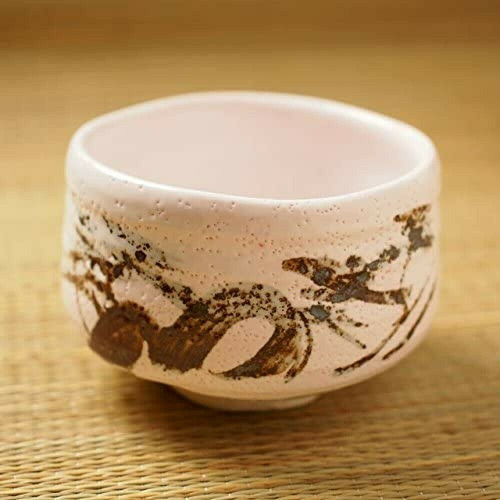
Shino (志野) — the warm white. Shino is generally regarded as the first white glaze developed in Japanese ceramics: a thick, milky feldspar glaze, white with a faint blush of crimson or orange where the fire touched it, often pocked with tiny pinholes the tea masters prized as yuzu-hada — "citrus skin." Under the glaze, potters drew simple designs in iron — grasses, fences, bridges — making Shino also one of the first Japanese ceramics to carry painted decoration under the glaze. A good Shino bowl looks less like a manufactured object than like something warm found in snow. Among collectors of tea ware, Shino is the Mino glaze that commands the deepest reverence.
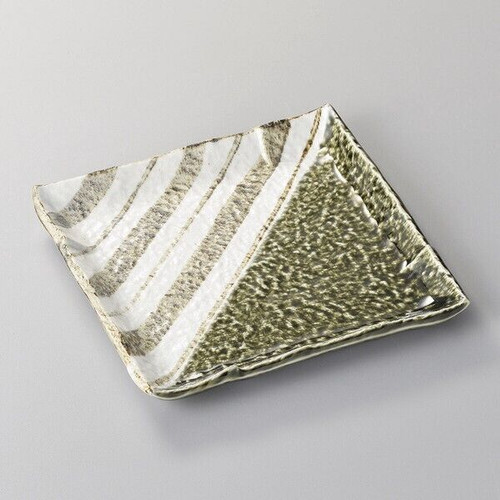
Oribe (織部) — the deliberate eccentric. Named for the tea master Furuta Oribe (1544–1615), a student of Rikyū whose taste ran to the bold and the deliberately irregular. Oribe ware is instantly recognisable: deep copper-green glaze pooled over part of the piece, the rest left pale and painted with quick geometric or botanical motifs; shapes that are intentionally warped, squared, or asymmetrical. Where most ceramics of the era aimed for refinement, Oribe aimed for wit. It is the most playful of the classical Japanese glazes, and its green remains so distinctive that "Oribe green" functions as a colour name in Japanese to this day.
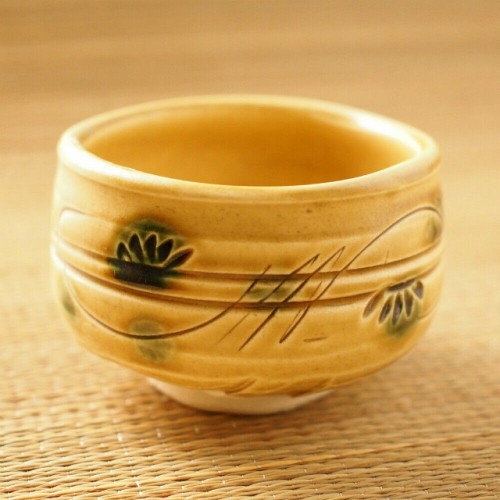
Kizeto (黄瀬戸) — the quiet yellow. "Yellow Seto" — the name carried over from the Seto tradition, the glaze made in Mino. Kizeto is a soft, matte, oil-yellow glaze, sometimes touched with patches of green (tampan) or scorch marks, over simple, humble forms. It is the least theatrical of the four, and for exactly that reason it has long been loved by people who use tea ware rather than display it. A Kizeto dish does not announce itself; it warms the food on it.
Setoguro (瀬戸黒) — the pulled-from-fire black. "Seto Black," again made in Mino, and the most dramatic of the four in technique. Setoguro tea bowls were pulled from the kiln at the peak of firing, red-hot, and cooled suddenly — a shock that fixes the iron glaze in a deep, lightless, matte black unlike anything achieved by slow cooling. The bowls are typically cylindrical, low, and severe. Setoguro is generally considered the first Japanese ceramic tradition to pursue black as the goal itself rather than as a byproduct — a register of black that Japanese craft would return to again and again, in ceramics and far beyond them.
One thread ties the four together. All of them were made for use — for tea actually drunk, in rooms where the bowl was passed hand to hand. The warps, the pinholes, the scorch marks were not defects tolerated; they were qualities chosen. That idea — that a surface marked by fire and making can be more beautiful than a flawless one — was given much of its earliest, fullest expression in these Mino kilns, and it has shaped Japanese aesthetics ever since.
5. The Workhorse — What Mino Ware Means Today
Here a small honesty is owed to the reader, of the kind we try to offer in every guide.
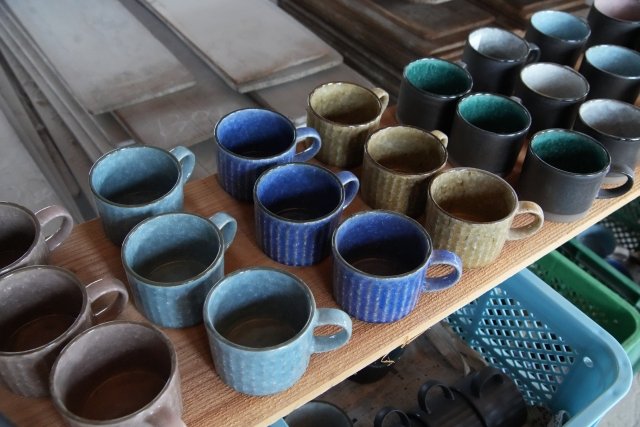
If you buy a piece of Mino ware today, it will most likely not be a Shino tea bowl. It will be a well-made, well-priced porcelain or stoneware piece — a mug, a rice bowl, a rectangular plate, a soba cup — produced in a modern factory or semi-industrial workshop in Tajimi or Toki, possibly without any style name attached to it at all. The overwhelming majority of contemporary Mino ware is everyday tableware, made in volume, sold without ceremony.
Some guides treat this as an awkward fact to be hurried past on the way back to the tea bowls. We would rather state it plainly, because we think it is the more impressive half of the story.
Consider what that volume actually means. Roughly every second piece of Japanese-made tableware — the bowls in school cafeterias, the plates in family kitchens, the cups on office desks across Japan — comes from one cluster of towns that has been solving the same problem, how to put good vessels on ordinary tables, for thirteen centuries. The Momoyama tea bowls were one solution to that problem, for one extraordinary audience. The cleanly glazed, dishwasher-tolerant porcelain bowl of today is another solution, for everyone. The kilns are the same hills.
This is also why Mino ware has no single look. Arita built its identity on porcelain painting, Kutani on dense overglaze colour, Bizen on unglazed fire-marked stoneware. Mino built its identity on answering demand — and demand keeps changing. The 1978 traditional-craft designation covering fifteen historical styles makes the point officially: Mino is not one aesthetic. It is a region-sized capability.
For the buyer, this has two practical consequences, one freeing and one cautionary.
The freeing one: Mino ware is where the quality-to-price ratio of Japanese ceramics is at its most generous. The region's industrial maturity means that even inexpensive Mino pieces tend to be well made — true glazes, durable bodies, shapes refined across thousands of production runs. It is the easiest tradition in Japanese ceramics to begin owning.
The cautionary one: because "Mino ware" covers such range, the name alone tells you less than other kiln names do. A 600-yen mug and a museum-grade Shino bowl are both, correctly, Mino ware. The name is the beginning of the question — which Mino ware? — not the end of it.
6. How to Read a Mino Piece
A few quiet checks help you place a Mino piece — or a piece you suspect is Mino — on its spectrum.
Look for a style name. If a piece is sold as Shino, Oribe, Kizeto, or Setoguro (or other designated styles such as Mino Iga or Ofukei), it is consciously made in a historical idiom, usually by a workshop or artist with a name worth knowing. These pieces sit in a higher register — in price and in intention — than unnamed production ware.
Read the glaze, not the label. The four classical glazes are recognisable with a little practice: Shino's thick warm white with pinholes; Oribe's pooled copper-green with painted panels; Kizeto's matte oil-yellow; Setoguro's flat deep black. Modern production pieces borrow these registers constantly — an "Oribe-green" mug from a Toki factory is a pleasant everyday object wearing a historical colour, and there is nothing wrong with that, as long as you know which kind of object you are buying.
Check the maker's mark and the box. Artist-made Mino pieces usually carry an impressed or painted mark and come in a signed wooden box (tomobako, 共箱) — the standard packaging of serious Japanese ceramics. Production ware carries a printed backstamp, often with the workshop or brand name, sometimes simply "美濃焼 / Mino ware, Japan."
Let the price tell you the category. As with most Japanese crafts, price is the honest signal. Everyday Mino production ware is inexpensive because the region is extremely good at making it efficiently — not because corners were cut. Named-style, hand-glazed pieces cost more because a person made decisions over each one. Both prices are honest; they are simply prices for different things.
7. Choosing and Living With Mino Ware

Where to begin. Because Mino's strength is range, the best first piece is simply the piece your table is missing. A pair of rice bowls, a deep noodle bowl, a set of small plates (mame-zara or kozara), a mug — any of these in Mino production ware will serve daily for years. If you want a first piece with the region's history in it, a single Oribe-glazed dish is the gentlest entry: the green is unmistakable, the price register is friendly, and it sits beautifully next to plain white porcelain.
Pairing on the table. Mino ware's lack of a single signature is an advantage here: it mixes well. An Oribe green plate under a white Arita bowl, a Kizeto-toned dish beside black lacquered chopsticks, a Shino-style teacup on a dark wooden tray — Mino pieces tend to behave as good neighbours rather than soloists. If your table already has lacquerware in the classic black and vermilion registers, the muted Mino glazes — yellow, green, warm white — sit alongside them particularly naturally.
Care. Most contemporary Mino ware is high-fired porcelain or stoneware and asks very little: normal washing, and most production pieces tolerate the dishwasher and microwave. Please always check the guidance for each individual piece, especially if it has gold, silver, hand-painted decoration, or crackle glaze — and gold or silver decoration never goes in a microwave. Two notes for the more traditional end of the spectrum. Thick-glazed pieces in the Shino register can be slightly porous; a brief soak in plain water before first use, and prompt washing after, keeps the glaze from absorbing strong colours and oils. And any hand-made piece with deliberate warps or crackle (kannyū, 貫入) in the glaze prefers hand-washing — the crackle is a beauty feature, but it is also a real network of fine lines that harsh detergents age faster.
8. Quick Terms
- Mino-yaki (美濃焼) — Mino ware; ceramics from the Tōno region of Gifu Prefecture (Tajimi, Toki, Mizunami, Kani).
- Setomono (瀬戸物) — the everyday Japanese word for crockery, from the neighbouring kiln town of Seto; used colloquially for ceramics of any origin.
- Shino (志野) — Mino's thick, warm-white feldspar glaze; generally regarded as the first white glaze in Japanese ceramics.
- Oribe (織部) — the copper-green glaze and deliberately irregular style named for tea master Furuta Oribe.
- Kizeto (黄瀬戸) — "Yellow Seto"; a soft matte yellow glaze over humble forms, made in Mino.
- Setoguro (瀬戸黒) — "Seto Black"; matte deep-black tea bowls pulled red-hot from the kiln, made in Mino.
- Yuzu-hada (柚肌) — "citrus skin"; the fine pinholing prized on Shino glazes.
- Tomobako (共箱) — the signed wooden box accompanying artist-made Japanese ceramics.
- Kannyū (貫入) — deliberate fine crackle in a glaze surface.
- Tōno (東濃) — the eastern-Gifu region where Mino ware is produced.
9. Frequently Asked Questions
Q: Is Mino ware porcelain or pottery?
Both. The region produces stoneware and earthenware in the historical styles and large volumes of porcelain in modern production ware. "Mino ware" names the region, not the material — which is also why no single answer to "what does Mino ware look like?" exists.
Q: How is Mino ware different from Seto ware?
They are neighbouring sibling traditions divided by a prefectural border — Mino in Gifu, Seto in Aichi. They share clay, glaze history, and centuries of migrating potters; two of Mino's most famous glazes even carry Seto's name (Kizeto, Setoguro). In everyday speech the word setomono ("Seto things") covers ceramics generally, so the words blur — but the production regions are distinct, and pieces from the Tōno cities of Gifu are Mino ware.
Q: Is mass-produced Mino ware "real" Mino ware?
Yes — and we would put it more strongly: volume production for ordinary tables is Mino's oldest and most continuous identity, older than the famous tea bowls. A factory-made Toki rice bowl and a hand-glazed Shino tea bowl are both honest Mino ware; they are answers to different questions, in different price registers.
Q: Which of the four classical glazes should a beginner try first?
Oribe, in most cases. The green is unmistakable, widely produced at friendly prices, and instantly lifts a table setting. Kizeto suits people who prefer their tableware quiet. Shino in its serious form is collector territory, though Shino-style production pieces make lovely teacups. Setoguro is the rarest in everyday retail and mostly lives in the tea-ceremony world.
Q: Can Mino ware go in the dishwasher and microwave?
Most modern production pieces, yes — check the maker's guidance on the box or backstamp. Exceptions: anything with gold or silver decoration (never microwave), and hand-made pieces with thick Shino-type glazes or crackle, which prefer hand-washing.
Q: Does Mino ware go well with other Japanese tableware traditions?
Unusually well — it is the most sociable of the Japanese ceramic traditions precisely because it has no single dominating look. Mino glazes in green, yellow, and warm white pair naturally with blue-and-white porcelain, with colourful Kutani accents, and especially with the black and vermilion of Japanese lacquerware.
10. Editor's Picks — Three Mino Pieces from Our Collection
Here are three Mino ware pieces from our collection — one cup, one bowl, one plate, in three different glaze colours — chosen as three easy first doors into the tradition this guide has described: a mug for every morning, the everyday rice bowl, and the small plate that starts a collection.
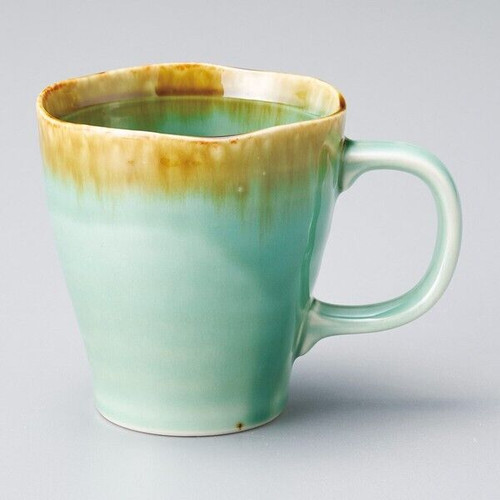
Pick 1 — Hisui Emerald Green Mug. A daily coffee-and-tea mug in a deep hisui (emerald) green glaze — the easiest possible way to put a Mino piece into your hands every single morning. The glaze has the quiet depth the region is good at, the price is friendly, and the form is sized for a real mug of coffee rather than a delicate cup. If owning Japanese ceramics has felt like something reserved for special occasions, this is the piece that makes it ordinary, in the best sense. (See the mug)
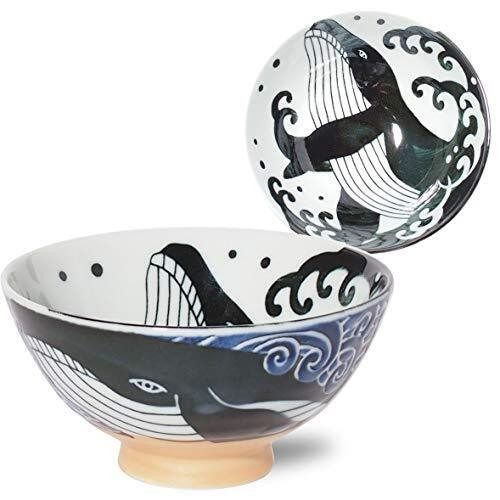
Pick 2 — Shironami Whale Rice Bowl (Gohan Chawan, size M). A practical everyday rice bowl that shows exactly why Mino ware has been loved on ordinary Japanese tables for centuries: durable, comfortable in the hand, light to lift, easy to wash, with a quiet white-wave pattern and a small whale swimming along the rim. The gentlest possible introduction to owning Mino ware — and it is also available as a set of two, which makes an easy small gift for a couple. (See the bowl)
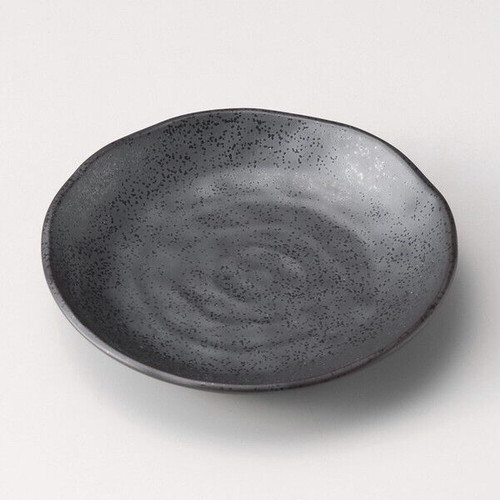
Pick 3 — Ibushi Black Mamezara (Small Plate). A small Mino plate in the smoked-black ibushi register — a quiet contemporary echo of the deep matte black this guide met in the Setoguro tradition. A mamezara is one of the easiest ways to begin using Japanese ceramics: it serves wagashi, pickles, a side dish, soy sauce for sushi, or a single chocolate after dinner, and a dark small plate makes whatever sits on it look deliberate. An inexpensive piece that earns its place on the table daily. (See the plate)
11. Closing
Mino ware resists the usual shape of a craft story. There is no single founding genius, no one glaze to memorise, no signature pattern to spot across a room. What there is instead is a region — four towns in the Gifu hills — that has spent thirteen hundred years making whatever vessels the Japanese table asked of it, and making them well: tea bowls that changed the history of aesthetics in one century, and half the rice bowls in Japan in this one.
If you remember one thing from this guide, let it be the answer to that pause at the beginning. What does Mino ware look like? It looks like the Japanese table itself — in every era, including this one. There is a good chance it already looks like yours.
If you would like to bring Mino ware into your own table setting, we invite you to