
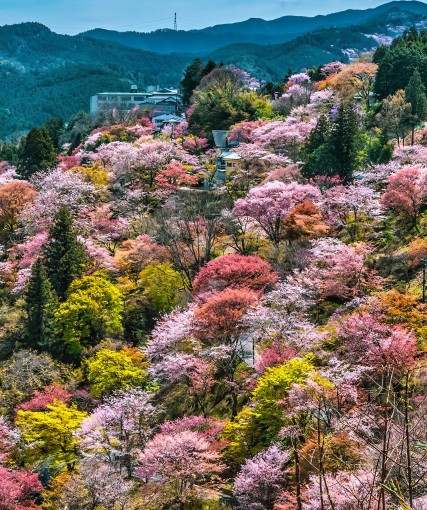
Every spring, Japan undergoes a quiet transformation. The bare limbs of cherry trees flush pink almost overnight, and across the country, people set down their daily routines to gather beneath the blossoms — to eat, to drink, to simply be present in the brief beauty of the season. This is sakura season in Japan: not a spectacle designed for visitors, but a living tradition that has shaped the Japanese sense of time, beauty, and belonging for over a thousand years.
The Kansai region sits at the heart of this tradition. Here, cherry blossoms fall on sacred mountain paths, castle walls, temple gardens, and lantern-lit canal banks. For the traveler who wants more than photographs — who wants to understand something true about Japan — Kansai in cherry blossom season is, quite simply, the place to be.
About the Region
Kansai is Japan's cultural and historical heartland, encompassing the ancient capitals of Kyoto and Nara, the merchant city of Osaka, and the castle towns and mountain pilgrimage routes that connect them. Unlike Tokyo, which wears its modernity proudly, Kansai carries centuries of history close to the surface. Temple rooftiles and castle towers are as much a part of the everyday landscape as convenience stores and commuter trains.
This layered quality makes Kansai uniquely rewarding during cherry blossom season. The blossoms here are not simply scenic backdrops — they fall on ground shaped by emperors, monks, warlords, and poets. Visiting during sakura season in Japan means encountering beauty that has accumulated meaning across generations.
History & Background
The Meaning of Sakura
To appreciate sakura meaning fully is to understand something that goes beyond aesthetics. The Japanese do not celebrate the cherry blossom despite its fleetingness — they celebrate it because of it. The concept of mono no aware (物の哀れ), loosely translated as the bittersweet awareness of impermanence, finds its most immediate expression in a petal drifting from a branch in a breeze. The beauty and the ending arrive together.
The practice of hanami (花見 — "flower viewing") traces its formal origins to the Nara period (710–794), when aristocrats gathered to admire the blossoms of ume (plum) trees. By the Heian period (794–1185), the imperial court in Kyoto had transferred its affections to cherry trees, composing poetry and drinking sake beneath their canopy. Over centuries, hanami gradually spread from the nobility to ordinary townspeople across Japan. It became, in a real sense, a democratic festival: one of the few occasions when the distinctions of social rank were softened by shared appreciation of the same transient beauty.
The variety most associated with modern cherry blossom viewing — the Somei Yoshino — was developed in the Edo period and spread rapidly across Japan in the Meiji era. Its characteristic cloud-like clusters of pale pink-white blossoms, appearing before the leaves, created the iconic image of sakura that the world now recognizes.
Walking the Region — Key Destinations
Yoshino-yama, Nara — The Sacred Mountain of Sakura
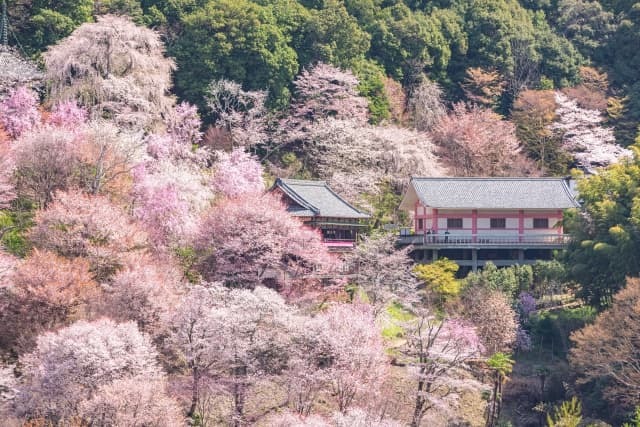
If there is a spiritual homeland for Japan's cherry blossom tradition, it is Yoshino-yama. Rising steeply above the Yoshino River in southern Nara Prefecture, this sacred mountain holds approximately 30,000 cherry trees across four distinct elevation zones — Shimo-Senbon, Naka-Senbon, Kami-Senbon, and Oku-Senbon — each blooming in sequence across roughly two weeks in early April. The effect, seen from a distance, is of an entire mountain range wrapped in pink and white.
The mountain's significance predates its cherry trees. Since the 7th century, Yoshino has been a center of Shugendo — the syncretic mountain asceticism that blends Buddhist and Shinto practice. The cherry trees were planted as sacred offerings to Zao Gongen, the deity of Kinpusen-ji temple at the mountain's heart. To walk here during bloom is not to walk through a park but through a living religious landscape where beauty and devotion have been inseparable for fourteen centuries.
Yoshino-yama is a UNESCO World Heritage Site, part of the "Sacred Sites and Pilgrimage Routes in the Kii Mountain Range." Arriving on a weekday morning, or staying overnight in one of the mountain's traditional ryokan, allows the place to reveal itself at its quietest and most atmospheric.
Getting there: Kintetsu Yoshino Line from Osaka-Abenobashi or Kyoto (transfer at Yoshino-guchi).
Kyoto — Gion, Maruyama Park, and Daigo-ji
No city in Japan offers as many layers of cherry blossom experience as Kyoto. Its 1,600-plus temples, shrines, and historic districts provide an almost inexhaustible series of settings for the season, each with its own character.
Maruyama Park (円山公園) in Higashiyama is the emotional center of Kyoto's hanami season. At its heart stands a magnificent shidare-zakura — a weeping cherry of extraordinary scale — illuminated each evening by paper lanterns. In the evenings, the park fills with families, colleagues, and travelers sharing bento boxes and warm sake while the lantern glow catches the hanging branches above.
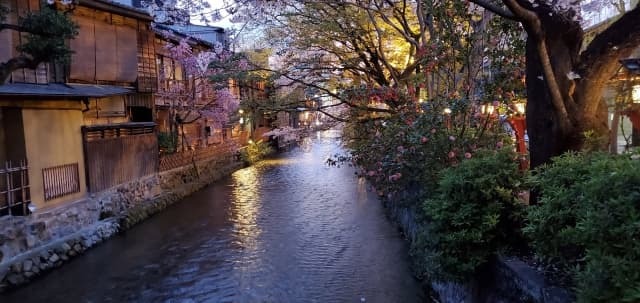
Gion (神園), Kyoto's most intact historic district, offers a quieter and more intimate cherry blossom encounter. The stone-paved lanes of Ishibei-koji, the canal-side willows and cherry branches of Shirakawa-dori, the lacquered signboards of old tea houses glimpsed through drifting petals — Gion during sakura season is where the connection between the blossoms and Japanese material culture becomes most tangible.
Daigo-ji Temple (醬醒寺) in southeastern Kyoto delivers a grander, more theatrical experience. The temple's Sanbo-in garden was redesigned in 1598 at the order of Toyotomi Hideyoshi for a legendary hanami party attended by over 1,300 guests. More than 700 trees of some 70 varieties now bloom across the temple complex, framing a five-storied pagoda in a composition of extraordinary richness.
Himeji Castle — World Heritage in Bloom
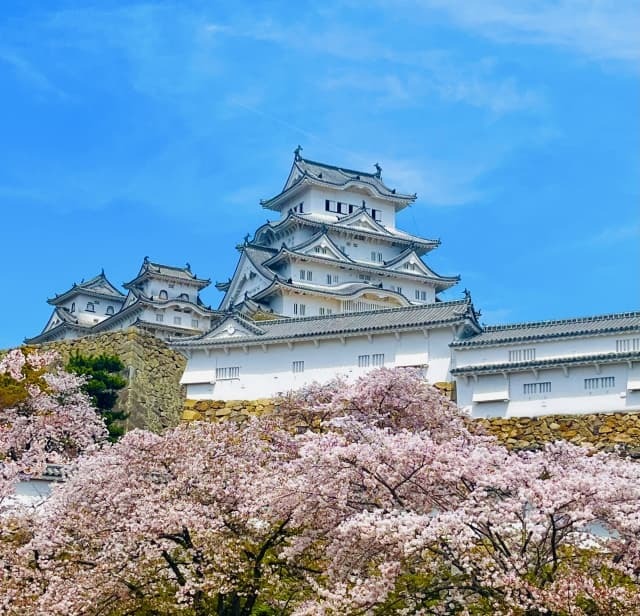
Himeji Castle (姫路城) is, by most accounts, the finest surviving example of Japanese castle architecture. Never destroyed by war or fire, its original 17th-century structure remains largely intact. Its gleaming white plaster walls and interlocking towers earned it the name Hakuro-jo (White Heron Castle) and, in 1993, a place on the UNESCO World Heritage list.
During cherry blossom season, the approach along Otemae-dori — the castle rising above a long avenue of blooming trees — produces a view that justifies even the most carefully planned journey. The white towers appear to float above the pink canopy, untethered from the earth below.
Getting there: JR Sanyo Shinkansen from Osaka (35 min) or Kyoto (60 min).
Osaka Castle — Hanami at Its Most Festive
Osaka Castle (大阪城) represents cherry blossom culture at its most exuberantly communal. The castle's inner moat is ringed by approximately 600 cherry trees, and the surrounding park becomes, during peak bloom, a patchwork of picnic gatherings, laughter, and the smell of grilled food. This is the Edo-period ideal of hanami made tangible: a public festival where the blossoms belong to everyone equally.
The juxtaposition of the gleaming reconstructed tower and the soft abundance of blossoms around its base creates one of urban Japan's most recognizable spring images. Visit in the late afternoon to watch the castle catch the golden light as the first lanterns of the evening illumination begin to glow.
The Craft of the Hanami Table
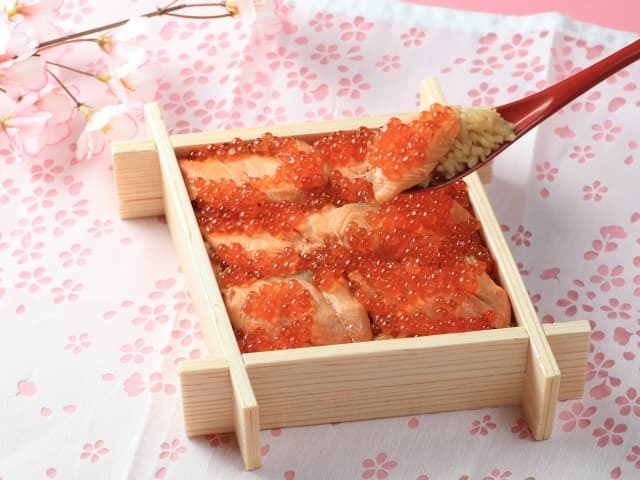
There is a dimension of sakura season in Japan that photographs rarely capture: the extraordinary attention paid to the objects of the hanami picnic itself.
The Japanese tradition of bento — a carefully arranged, boxed meal — reaches its most refined expression in the jubako, a set of stacked lacquered boxes used for special-occasion dining. A jubako prepared for hanami might hold seasoned rice, tamagoyaki, pickled plum, and spring sweets, arranged as deliberately as a flower arrangement. The box is considered part of the pleasure of eating, not merely its container.
Yamanaka lacquerware, produced in the Yamanaka Onsen district of Ishikawa Prefecture, represents one of Japan's most accomplished traditions in this craft. Developed over 400 years, Yamanaka's artisans are celebrated for their rokuro (lathe-turning) technique — a precision of form that gives their pieces an elegance that endures long after the picnic season ends.
The same sensibility extends to the rice bowl. Kutani ware, originating in the Kaga region of Ishikawa in the 17th century, is distinguished by its bold use of overglaze enamels: rich reds, deep greens, blues, and the luminous gold of kinsai decoration. A Kutani bowl painted with cherry blossom motifs keeps the season present at the table long after the petals have fallen.
And then there is the noren — the split fabric curtain that marks doorways throughout Japan. A linen noren printed with sakura motifs, hung in a home doorway through the spring, brings the season indoors — a private gesture of welcome that has been part of Japanese domestic life for centuries. The sakura meaning embedded in these objects is not decorative; it is an understanding of time, beauty, and the value of things that will not last forever.
Editor's Picks
For travelers who wish to bring something of Kansai's cherry blossom season home — objects that carry genuine craft heritage rather than tourist association — these are pieces worth knowing.
Jubako Bento Box — Yamanaka Lacquerware, Sakura Shape, 5-tier, Pink
A five-tiered jubako in a sakura-inspired form, made in the Yamanaka lacquerware tradition of Ishikawa Prefecture. The soft pink tones and cherry blossom silhouette speak to 400 years of craft knowledge. Equally beautiful as a displayed object and as a functional special-occasion box.
View product →
Kyoto Noren — Linen Door Curtain, Cherry Sakura, 150x88cm, Pink
A generously sized linen noren printed with a cherry blossom design, made in the Kyoto textile tradition. At 150x88cm it works well as both a functional doorway curtain and a wall hanging. Linen softens and deepens with age and washing — this is a piece that improves with time.
View product →
Kutani Ware Rice Bowl Set of 2 — Gohan Kinsai Sakura, Fukuda Shoryu
A pair of Kutani rice bowls decorated with the kinsai (gold overglaze) sakura motif from the atelier of Fukuda Shoryu. The richness of Kutani's characteristic palette — deep color fields threaded with gold — gives these everyday bowls a presence that transforms the dinner table.
View product →
Quick Terms
Sakura (桜) — Cherry blossom; by extension, the entire cultural tradition of springtime flower-viewing in Japan.
Hanami (花見) — Literally "flower viewing"; the practice of gathering beneath cherry trees to eat, drink, and mark the season together.
Mono no aware (物の哀れ) — A Japanese aesthetic concept meaning the bittersweet awareness of impermanence; most vividly evoked by the falling of cherry petals.
Somei Yoshino (染井吉野) — The most widely planted cherry variety in Japan, known for pale pink-white blossoms appearing before the leaves.
Shidare-zakura (枝市れ桜) — Weeping cherry tree; distinguished by its long drooping branches covered in blossoms.
Jubako (重笥) — Stacked lacquered boxes used for special-occasion meals; closely associated with New Year and hanami.
Noren (暖簾) — A split fabric curtain hung in doorways; used to indicate an open business, or as a seasonal decorative element in homes.
Sakura zensen (桜前線) — The "cherry blossom front"; the seasonal progression of bloom northward across Japan, tracked annually by meteorologists.
Travel Tips
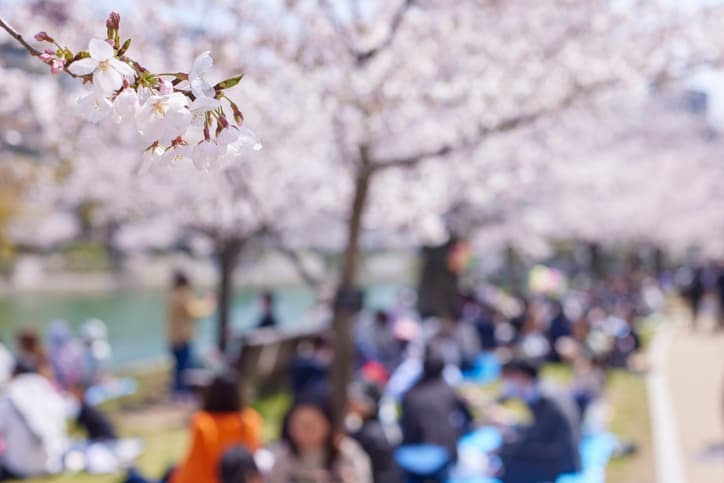
Timing and forecasts: The precise timing of peak bloom varies year by year with winter temperatures. Japan Meteorological Corporation and several independent services publish annual sakura zensen forecasts beginning in January or February — essential reading for anyone planning a blossom-timed visit. In Kansai, lowland sites (Osaka, Kyoto) typically bloom before highland ones (Yoshino), making it possible to extend your sakura journey by planning Yoshino toward the end of your itinerary.
Accommodation: Book as early as possible — ideally three to six months in advance for popular periods. Cherry blossom season is Japan's busiest domestic travel time, and traditional ryokan in desirable locations (particularly Yoshino) sell out quickly.
Getting around: A JR Kansai Area Pass or Kansai Pass covers most rail routes between Osaka, Kyoto, and Himeji. For Yoshino, use the private Kintetsu line (not included in JR passes). IC cards (ICOCA, Suica) are accepted on most urban transit.
Crowds: Peak bloom weekends at Maruyama Park, Osaka Castle Park, and Himeji Castle attract very large crowds. Arriving before 8am offers a noticeably quieter experience and often the most beautiful light for photography.
Picnic provisions: Convenience stores (konbini) throughout Kansai stock excellent seasonal bento and spring-themed sweets during sakura season. Department store basement food halls (depachika) — particularly in Osaka and Kyoto — are outstanding sources for more elaborate picnic foods.
Night viewing: Many major sites offer illuminated night-viewing (yozakura) during peak bloom — Maruyama Park's weeping cherry and Osaka Castle's moat-side trees are particularly striking after dark.
FAQ
Q: What month is sakura season in Japan?
Cherry blossom season in Japan falls primarily in March and April, though the exact timing varies by location and year. In the warmest regions — Kyushu and parts of western Honshu — blooms can begin in mid to late March. The Kansai region (Osaka, Kyoto, Nara, Himeji) typically reaches peak bloom in late March to early April. Higher-altitude sites such as Yoshino-yama in Nara bloom approximately one to two weeks later than lowland areas, often in the first two weeks of April. Northern regions such as Tohoku and Hokkaido see their blossoms in late April and early May. Annual forecasts are published each winter and are essential planning tools, as bloom timing can shift by one to two weeks depending on winter conditions.
Q: When to see cherry blossoms in Japan in 2026?
Based on current meteorological forecasts for 2026, the Kansai region is expected to see cherry blossoms begin opening in late March, with peak bloom (mankai) likely falling in the first week of April in Kyoto and Osaka, and mid-April in higher-elevation sites like Yoshino-yama. However, these projections are updated regularly as spring approaches, and conditions can shift by several days in either direction. For the most current 2026 forecast, consult Japan Meteorological Corporation's official sakura zensen release or reputable tracking sites such as Weathermap Japan. Building a few days of flexibility into your itinerary is always advisable — the blossoms do not negotiate with travel schedules.
Q: How long do sakura cherry blossoms last?
A single cherry tree at full bloom typically holds its blossoms for one to two weeks under favorable conditions — calm, mild weather with no heavy rain. Wind and rain can shorten this to just a few days, which is part of what makes the blooms so keenly anticipated. Across Japan as a whole, the sakura season lasts roughly three to four months, as the cherry blossom front moves progressively northward from Okinawa in late January to Hokkaido in early May. In Kansai specifically, a well-planned itinerary incorporating both lowland sites and Yoshino-yama can extend your personal viewing window to three or four weeks. The brevity of the blooms is, for many who experience them, inseparable from their meaning — the awareness that they will not last is precisely what makes them worth traveling to see.
Explore our collection of Japanese craft and tableware for cherry blossom season → manekineko-ai.com